The International Center of Cultural Exchange and Diplomatic Friendship: Day 4.

Finished. Back in London now.

Here is a relevant anigif work courtesy of Ben Jeans Houghton


OMNIA FUTUTAM ATQUE NIHIL ERIT IN SAECULUM OK 2012
(Everything is fucked and nothing will ever be ok) Appropriated Gif, Dimensions Variable

The International Center of Cultural Exchange and Diplomatic Friendship: Day 3.

Penny and Dan say that they’ve only ever seen Column once, from a distance, and only for a moment. I’m riding fast down towards the city when I experience a similar thing. A slight, winding, dark grey line appears in my peripheral vision, but when I turn my head to look, it’s gone. As I get closer to town I see some anti-abortion activists outside the university. I stop and speak to them. One of my favourite things to do with anti-abortionists is to tell them that I think abortion should be mandatory unless you get a special licence to have a kid. The person I’m speaking to asks me how people would get a licence and I say that they’d have to complete gameshow style, physical challenges. Maybe like that weird show The Cube, presented by Philip Schofield. He says he doesn’t know the show so I spend five minutes describing it before he twigs that I’m either taking the piss or mental. He points at a police officer watching us and asks me to leave.


By the time I get to the docks the sun has started to set. I take a look across the water but can’t see anything. I figure I’ll go into one of the galleries and ask about it. Apparently different weather conditions affect it in different ways so I guess it’s best to ask instead of just wandering up and down the docks in the cold.
  I walk towards the Cunard Building where one of the exhibitions is happening. When I approach reception, there are two people there. A young, pretty girl, with a soft face, VOLUNTEER printed on her T-shirt, and a lanyard around her neck, and then an older, more authoritative looking woman with long frizzy hair. The older woman looks up at me first.

‘Hi, do you know where the column is?’
[Recognisably North American accent]
‘The water?’
‘I think so - on the water, Anthony McCall.’
‘Well, there you go’
‘…’
[She grabs a Biennial guide and starts jabbing her finger at the little map on the inside cover.]

‘Have you ever seen it?’ I ask
‘Not to my knowledge.’
[I laugh but I don’t know what she means.]

‘He’s here you know.’
‘Who, the artist?’
‘Could be, could be someone who works for him’
[She says this conspiratorially, making eyes at some of the visitors in the gallery space, I look around but none of them look like the photo of the artist I saw on the internet.]

[She turns back to the map and points her finger at a point further up the docks.]
‘Here we go, just make sure you close your eyes.’
‘Amazing, thanks very much’
‘Yeah, because this is where we are, and that’s the Museum of Liverpool, and there is Open Eye Gallery…’
[She is moving her hand back and forth across the map, pointing at different Biennial locations.]
‘Ahh, thanks that’s amazing yeah.’
‘And this is the Walker Gallery, and this is where we are…’

This carries on and I start to move away from the desk nodding and saying, ‘Ahhh, yeah thanks that’s great, cheers, that’s perfect’, just before I turn around the younger woman with the soft face and the lanyard catches my eye and mouths something at me. I can’t tell what it is, but it looks like ‘Snot wheels, never wasp.’
  I look at her and make a subtle but clear indication with my face that she should mouth it again because what I think she mouthed makes no sense at all, but she shakes her head and her eyes look sad and I feel ashamed that I couldn’t understand what she wanted to communicate. The North American lady laughs and says, ‘Remember to close your eyes.’
  I head back to the docks, to where she pointed on the map. A porter from the Museum of Liverpool smokes and stares at me with barely concealed hatred. I look across the Mersea, to the sky above a cooling tower where Column should be. There is nothing. I search up and down the clouds, sweep my gaze across the old industrial landscape, empty of people. It’s funny in a way, because I guess when Liverpool was an industrial city or whatever then there would have probably been clouds of smoke rising up from everywhere, all the factories and stuff. I get my phone out and try to zoom in on the sky with the camera, hoping to some wispy traces; anything. All I get is a pixellated screen of clouds. I take some photos but they are just blurry grey, tinged pink by the setting sun.


The International Center of Cultural Exchange and Diplomatic Friendship: Day 2.

Embarcing Failure (1)


Artists often talk about failure. Lots of people who haven't read much Samuel Beckett quote this line he wrote,

'Try again. Fail again. Fail better.'

I think Beckett is talking about the existential impossibility of succeeding. To succeed would be to transcend our humanity, and Beckett certainly wouldn't have been doing that. Even within the tiny framework of our understanding, success is like happiness or pleasure, it is a fleeting, transient feeling: untrustworthy and impermanent. An idea best left alone.

But there are two ways of shying away from the idea of success. Beckett, I think, is semantically uncomfortable with the word and its associations.

The people who say the quote,

'Try again. Fail again. Fail better.'

are aware of the embarrassment around the word, but they attach their embarrassment to the word and not its meaning. This gives the quote a self-help patina; the idea that if you re-program yourself to not use the word "success", then you will obliquely, but necessarily, succeed.

The irony is that this probably is a useful self-help technique. Evaluating your actions in terms of success and failure could cripple your ability to act. Seeing all of your actions as failures (but with failure here meaning something else, not real failure, something more like partial success) allows you to disregard an unhelpful way of thinking.

But Beckett wasn't interested in helpful or unhelpful ways of thinking. Philosophy is not self-help. Understanding is not succeeding. Meaning is not happiness.

--

What would it mean to embrace failure - like real failure?

I was in a writer's group on Tuesday night, and we were discussing how to write as a dickhead - as in how to write as characters who is unlikeable. The problem being to write in the voice of a character who is meant to be a dickhead in the story, but who isn't somehow so irritating that the reader becomes annoyed at the author who wrote the story.

In callouts for artists residencies or development opportunities, there is often an emphasis on experimentation or open projects with no pre-defined outcomes. But at the same time, there is an unwritten implication that there will be an outcome, or that the experimentation will lead to something concrete.

When I speak to people about performance that involves some level of interaction with the audience, we often talk about the exciting possibility of failure within an interaction, but not the exciting possibility of the failure of the whole performance.

--

Technically, I'm on a residency - I answered a callout, emailed a proposal and now I'm here in Liverpool, thinking, making. And but also it feels like a holiday. I'm staying with friends, and last night we went to a gallery and had a beer and then came home and watched a film and talked bollocks.

A friend of theirs is staying, and so when she asked what I was doing here, I explained that I'm thinking about failure. I met Penny and Dan when I stayed with them during my 2010 residency at the Royal Standard. In a way, I wouldn't be here now if I had somehow failed in my interactions with Penny and Dan. Social situations aren't explicitly tests, but there are ways in which you can fail them. Dan made the point that, for example, in 2010 when I stayed with them, I didn't take a shit in their bath, which would have most likely been considered a failure on my part.

There are more subtle ways you can fail. In 2010 another artist came to do the residency once I had left. When I returned to Liverpool, I asked the gallery how it had gone - whether the work was good etc. The response was not so much about the work, but more about the social interactions between the artist and the members of the Royal Standard. One example of this was that the artist had asked to be taken to where James Bulger had been abducted. This is not necessarily offensive, but at the same time the request implied a failure to understand the history of the place in which the artist was working.

I met a curator who had organised an exhibition in Shenzhen in China. Shenzhen is a huge city just north of the border with Hong Kong. It is one of China's Special Economic Zones, with huge amounts of money poured into its development. The curator had put on a show of work by artists from China and Hong Kong in a building inhabited by migrant workers from other parts of China who were building the huge skyscrapers that make up the Shenzhen skyline. A lot of the work in the exhibition was subtly critical of the two tiered development of Shenzhen - the poor communities and building workers live in cramped conditions in places known as City Villages. But there was an implicit agreement that the work should not get anyone in trouble. The authorities were going to visit the show and the Chinese artists were wary of creating any political tension with their work. An artist from Hong Kong installed work that was directly and intentionally antagonistic to the authorities and then left after the opening to go back to Hong Kong. The curator was distraught - she knew the authorities would not approach her, but the Chinese artists were worried that after the exhibition finished they would be regarded as politically dangerous because of their association with the exhibition.

--

The most important rules of social engagement are not laid out in words, they are implied by, and deeply embedded within, our behavioural relations. These rules are both obvious and infinitely complex. Following the rules won't necessarily lead to success, but not following them may well lead to failure.

-----
(1) I think I might have stolen "Embarcing Failure"  from somewhere else. But I googled it but it didn't come up so I'm just going to use it.


The International Center of Cultural Exchange and Diplomatic Friendship: Day 1.

I'm in Liverpool until Saturday. I'm not sure why. Ostensibly I'm here to take part in a residency program run by Penny Whitehead and Daniel Simpkins, but in reality, I just looked at google calendar on Sunday night and it said LIVERPOOL from Wednesday until Saturday so now I'm here.

That is how my life works, I just set my phone to tell me what I'm doing , and then I do it. I don't know what I'd do if my phone broke. I'd probably just write everything on scraps of paper and be early/late/in the wrong place all the time like I used to.

--

I was walking across London Bridge the other day and I thought 'I've thrown my life at the wall and it didn't stick'. It came through like that, in speech marks, as though I was saying it, but I wasn't. It was being said, but not by me. I think it means that I consider myself a failure, or, at that moment I was considering the idea of considering myself a failure.

On the train up here I thought 'I feel like I've been pumped by the world', again, in speech marks - someone else's words somehow. I guess by pumped I mean fucked or milked. Like I am a bag of pus that has been squeezed by a giant hand and now I'm empty.

A friend reminded me that I had a saying that was the axiomatic basis of my thinking when I was at art college. He quoted it to me - wrote it down actually, and put quotation marks around it, "Everything is fucked and nothing will ever be ok". I smiled and laughed - it was meant to be a joke at the time, but sort of a true joke.

--

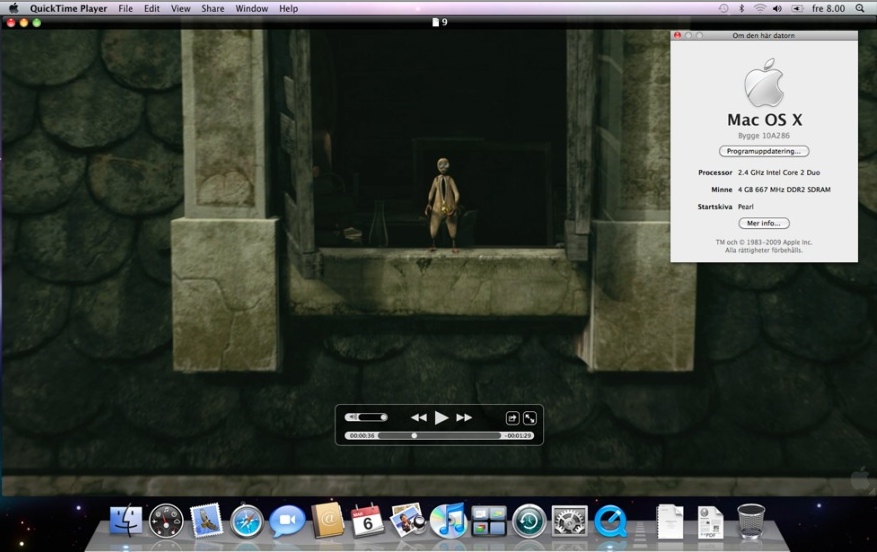
I went to watch a film about Stuart Hall at the Bluecoat. It was a three screen digital projection. As I walked in I heard a very loud Windows "error" noise


And then as the film looped the Quicktime toolbar came up on the screen.


There was a fly in the room. It appeared occasionally in front of the screens, casting a tiny shadow and giving the film a 3D vibe that was distracting but not unpleasant.

A geezer in a shell suit came into the room. He sat next to me. He smelled really bad. Nylon isn't a very breathable fabric.


Two women walked in and came over to sit near me and the shell suit guy. I thought, 'I hope they don't think that smell is coming from me'. This was a real thought and I just thought it without having to think about thinking it, even though I didn't know the women, and I wasn't going to speak to them, so it didn't matter if they thought it was me who smelled bad.

It was obviously the man in the shell suit who smelled bad though. The shiny-ness of the shell suit was visible even in the dark room.

--

I walked past a nightclub called the Krazyhouse. I felt like I'd had a dream about it, a dream where I was in the foyer and I was waiting for someone to arrive and when they arrived then we'd have to try and kill each other but they never came and that's how the dream ended; in the brightly coloured, but still dank and sad foyer of a nightclub that I have never been to, waiting in the cold transition from street to club, that smelled of both stale and fresh alcohol, cigarette smoke from outside, and the Red Bull tainted sweat of the bouncers, who eyed me warily, tolerating my presence but only just.

Ambient Notes (Wysing)

Yesterday I was at Wysing Arts Centre near Cambridge, giving a performance-lecture to a group of artists, curators and academics who are there as part of the Escalator Retreat Program.

I stayed for the afternoon and watched them give short presentations on their work. I made notes on each person's presentation. Some of the notes were functional: names, references, questions. Some were more like a parallel thought process, relating in only oblique ways to what was being said. I'm calling these 'Ambient Notes', and, in no particular order, here they are.

 ---

Took apart a whole house, packed it into suitcases bit by bit and took it to Glasgow on an Easyjet flight

Academia as a genre, like detective fiction etc.

1 to 1 mapping = Objectivity or truth

Anti-production as advanced cultural commodity

Vibe/Style/Taste/Colloquialism

Big Cans of Fosters in America

"And we Don't Even Know if our System is our System Anymore"

Oneiron

Mapped Dislocation

Macs = Technology OR symbol of techno-progression

Regeneration narratives

Ghosting - Casinos on burial grounds

Real i.e. not art

Art as housekeeping

Yearning for Objecthood, to be an object

Keith Chegwin, hid bottles of vodka in bushes on the way back from off licence so that when he ran out, he could drink them on the way to buy more booze. Kind of Outside Broadcasting

Grit/Crystal Formation

My Grandpa speaks very highly of the King of Morocco

Translation as teetering language

Is politics politics when it is oblique?

Does "The King" = The King?

A British Embassy in London

Master keys w/ octagonal fobs (?)

Cowbells

Dissonance/chromaticism/tempered tuning

Gabba nihilism vs Disco

Paradise Desktop Backgrounds vs Cosmic Desktop Backgrounds

Awkward Interval

Socratic privelage

Olympics: Inherent or additive ideology?

Caption + Credit Please

The Importance of Paying Attention

What would academia be without abstraction ? (1:1 mapping)

What would good curation be?

Cultures is world and world's reflection

Verbing the noun

Ear wax

Common use as explicit/loud, compressed by use, dynamics

"Starting art"

Art is never methodology

Research as fetish

"Acetate" = Acetate

The banality of the uncanny

Hobbies = valid art = not valid

"The Gap" or like, Gap, or like gaps, or like the gaps.


Typing

As part of Making Myself a Better Fiction Writer, I'm learning to touch type. I currently type with two fingers (one on each hand. I used to type with one finger, but my IT teacher in secondary school leant over my desk and said, 'you know, you could double your typing speed pretty easily').

Here are some of the things I've been typing via an online Learn to Type for Free website.

Keyboard - lesson one

Exercise two: ah had kag slag ah had lag slag ah had

Exercise three:  hash flash ask has hash flash ask has hash

Exercise four:  dash gash;lash dash gash lash dash gash lash

Exercise five:  lad sash flag lad sash flag lad sash flag

Exercise six:  lad sash flag lad sash flag lad sash flag

Exercise seven: glass alfalfa sdds glass alfalfa adds glass alfalfa adds

Exercise eight:  sad shall salad sad shalkl alad sad shall salad

Exercise eight:  ash glad alas ash glad alas ash glad alas

Exercise ten:  all flask half all flask half all flask hals


New work by the ARKA group as part of Joint Ventures


Joint Ventures
05/10/12 - 12/10/12
As part of Space In Between's continued interest in, and investigation of, collaborative practice we present Joint Ventures. Exhibited at Oval Space E2, Joint Ventures features new work by Ben Jeans Houghton & Matthew de Kersaint Giraudeau, Kazimierz Jankowski & Jennifer Bailey, Xavier Poultney & Hannah Barton, Becky Bolton & Louise Chappell, Simon Linington & William Mackrell, James Irwin & Will Robinson, Luke Montgomery & Josh Alexander. Download the full press release here.

The Parable of the Horse

The parable of the horse is this – One day three men were looking at a horse being ridden along by a human man. The horse started to make a toilet, as it walked, right there on the pavement, out of its bot bot, and then the human man who was riding the horse got down and cleaned up the toilet that the horse had made on the pavement. The first man said 'Wow, look at that horse and how it just made a toilet right there on the pavement'. The second man nodded in agreement and said to the other men, 'Yes, it would be wonderful if we could just make a toilet right where we stood and then another human man had to come along and clean it up', and the third man turned to the other two men and he said,

'Yes, but always remember, though a horse may make a toilet where ever it likes, on paving stone or on roughly poured concrete or in field, and a human man has to clean it up, that same human man will then take the horse back to the horse's special wooden house, and nail metal shoes into its feet.'

A lot of drawings

More drawings.

I showed a lot of these at CAVE Art Fair in Liverpool last week.

I also used some of them as ambient illustration for my performance A Short Essay or Lecture Concerning Anal, but as the term 'ambient illustration' suggests, they were just suggestive of certain ideas in the talk, rather than being illustrative in the traditional sense.

This is ongoing.

 Arabic Mountain Dew, pen on paper, 2012

 Big Mound, pen on paper, 2012

 Big Spotty Pile, pen on paper, 2012

 Cross, biro on paper, 2012

 Flossed Tube, biro on paper, 2012

 Flowing Pile, pen on paper, 2012


 Huge Mound, pen on paper, 2012

 Inner and Outer Ring 2, biro on paper, 2012

 Inner and Outer Ring 3, biro on paper, 2012

 Inner and Outer Ring, biro on paper, 2012

 Jewel Ball, pen on paper, 2012

 Lit Ball, pen on paper, 2012

 Long Mound with Entrance, biro on paper,2012

 Medium Spotty Pile, pen on paper, 2012

 Musical Score, pen on paper, 2012

 Painting, pen on paper, 2012

 Protruding Wand, biro on paper, 2012

 Rounded Box, pen on paper, 2012

 Screw, pen on paper, 2012

 Small Cylinder, pen on paper, 2012

 Small Spotty Pile, pen on paper,2012

 Tall Ball and Cup, pen on paper, 2012

 Tall Cylinder, pen on paper, 2012

 Thin Box, pen on paper, 2012

 Through Road, biro on paper, 2012

 Tongue or Maggot, pen on paper, 2012

 Tongue, pen on paper, 2012

 Tree 2, pen on paper, 2012

 Tree, pen on paper, 2012

 Trumpet 2, biro on paper, 2012

 Trumpet 3, biro on paper, 2012

 Trumpet, biro on paper, 2012

 Tube and Snake, biro on paper, 2012

 Tube, biro on paper, 2012

 Turned Growth, biro on paper, 2012

 Turned Protrusion, biro on paper, 2012

 Two Rings, biro on paper, 2012

Vase, biro on paper, 2012

Tiny thoughts, trying to connect.

I'm preparing for a series of performances and an installation of drawings for CAVE Art Fair. I'm writing something that I can't necessarily talk about yet (until the press all gets sent out), but the more abstract, meta-theme is about subjects and objects, so here are some notes and ideas in no particular order of importance.

-Subjects are internal and objects are external.

-Our digestive system processes objects, but does so via a semi-permeable membrane. Our digestive system, like our skin is an external organ.

-We are a tube, and the external part of that tube is an object.

-Our skin is a visible object.

-Our digestive system is an invisible object, a hidden object.

-Objects are beyond us, as subjects.

-We are subjects, but only to ourselves.

-We are objects to other people.

-Objects are more real than us (me).

-Only other people are objects to other people, for us.

-Objects are. We (I) do.

OR

-Objects act, we (I) react.

-The anus is a producer of objects.

-Art is a subject-object.

-A subject-object is an object whose existence or meaning is related to or predicated on (the existence or processes of) a subject.

-Shit is a subject-object.

-We process objects externally via our digestive system.

-We (subjects) wrap ourselves around objects, but we do not transcend our subjectivity.

-We carve at the joints of reality (objects).

-We are unreal.

-We are less real than objects.

-We are less real than other people.

-I am less real than other people.

-Nostalgia is a yearning for a time that never was.

-Nostalgia is a yearning for authenticity (that never was).

-Nostalgia is a yearning for the transcendence of our subjectivity; our subjecthood.

-Nostalgia is a longing to be an object for yourself.

-(Subjectivity is the only possibility for knowledge [of objects], and also the impossibility of that knowledge [of objects])

-Subjects are false. Objects are true.

-To look into the digestive system is to look into an object, an externality.

-Subjectivity can only hug at objectivity.

-The reason for a subject is to hug at objects. Enclose them. Rub at them. Shape around them as closely as possible.

-Third person narratives allow the narrator to know subjects as if they could know subjects.

-Viewing (images, moving images) allows the viewer to identify with objects as subjects.

-Viewing allows the viewer to identify with subjects as objects.

THEREFORE (?)

-Viewing allows the viewer to identify with objects.

-To look into the digestive system is to peer into our closest relationship with objects, but the relationship is false. We are peering into a hidden object, but still an object.

-To look into the digestive system is to look for a transcendence that we cannot have.

-Subjects can carve to the joints of reality (objects), as close as they can carve, but never closer.


More Drawings


Big Flower, pen on paper, 2012


Convoluted Waterfall, biro on paper, 2012


 Death Ray, biro on paper, 2012


 Flying Tap, pen on paper, 2012


Fob, biro on paper, 201

Mound with Antenna, pen on paper, 2012


Mound with Entrance, pen on paper, 2012


Philp's Chair, pen on paper, 2012


See Through Planks, biro and pen on paper, 2012


Square Hood, gel pen on paper, 2012

Swirls, pen on paper, 2012


Tire, pen on paper, 2012


Waterfall, biro on paper, 2012


Wooden Nipple 2, biro on paper, 2012


Wooden Nipple, biro on paper, 2012