Ambient Notes #9 (Gerard Byrne)

Yesterday I went with J. and R., two friends from Open School, to a Visual Cultures Lecture at the RCA. Gerard Byrne (GB) was speaking about the work A Thing is a Hole in a Thing it is Not.

--

-I force J. to speed eat an apple before the lecture starts because I feel like an apple is the most disruptive food to eat in a lecture situation.

-The lecture theatre has leatherette seats. They are comfortable, but sweaty.

-According to J., GB has got 'something of the Matthew Barney about him'.

-The room is very well equipped, AV wise. There are eight speakers evenly mounted around the room. There is high quality theatre lighting, plus fluorescent strip lights mounted vertically on the sound proofed walls. (They look "cool"/"stylish".)

-A man and his young daughter sit in front of us eating mini-muffins.

-GB has has a lot of exhibitions - that is the gist of the introduction.

-The man w/ daughter in front pulls out a one litre carton of Tropicana. Him and and the daughter start to drink directly from the carton.

-It feels like the person doing the introduction isn't really that invested in its presentation. It is a long introduction.

-The lights dim, we are expected to clap.

-GB is spotlit, the "stylish" vertical fluorescents dim slightly.

-GB says the lecture might be a bit "non-linear". Some people in the audience look at each other.

-GB says, 'detritus of the mediasphere.'

-It is warm in the lecture theatre, the sweat is flowing freely down my back.

-GB says, 'Brechtian doubling.'

-The daughter is really going for that Tropicana.

-I remove my jumper, but it doesn't help. The sweating is just more present, visible.

-I'm not having a go, but the man really shouldn't be letting the daughter drink all that juice.

-A student looks at the side of another student's face and yawns - more at the student than at the lecture.

-It's just that orange juice is mainly sugar. Just eat an orange! You know what I mean?

-One weird thing about the lighting is that GB looks like he's got a moustache even though he hasn't.

-GB says, 'temporal collapse.'

-I keep having to expend mental energy on remembering that GB doesn't have a moustache.

-GB says, 'dangerously adequate.'

-Another thing about the lighting is that it flickers ever so slightly, as though GB is just about to teleport. 

-Or, maybe, he is a hologram. Like Tupac.

-GB says, 'modularity, repetitiveness, endlessness', 'reclaiming my ancestry, for artists.'

-A film plays, but GB is still on mic - he pours some water from a glass bottle and it is relayed to us via the mic and it is a wonderful sound; close and rounded and soft.

-Like, just give the kid some water and a chocolate bar - that would be better than all this juice.

-GB's films make me really want to smoke.

-The daughter finishes the Tropicana and almost immediately tells her dad that she needs the toilet and wants to leave. They leave.

-GB talks about the resistance of the "minimalist" artists to being categorised as a movement.

-I wonder if the Open School artists will end up being categorised as a movement?

-I wonder if I will be seen as the figurehead of the movement. Who can really say? Probably.

-GB explains the theological idea that the world around us is an indexical image of the Old Testament. 

-People start leaving the lecture. People are always leaving lectures like they didn't realise it was going to be longer than 20 minutes.

-On screen: a picture of Donald Judd reading a Donald Judd book.

-GB says, 'the contemporary situation of temporality.'

-GB says, 'prop-like', 'hollowness', 'theatre'.

-The Q&A starts, the lights gently rise, people stretch and look around the room.

-GB has really enjoyed giving the talk and is really generous to the people asking questions. It's hard not to warm to him as a person. I sometimes wonder how much that has to do with success - like, just people warming to you and thinking you're nice and easy going. Probably a lot.

-Students are kind of beautiful nowadays. When I was a student everyone was a bit of a mess, but these days people are looking great. Or maybe I'm just older and I equate youth with beauty.

-There is a balcony in the lecture theatre that I didn't even realise existed until someone asks a question from it and GB's eyes are drawn up above my head.

-Oh, no. Wait. it wasn't the lights, he does have a moustache.


"The" Olive

I went out to get some food and on my way back into Open School I decided to use the toilet. I normally use the ones on the first floor near our studios, but this toilet - which I hadn't used before - is right next to the back door so it made sense to pop in before I went back upstairs.

As I turned on the tap I realised there was an olive in the sink. A black olive. I noticed it because it was positioned on the plughole, directly under the stream of water that came out of the tap. It wobbled ever so slightly as the water ran over it, and it looked shiny. It gleamed.


I thought, 'that's funny' and for a second I didn't know what to do, but then, obviously, I took the olive out of the sink and put it in the bin.

--

About half an hour later, Glen came upstairs and knocked on the studio door. He came in and said, 'Has anyone touched The Olive?'

and I said, '"The" Olive?'

And he said, 'Yeah, The Olive in the sink downstairs'

I told him I'd thrown it away and he asked me why, which was confusing. Eventually he asked me if I was going to go out and buy another one and I was like, 'I'm not going out to buy a jar of olives, just to put an olive in the sink of the downstairs toilet.'

And he said, 'The Olive.'

I like Glen, me and him get on, but I've got a lot of work on at the moment, so I told him to get fucked.

He's not one to make an argument so he just left and said 'Well, I'll have to tell Nick.'

Nick is alright too, actually, but he is a bit more senior than Glen and he runs the building. About half an hour later he came upstairs and told me I had to go and buy olives to replace The Olive and I didn't want to get on his bad side so I just went out and did it.

Micro-trauma #2: Dead Pets and Detachable Ears

For me, everything is synecdochal - parts of a thing can stand for the whole of a thing, and the whole of a thing refers to its parts.

In this way, an ethics of negativity can be drawn from tiny moments of local trauma, just as it can from recognisable, large scale crises.

And that's why yesterday, I wandered down to a small, unlovely patch of concrete and haphazardly trimmed greenery called Ufton Gardens to search for evidence of death.


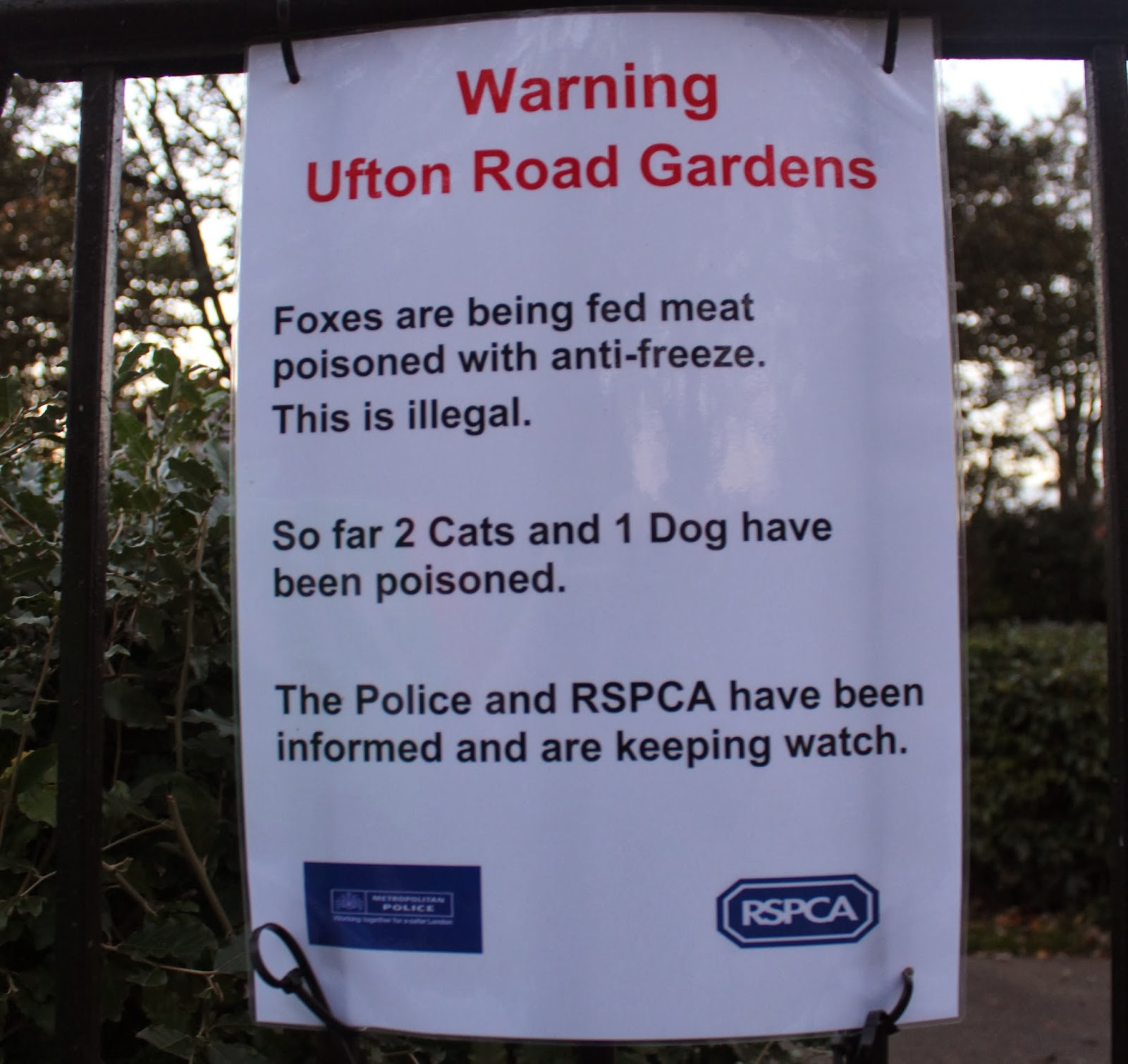
I found the story on the Hackney Post and thought it looked interesting. The picture explains the story quite succinctly, but to summarise: someone had been leaving poisoned meat in Ufton Gardens in an attempt to kill off the local foxes. Unfortunately for local pet owners, two cats and a dog had died from eating the meat. The story didn't say how the fox population had been affected.

According to the story, a man living on Ufton Road had 'openly confessed to setting out poisoned meat, after he caught foxes eating carp from his pond'.

I couldn't find Ufton Gardens on google maps, so I put on my coat and went out to find it. It took two minutes to get there, and after walking around the small patch of concrete and finding no meat and no dead animals, I realised there wasn't much to research. The laminated sign that features in the photo was nowhere to be seen.

From across the road, three teenagers standing outside the off licence watched me with little to no interest as I circled the non-space trying to think what could be gained from being there.

I wanted to speak the man with the carp. I wanted to see where the pets had been buried. I wanted to know what sort of meat was used for bait. This was the location where the meaning of those things converged, but no meaning could be squeezed from this place today.

So I went into the off licence and bought some chocolate.

When I went back into the building, Glen had a trolley full of stuff that he was taking out of an upstairs cupboard and moving into storage.

He showed us a sports bag full of someone's eraser collection.


I have vague memories of school friends who "collected" stuff like this. I collected cereal box toys for a while, in the mistaken belief that they would accrue some material value. I have the box at my parents' house, I never quite manage to throw it out.

We searched through the bag, picking out erasers shaped like vinyl records, animals, a lip balm. Cultural detritus of the lowest order. 


We found this rubber bust of Van Gogh. He was depicted with one ear, but on the wrong side of his head. (He - or Gaugin, according to the latest theories - cut off his left ear, not his right.) It was nice to think of this tiny piece of kitsch interfering with the reception of a historical narrative.

Glen said that he'd seen Van Gogh doll with a detachable ear.


The label says, 'I'm Van Gogh, my ear comes off!', which presumes the British pronunciation of Van Gogh ('goff', rather than 'goh'), if it's meant to rhyme.

At least it's the correct ear.


Micro-trauma #1: De Beauvoir Crash

On Monday morning I walked up towards Open School from Haggerston station. As I approached our building, which is on the corner of De Beauvoir Road and Downham Road, I realised that police tape was blocking the entrance to the building, and policemen were blocking off De Beauvoir Road.

At first I thought there had been a murder, but then as I passed the police tape, I could see a smashed up car in the middle of the road. I couldn't go through the front doors of the building as they were taped off so I went round to the back entrance.

--

E. arrived for rehearsals and I told her about what I'd seen and she told me what she had seen and we spoke about it for a bit and then stopped speaking about it. We were rehearsing and writing for this thing we're doing in Wales in November.

--

At about 3pm we weren't getting anywhere with writing the thing and E. suggested we go for a walk. We came out of the back doors and saw G. and M. the two guys who manage our building in the day. G. told us that the crash had happened late the previous night. The car had been travelling at 50mph in a 30mph zone, hit ten different cars, thrown the passenger through the front window and spun around into the middle of the road. The driver, realising that he had killed his friend, fled from the scene, and threw his jacket down the stairs to our building's basement, which was why the front of the building had been taped off. G. said that the forensics team had taken hours to do their work, much longer than they'd said they would.

We walked around to the front of the building. The policemen were gone, and the police tape had been taken down, with just a few remaining strands fluttering from a lamppost. We walked along De Beauvoir road. Down each side of the road, all the cars that had been hit were lined up nose to tail, very close to each other - wing mirrors hanging off, dents in the side, wheel arches crumpled. A big Turkish guy was talking to a small audience on the pavement, claiming to have seen the whole thing. He said that there had only been the driver, and that the driver had died, but that he hadn't come through the windscreen. A woman said that she'd heard different, but the guy was sure he'd seen it. A thin man complained and pointed at one of the cars that had been hit. It was his car. It didn't look too badly damaged, but I nodded and made appropriate noises. As we made to leave a young white guy with a nice camera turned up on a bike, he looked sheepishly at us and the group we were with. I kept expecting him to ask something, but he didn't and we walked on.

We stopped for a minute to look at the patterns made on the road by the forensics team: yellow chalk ovals surrounding vague skid marks. The ovals all sort of pointed up the road, towards where I'd seen the smashed car that morning. The car was gone now. Everyone and everything was gesturing to something that was no longer there.

--

Yesterday, while waiting to meet a friend outside school, I saw a roadside memorial to the guy who died in the crash: Anthony "Tony" Clarke. There were flowers and messages on bits of A4 paper in plastic wallets. The messages had that slightly impersonal feel of a public declaration and it was sad to think of his family and friends not knowing what else to do. A violent death.

--

Today I looked at the news stories written about the crash. It seems like the Turkish guy was right, the police believe Anthony had been driving the car alone. All the news stories were based on the same information from the police. No one had printed any interviews. Only the Hackney Gazette had bothered to get any photos, and the photographer must have arrived after the car had been taken away because the pictures were of nothing.


The Embeddedness of Being Robbed


Yesterday, Maria Lind, Director of the Tensta Konsthall gave a public talk at Open School East.

She spoke about the Konsthall's process of 'becoming an institution'. The Tensta Konsthall is already an institution in a few obvious ways: it's a contemporary art centre in a poor suburb of Stockholm that opened in 1998 and gets most of its funding from the Swedish Government. But Maria spoke about the need to become something more like a 'local player'- an institution more like a school, or a sports centre, or a local restaurant - that is woven into the social fabric of the area and has enough stability to make long term planning possible. She said the three things she wanted for the Konsthall were embeddedness, inhabitation (of the local area) and autonomy.

One part of the talk particularly interested me. Maria was speaking about the Tensta Konsthall's café which opened in 2011, when she took over as director. It provides coffee and food at reasonable prices and to enter the exhibition spaces you have to walk through the café . There is a market on the same square as the Konsthall and many of the market traders get their hot drinks from the café   It gives the Konsthall visibility and presence in an area where it might otherwise seem quite alien.

And then she mentioned that since the café had opened, the Konsthall had been robbed twice, and they'd had several attempted break ins. The way she spoke, it sounded like she was talking about the robberies as part of the same process of becoming a "local player". Like, they started the café and only when people started robbing them did they know that the café was doing its job.


This made total sense to me - if the café was well known enough for people to rob it, then it was doing its job of providing the gallery with local visibility. It was kind of an impressive commitment to the idea of being part of a local community: the idea that to be embedded is to be robbed.

The reason you can rob a café is because it has cash and to enter it you just walk in the door. Imagine a commercial gallery in West London. Opaque windows and a buzzer entry system with a single intern on the front desk. Who has cash there? Probably no one. Maybe just the intern actually, when they get sent for coffee.

To even have a café to be robbed is to define yourself in very different terms to the model of the private, commercial gallery.

I spoke to a friend about it and he said someone he knew in New York spoke about being mugged as a rite of passage. It's crass - being mugged is totally shit and traumatic - but it's true in a way. It's only tourists who "worry" about being mugged in New York. A bit like how in London its hard to find someone who worries about getting burgled. You live in a city, it will happen at some point.

Bad things are necessary, not because they are part of a process, or that experiencing them makes you stronger, but because bad things exist. For bad things not to happen to you, you have repress or ignore a certain section of reality. A public institution should be embedded in reality as much as it should be embedded in the community.

Two things

BELLYFLOP published my review of two Dance Umbrella FRINGE events: Road Postures by Roberta Jean, and the FRINGE Cabaret.

You can read it here.

--

And, tomorrow - Saturday 12th October - ACKROYD (Matthew de Kersaint Giraudeau & Andrew Sunderland) are exhibiting a new installation called MEAT-PARTY, comprising new sound/sculptural/video works at Fly Me Through the Night, a one night show at Pilot in Primrose Hill.


Here is a sneak peek at a new ACKROYD video which will be part of the installation.


Field Broadcast: Asterix & Obelix & a Menhir

http://fieldbroadcast.org/

Click the link. Download the software.

Tonight at 8pm, I'll be broadcasting a new work called Asterix & Obelix & a Menhir.


The ARKA group: Talks about dreams

On Thursday 12th September, the ARKA group held an evening of talks and discussion about dreams and dreaming as part of our exhibition at Baltic 39, Rapid Eye Movement (Paradoxical Sleep).

Images from the talk are below the soundcloud player.


Low-Probability High-Impact (The Black Swan)


In autumn I will be hosting a dinner event at Rhubaba in Edinburgh. I'm here right now for the festival, and so me and the directors are going to have a meeting tonight and talk about what's going to happen at the dinner event.

I thought I'd try and get it all clear in my head before then.

--

A while back a friend told me about a traumatic event that happened to him when he was young. He was in the high street of the town where he lived, in the middle of the afternoon, when a man attacked him with a knife and stabbed him in the back 17 times. By chance, none of his internal organs had been damaged by the attack and my friend survived. The attacker was a man with severe mental health problems who had escaped from a secure facility in the midst of a psychotic episode. He handed himself in to a police station later in the afternoon.

My friend went on to speak about some counselling or therapy he had received. As I understood it at the time, the therapist was a specialist in the psychological trauma caused by low-probability, high-impact events such as the random violent attack my friend had experienced. Other such events included being struck by lightning, surviving a plane crash or winning the lottery.

Part of the problem, according to his therapist, is that experiencing such unlikely events skews our already limited understanding of probability. I'd read about the human mind's limitations when it came to probability, for example, the fear of hypothetical terrorist attacks far outweighs the fear of being hit by a car, despite the mathematical probabilities of being affected by either event.

According to the therapist, the stress caused by experiencing such an unlikely event could manifest itself in several ways; you might believe that you were unlucky and that more of these unlikely events could happen to you, or you might believe that you were now invincible because you had survived something that very few people have ever experienced. Both of these ideas are a kind of psychosis - a misunderstanding of the real probability of events, but then our everyday understanding of probability is already psychotic in that sense.

I was fascinated by the idea that such different events as winning the lottery or surviving a plane crash were united by the psychological trauma that they could cause. And I was particularly fascinated by the interplay of abstract and empirical understanding. Experiencing a low-probability event gave the human mind an empirical insight into a reality where such things were possible, and yet the mind did not have the capacity to successfully abstract that knowledge into a rational understanding of probability.

--

When Rhubaba asked me to host a dinner event, I decided that I'd ask my friend to attend, along with some other people who had experienced low-probability, high-impact events. I would also ask a psychologist, or maybe a specialist counsellor of the sort my friend had spoken about, and maybe a mathematician who could speak about probability.

I spoke to my friend again, and it turned out that I'd got some of the details a bit wrong: the counselling wasn't specific to the kind of low-probability event that he had experienced, and the anxiety could be described as a form of Post Traumatic Stress which can be caused by many different kinds of events, not just unlikely ones. Also, my friend couldn't remember the term used by a psychiatrist to describe low probability events. The term I have been using - "low-probability high-impact" - is a bit unwieldy, so I'm trying to find something better.

Sian, one of Rhubaba's directors, suggested the term "Black Swan", taken from the book The Black Swan by Nassim Nicholas Taleb.

A Black Swan event, according the wikipedia page, can be identified in three ways:

"1. The event is a surprise [...].
2. The event has a major effect.
3. [The event] is rationalized by hindsight [...]"

Taleb's writing is more concerned with economics and history - large scale, unpredictable events like the recent global recession, or the fall of Communism. Things that define the way the world is now, but that we could never have predicted. We rationalise them in retrospect - claiming them to be articulable in terms of cause and effect, but Taleb believes that their essence is in their unpredictability.

Although he is writing about things of a very different scale, the events I have been thinking about are similar in quality, and the post-rationalisation process is linked to the Post Traumatic Stress response. The inability of the human mind to adequately comprehend low-probability events causes a pathological rationalisation of the experience of such events.

--

So, although we have lots of work to do, maybe we have a title for the event. The Black Swan Dinner.

Stewart Lee on Writing


I'm in Edinburgh, watching a load of shows. More performance than I've ever seen in such a short amount of time.

It's making me think about how I'm going to write my performance (in collaboration with Eleanor Sikorski) for Experimentica13.

What I've noticed in the stuff I've seen is that the presentation of a show can often sublimate the content it is attempting to present.

Sometimes a lack of content is masked with complex presentation. And, a few times, great content is ruined by its presentation.

--

The above lecture by Stewart Lee on writing is great, just generally, but this section

http://youtu.be/IrXVaytvJtQ?t=50m6s

is particularly good on the importance of good writing, presented simply and directly.

It's reminded me that I'm not one for staging, and also, it's reminded me that Stewart Lee's laugh is brilliant.


Implausible Imposters Installation Shots

All images by Anna Arca, courtesy of Ceri Hand Gallery

Object with Hair #1 (with bag) and Object with Hair #3 (balanced), home made play doh, found synthetic hair, plastic bag, spray adhesive, wood and gaffa tape, ~150cm x 50cm x 40cm, 2013

Object with Hair #2 (hanging), home made play doh, synthetic hair, food colouring, glue, wood, string, tape, nails, ~150cm x 50cm x 40cm, 2013

Object with Hair #4 (on plinth), home made play doh, human hair, wood, synthetic hair, cardboard, paint, nails, ~150cm x 50cm x 40cm, 2013

Three Drawings from An Infinitely Ongoing Series Cataloguing Every Object, Both Real and Imaginary, in the Entire Universe, all pen on paper, oak frame, 39.7cm x 31cm framed, 2013

Wholegrain Object

 Lars von Trier Object

Magnets Object

Photos I took at night in the estate where my parents live

My parents have lived in the same house for 30 years. It's on an estate of 60s brick houses.

I was back here for a week for a music job. On the Thursday I went out for a meal with an old friend, it was hot and we drank a lot of wine with ice. When we said goodbye I felt like I wouldn't see her again for a long time.

On the way back to my parents' place the air felt thick and hot. The streetlights glowed orange and the vegetation on the estate seemed to reach towards them like they were a surrogate sun. I took these photos and felt a kind of hovering freedom - I don't think I've inhabited those streets in that way since I was a kid.

The next morning as I walked back up to town to buy a birthday present for my nephew, a thunderstorm shattered the thick clouds and in the distance I saw fork lightning shooting from the sky down into the fields at the edge of the town.