A long time ago, someone honest asked me if I washed my legs in the shower. He asked me this because he didn't. He said he couldn't see the point, didn't really know where to start, and that they probably weren't the dirtiest part of you. I thought for a while, and then realised that I didn't wash my legs either. We were working at a restaurant at the time and asked one of the waitresses whether she washed her legs in the shower. She said she did and looked at us as though washing your legs in the shower was a basic human instinct.
From that day on I made a conscious effort to wash my legs in the shower. More recently I realised that in washing my legs in the shower, I had given up washing my arms. This, I realised, was the sacrifice I had unconsciously made. Most people have a standardised shower time - dependant not on how dirty they feel, but on how long they normally spend in the shower. My internal timing mechanism was not about to lengthen my allotted shower time simply because I had decided that the cleanliness of my legs should be a priority.
This is how it remains, although because I agreed with my friend that legs probably don't need washing that much, I don't really put the effort in. Also, water from a shower moves in a downward flow, so your legs probably get a rinse anyway, whereas your arms get no attention unless you make an effort.
I was thinking of switching attention back to my arms, or maybe starting a rota (Monday = legs, Tuesday = arms, etc.), but I'm not sure the effort would be appreciated.
Maybe we could establish some truth through the inter-subjectivity of the comment box.
Which do you wash, your legs or your arms? And why? And how?
I would like to teach in an art college at some point. When I do, I will pin up two pieces of paper on either side of the studios. On one will be written
pragmatism
and on the other will be written
idealism
And the students will choose which group they want to be in.
I'm not sure what happens next, but we'll cross that bridge when we come to it.
pragmatism
and on the other will be written
idealism
And the students will choose which group they want to be in.
I'm not sure what happens next, but we'll cross that bridge when we come to it.
The Pursuit of Fecality by Antonin Artaud
There where it smells of shit
it smells of being.
Man could just as well not have shat,
not have opened the anal pouch,
but he chose to shit
as he would have chosen to live
instead of consenting to live dead.
Because in order not to make caca,
he would have had to consent
not to be,
but he could not make up his mind to lose
being,
that is, to die alive.
There is in being
something particularly tempting for man
and this something is none other than
CACA.
(Roaring here.)
To exist one need only let oneself be,
but to live,
one must be someone,
to be someone,
one must have a BONE,
not be afraid to show the bone,
and to lose the meat in the process.
Man has always preferred meat
to the earth of bones.
Because there was only earth and wood of bone,
and he had to earn his meat,
there was only iron and fire
and no shit,
and man was afraid of losing shit
or rather he desired shit
and, for this, sacrificed blood.
In order to have shit,
that is, meat,
where there was only blood
and a junkyard of bones
and where there was no being to win
but where there was only life to lose.
o reche modo
to edire
di za
tau dari
do padera coco
At this point, man withdrew and fled.
Then the animals ate him.
It was not a rape,
he lent himself to the obscene meal.
He relished it,
he learned himself
to act like an animal
and to eat rat
daintily.
And where does this foul debasement come from?
The fact that the world is not yet formed,
or that man has only a small idea of the world
and wants to hold on to it forever?
This comes from the fact that man,
one fine day,
stopped
the idea of the world.
Two paths were open to him:
that of the infinite without,
that of the infinitesimal within.
And he chose the infinitesimal within.
Where one need only squeeze
the spleen,
the tongue,
the anus
or the glans.
And god, god himself squeezed the movement.
Is God a being?
If he is one, he is shit.
If he is not one
he does not exist.
But he does not exist,
except as the void that approaches with all its forms
whose most perfect image
is the advance of an incalculable group of crab lice.
"You are mad Mr. Artaud, what about the mass?"
I deny baptism and the mass.
There is no human act,
on the internal erotic level,
more pernicious than the descent
of the so-called jesus-christ
onto the altars.
No one will believe me
and I can see the public shrugging its shoulders
but the so-called christ is none other than he
who in the presence of the crab louse god
consented to live without a body,
while an army of men
descended from a cross,
to which god thought he had long since nailed them,
has revolted,
and, armed with steel,
with blood,
with fire, and with bones,
advances, reviling the Invisible
to have done with GOD'S JUDGMENT.
There where it smells of shit
it smells of being.
Man could just as well not have shat,
not have opened the anal pouch,
but he chose to shit
as he would have chosen to live
instead of consenting to live dead.
Because in order not to make caca,
he would have had to consent
not to be,
but he could not make up his mind to lose
being,
that is, to die alive.
There is in being
something particularly tempting for man
and this something is none other than
CACA.
(Roaring here.)
To exist one need only let oneself be,
but to live,
one must be someone,
to be someone,
one must have a BONE,
not be afraid to show the bone,
and to lose the meat in the process.
Man has always preferred meat
to the earth of bones.
Because there was only earth and wood of bone,
and he had to earn his meat,
there was only iron and fire
and no shit,
and man was afraid of losing shit
or rather he desired shit
and, for this, sacrificed blood.
In order to have shit,
that is, meat,
where there was only blood
and a junkyard of bones
and where there was no being to win
but where there was only life to lose.
o reche modo
to edire
di za
tau dari
do padera coco
At this point, man withdrew and fled.
Then the animals ate him.
It was not a rape,
he lent himself to the obscene meal.
He relished it,
he learned himself
to act like an animal
and to eat rat
daintily.
And where does this foul debasement come from?
The fact that the world is not yet formed,
or that man has only a small idea of the world
and wants to hold on to it forever?
This comes from the fact that man,
one fine day,
stopped
the idea of the world.
Two paths were open to him:
that of the infinite without,
that of the infinitesimal within.
And he chose the infinitesimal within.
Where one need only squeeze
the spleen,
the tongue,
the anus
or the glans.
And god, god himself squeezed the movement.
Is God a being?
If he is one, he is shit.
If he is not one
he does not exist.
But he does not exist,
except as the void that approaches with all its forms
whose most perfect image
is the advance of an incalculable group of crab lice.
"You are mad Mr. Artaud, what about the mass?"
I deny baptism and the mass.
There is no human act,
on the internal erotic level,
more pernicious than the descent
of the so-called jesus-christ
onto the altars.
No one will believe me
and I can see the public shrugging its shoulders
but the so-called christ is none other than he
who in the presence of the crab louse god
consented to live without a body,
while an army of men
descended from a cross,
to which god thought he had long since nailed them,
has revolted,
and, armed with steel,
with blood,
with fire, and with bones,
advances, reviling the Invisible
to have done with GOD'S JUDGMENT.

I was searching for stuff about Jason Rhoades' piece at 'Walking in My Mind' at the Hayward, because of it's references to the creative process as ingestion/digestion/expulsion. While side tracked by his collborations with Paul Mc Carthy (another artist who I will write about on here at some point), I found this wonderful story on, of all places, Kanye West's Blog.
Here is the link to the original story on the Guardian site.
http://www.guardian.co.uk/world/2008/aug/12/3
and here is the text in full
Giant dog turd wreaks havoc at Swiss museum
Inflatable artwork blown from moorings and brings down power line
A giant inflatable dog turd created by the American artist Paul McCarthy was blown from its moorings at a Swiss museum, bringing down a power line and breaking a window before landing in the grounds of a children's home.
The exhibit, entitled Complex Shit, is the size of a house. It has a safety system that is supposed to deflate it in bad weather, but it did not work on this occasion.
Juri Steiner, the director of the Paul Klee centre, in Berne, told AFP that a sudden gust of wind carried it 200 metres before it fell to the ground, breaking a window of the children's home. The accident happened on July 31, but the details only emerged yesterday.
Steiner said McCarthy had not yet been contacted and the museum was not sure if the piece (pictured here) would be put back on display.
The installation is part of an exhibition called East of Eden: A Garden Show, which features sound sculptures in trees and a football ground without goalposts. The exhibition opened in May and is due to run until October.
The centre's website describes the show as containing "interweaving, diverse, not to say conflictive emphases and a broad spectrum of items to form a dynamic exchange of parallel and self-eclipsing spatial and temporal zones".
After a weekend of real sickness (a nasty virus that affected everyone I work and live with), I'm reminded of how illness forms mental states. The strange delirious logic of nausea, the dulled nihilism of stomach pain and the momentary elation that comes from the pain leaving, from health returning.
I have a friend who has had several bouts of pancreatitis (more painful than child birth, or so he tells most of the women he meets). In hospital, when he needs serious medication, the doctor asks him to rate his pain level. But he cannot remember if this pain is worse than the pain he suffered the last time. We have no memory for pain, no way of judging it in relative terms.
Every time we get sick we experience it as though we have no basis for the feeling of illness. We might get more used to the processes involved, (I'm a seasoned professional at waiting until I'm in the toilet before I vomit, no matter how suddenly the urge comes upon me.) but the pain, and the essential sick-ness, of sickness is new to us, every time.
I have a friend who has had several bouts of pancreatitis (more painful than child birth, or so he tells most of the women he meets). In hospital, when he needs serious medication, the doctor asks him to rate his pain level. But he cannot remember if this pain is worse than the pain he suffered the last time. We have no memory for pain, no way of judging it in relative terms.
Every time we get sick we experience it as though we have no basis for the feeling of illness. We might get more used to the processes involved, (I'm a seasoned professional at waiting until I'm in the toilet before I vomit, no matter how suddenly the urge comes upon me.) but the pain, and the essential sick-ness, of sickness is new to us, every time.
A game me and my girlfriend were playing last night. I can't remember how it started, but it involved basic puns using the word 'poo' and the names of politicians.
David Camerpoo (David Cameron)
Harriet Pooman (Harriet Harman)
Hazel Poos (Hazel Blears)
Tony Poo (Tony Blair)
Bill and Hilary Pooton (Bill and Hilary Clinton)
Gordon Brownpants (Gordon Brown)
David Camerpoo (David Cameron)
Harriet Pooman (Harriet Harman)
Hazel Poos (Hazel Blears)
Tony Poo (Tony Blair)
Bill and Hilary Pooton (Bill and Hilary Clinton)
Gordon Brownpants (Gordon Brown)
{published concurrently on arkaanalysis.com and ashortdescriptionofmypoo.blogspot.com}
A short description of my dream
I am hungover. I am at work. The sky is already darkening as I chuff, sullen-eyed and greasy, on an afternoon cigarette, casting what has become an increasingly accepting gaze upon the turd which has now sat clinging on to the step by the fire escape in the smoking area for over a week. I receive a text message: 'Yo, would you email me a critical write up of that dream you had about pooing yourself?'
This instantly strikes me as problematic. The pooing dream happened at some point between falling drunkenly into bed on Tuesday night and farting myself awake on Wednesday morning. Sam Smith's Alpine Lager, while cheap, does have the unfortunate side effect of producing something akin to an all-night anal yodel. Though I might as well point out now that I did not actually shit myself in my sleep, I merely dreamed about it. I will return to this point.
On Wednesday night, drunk again, I mentioned the dream. I clawed around in that dark and hazy part of the mind that seems to shut off so quickly after waking from a dream for some more details on the dream, but what I could remember was quite limited. By the time I was invited to critique my unconscious defecatory hallucinations on Thursday, all I could really remember was the dream as I described it on Wednesday night.
In this dream I pooed myself, but a lot. I pooed myself a lot, loads. I think I was clad in some kind of denim trouser of yesteryear, maybe those cut-off shorts I threw away last time I moved house. Anyway they were sopping with brown, and I was in a swimming pool changing room, or maybe a leisure centre, except in some kind of massive toilet hall, full of horrible cubicles and open pits. I can't remember whether this was a horrific scene or something relatively normal. By which I mean, normal within the context of the dream, normal in the way that certain things can seem completely normal in a dream, which on reflection are utterly abnormal and disturbing. Some kind of hosing down happened, possibly with a shower head. All I know is I pretty much cleaned up the mess and got out of there without any adverse consequences. I don't remember seeing or speaking to anyone in between the terrible event and its resolution.
The dreams that seem to stick with me most these days, indeed often the only ones I have or ever remember, are those soaked in the emotions of fear, dread and anxiety. Social anxiety, embarassment, pure moments of panic. One recent nocturnal adventure peaked with a terrible moment of realisation, as I applied gel to my hair in the mirror, that I was completely bald from the ears upwards, with great tufts of hair coming away in my hands. Shock, then horror, then fear, then sheer rage as I went absolutely fucking mental and started wheeling around the room kicking the shit out of cupboards, doors, windows and thin partition walls. I woke up and for a moment was truly terrified, before suddenly becoming aware of the hair on my head and the sound of my alarm going off to wake me up for work.
Am I afraid of going bald? Probably. Am I afraid of shitting my pants? Well I'd rather it didn't happen, but I don't fear it in the same way as baldness. I feel I have more control over my sphincter than I do over my genetic make-up and my susceptibility to hair loss. So why the dream? Was it purely a by-product of the Alpine fart yodels rippling through my guts? Did my sleeping brain detect a peak in activity in that part of my body and convert it into a narrative?
I don't profess to know a lot about dreaming, and I certainly didn't intend for this dream to be subjected to a critical appraisal. I'm sure I've had many dreams far more suitable for such an exercise. Nevertheless, the fact remains that I shat myself in a dream. A lot. At the time this seemed to have no tangible consequences in the real world, in terms of actual pooing. But now I can see that there were consequences. That when I shat myself in my dream, I did produce something, just not shit in a literal sense.
What I did produce was a critical review of a dream I had about pooing myself.
A short description of my dream
I am hungover. I am at work. The sky is already darkening as I chuff, sullen-eyed and greasy, on an afternoon cigarette, casting what has become an increasingly accepting gaze upon the turd which has now sat clinging on to the step by the fire escape in the smoking area for over a week. I receive a text message: 'Yo, would you email me a critical write up of that dream you had about pooing yourself?'
This instantly strikes me as problematic. The pooing dream happened at some point between falling drunkenly into bed on Tuesday night and farting myself awake on Wednesday morning. Sam Smith's Alpine Lager, while cheap, does have the unfortunate side effect of producing something akin to an all-night anal yodel. Though I might as well point out now that I did not actually shit myself in my sleep, I merely dreamed about it. I will return to this point.
On Wednesday night, drunk again, I mentioned the dream. I clawed around in that dark and hazy part of the mind that seems to shut off so quickly after waking from a dream for some more details on the dream, but what I could remember was quite limited. By the time I was invited to critique my unconscious defecatory hallucinations on Thursday, all I could really remember was the dream as I described it on Wednesday night.
In this dream I pooed myself, but a lot. I pooed myself a lot, loads. I think I was clad in some kind of denim trouser of yesteryear, maybe those cut-off shorts I threw away last time I moved house. Anyway they were sopping with brown, and I was in a swimming pool changing room, or maybe a leisure centre, except in some kind of massive toilet hall, full of horrible cubicles and open pits. I can't remember whether this was a horrific scene or something relatively normal. By which I mean, normal within the context of the dream, normal in the way that certain things can seem completely normal in a dream, which on reflection are utterly abnormal and disturbing. Some kind of hosing down happened, possibly with a shower head. All I know is I pretty much cleaned up the mess and got out of there without any adverse consequences. I don't remember seeing or speaking to anyone in between the terrible event and its resolution.
The dreams that seem to stick with me most these days, indeed often the only ones I have or ever remember, are those soaked in the emotions of fear, dread and anxiety. Social anxiety, embarassment, pure moments of panic. One recent nocturnal adventure peaked with a terrible moment of realisation, as I applied gel to my hair in the mirror, that I was completely bald from the ears upwards, with great tufts of hair coming away in my hands. Shock, then horror, then fear, then sheer rage as I went absolutely fucking mental and started wheeling around the room kicking the shit out of cupboards, doors, windows and thin partition walls. I woke up and for a moment was truly terrified, before suddenly becoming aware of the hair on my head and the sound of my alarm going off to wake me up for work.
Am I afraid of going bald? Probably. Am I afraid of shitting my pants? Well I'd rather it didn't happen, but I don't fear it in the same way as baldness. I feel I have more control over my sphincter than I do over my genetic make-up and my susceptibility to hair loss. So why the dream? Was it purely a by-product of the Alpine fart yodels rippling through my guts? Did my sleeping brain detect a peak in activity in that part of my body and convert it into a narrative?
I don't profess to know a lot about dreaming, and I certainly didn't intend for this dream to be subjected to a critical appraisal. I'm sure I've had many dreams far more suitable for such an exercise. Nevertheless, the fact remains that I shat myself in a dream. A lot. At the time this seemed to have no tangible consequences in the real world, in terms of actual pooing. But now I can see that there were consequences. That when I shat myself in my dream, I did produce something, just not shit in a literal sense.
What I did produce was a critical review of a dream I had about pooing myself.
TOM O'HARA
Interview with Mathilda Fowler. Part 2.

For the second part of the interview with Mathilda Fowler about her Seaward residency at Post-Projects, we talked about the walk she led, from the gallery space all the way to Crossness Sewage Treatment Works. She talks about the wild fruit and herbs that grow along the sewage pipes, her interest in defensive architecture and our need to separate ourselves from our own poop.
Below the interview you can also watch a video piece made for the exhibition called, Incorporate.
[for part 1 click here]

Mathilda Fowler: The residency was called seaward because the word 'Sewer' is from the old English for something that travels towards the sea. The walk was initially intended to be a complementary event to the residency, but it transpired to be something a bit more important than that, but I'm still trying to get to grips with in what way.
The walk followed the route from Post Projects in Deptford, to Deptford pumping station, and then along the Southern Outfall sewer. The Southern Outfall sewer is where all the smaller South London sewers flow and become this gigantic artery of sewage. It carries waste through New Cross, Greenwich, Woolwich, and Plumstead all the way to Crossness Sewage Treatment Works. The sewage used to just go there because it was down river of London, so you could just deposit it in the Thames. Nowadays it is all treated and then made clean and beautiful and lovely... before they deposit it back in the river.
In London you have the Northern Outfall Sewer, and the Southern Outfall Sewer: equivalent systems on either side of the Thames. Both of these outfall sewers used gravity for a lot of the drainage, so they move from high to low land. When the Southern Outfall Sewer reaches low land, the sewer pipe stops being underground. The walk was about 10 miles. We walked through the city, following the underground pipe, which was built mostly under main roads as a sort of subterranean mirror image. The pipes match the width of the roads for surface drainage. And the roads are a natural network that connects all the houses.
You follow these main roads, and as the land level drops, it turns in to the Erith Marshes. At that point, the pipes come out from underground, but are hidden by a grass mound in to which they are built, called, 'The Ridgeway'. These two massive sewage pipes then run all the way to Crossness in an incredibly straight line, through this wild part of London. It's not pretty countryside, just wasteland, but you can walk along it all the way to the sewage treatment works, and then round it to the point at which you can see the pipes go back in to the water.
So when we did the walk we followed the pipes as far as we could, to the treatment works. But the point at which the pipes stop being subterranean infrastructure, and become something visible, that's the interesting bit.
Even when we weren't thinking about the sewers or talking about the sewers, you could smell them. Along the roads, inexplicably at some points.
Once you get to the Ridgeway, you leave the built up areas, and there are access points all along the way. Little parapets with hatches leading down to the pipes, and you get wafts of sewage as you pass those. Interestingly, along the Ridgeway, there is an awful lot of wild fruit and vegetables growing there. Loads of wild fennel, everywhere. I don't know why. You would assume the pipes are well sealed, but at one point along the route, there are lots of bulrushes growing along the side of the Ridgeway. Bulrushes only grow where it is wet and marshy, and normally they grow in lowland, but these are up along the mound where the pipes are. There has to be a really significant amount of leakage.
There are pears, and blackberries and apples. I picked some blackberries and made a pie which I fed to people. Nicola, who is one of the people running the project space, has a very sensitive gag reflex, and I couldn't talk about the blackberry pie with her because it made her feel so sick. I will say, that before I picked and ate the blackberries, I found a document relating to some sort of regeneration project to do with the Ridgeway, and they had run some tests on various fruits growing there and they are absolutely fine, no chemicals or high levels of anything bad. But still, when you are eating them raw, there is still this association in the back of your mind.

The problem with the Ridgeway is not just the occasional smell of sewage, there is also a lot of human shit around in the wasteland. People seem to go there to have a poo. There is a dirt path flanked by bushes and trees, and it is used as a dumping area. It goes through some nasty places, at one point it passes Belmarsh prison. It also seems to be that along this route, all of South London's rubbish and recycling is brought. There are rubbish trucks and a huge recycling centre.
Although there is a sewage treatment works there now, that area used to be where the sewage was dumped back in to the river. The area was very depressed for a long time, and quite contaminated. There are council estates around there. In the crudest way possible, it seems like where the city just dumped its undesirables.
There is a huge estate at the end of the sewage treatment site called Thamesmeade which was built before the sewage treatment works were in place. In the early 20th century they weren't treating it at all, and the modern sewage works were only built in the 60s or 70s. There was sewage processing before then, though I'm not sure to what extent!
Before I decided to focus on the sewage system, I had an interest in hygiene, or a kind of hygienic aesthetic, or architectures of hygiene. And also how that relates to a social situation. A longer term interest of mine is in defensive design or environments, where things are designed to protect the people or the architecture from destructive elements; potentially a very political situation. So you have airports with carefully designed traffic flow systems, and reinforced structures; pillars wrapped in blast proof kevlar etc. but at a microscopic level you have materials that have antimicrobial agents, resist MRSA etc. there is a whole spectrum of defensive forms. I suppose the sewer system is the probably the most important piece of infrastructure that exists in a city, and it is defensive. It separates and protects a population from its own waste.
The Victorians initiated a hygiene project. The culture of hygiene is incredibly important, morally. That develops architecturally up until the early 1920's where you have these sanatoriums and palaces that worship sunshine and healthiness. At the point of building sewers, it was a case of having to subvert the waste. To put distance between ourselves and it.

Matthew Giraudeau: Did they have to build the sewers underground?
MF: I went to an interesting talk by Kelly Shannon, who is interested in water urbanism, she was giving examples of overground sewage systems in Mumbai slums. They become pathways, because they are the only part that can't be built on. But, in a 'Modern' city it seemed important psychologically to distance yourself from your waste, to rise above it, not to be confronted with that idea. So it has to underground.
There seems to be a huge desire to separate ourselves from our waste, and to get rid of any allusion to our animal nature.
There is a huge industry based around helping us pretend that we don't shit. Have you seen the Neutradol adverts? It is one of these air fresheners that doesn't mask the smell it neutralizes it. There is a housewife and her she goes in to her bathroom, and the toilet is smelly and angry and it berates her for being stinky and shitty and it's basically saying, “oh haven't you done a smelly poo”. She has friends coming round, and she is really ashamed, but then she uses this product and the toilet starts belching flowers. Just a total rejection of the idea that we shit.
-------------------------------------------------------------------------------------------------------
Incorporate, digital video, 2009. Mathilda Fowler
The internet is the ultimate anal retentive. It saves every little turd that you drop in to its hands. I've recently found some old websites from a teenage metal band (we were called 'Excellent Flying Deth'). I deleted my website, but my bandmates' are still up, as is the site for 'Dead Corpse', our rivals/colleagues.
Here they are. I'm the one with the bad curtains and Harry Potter glasses.
http://www.deadcorpse.iwarp.com/
http://dethmachine.faithweb.com/
http://sickboy.4t.com/
http://mutt.4t.com/
http://www.wallofthunderquod.4t.com/
http://www.monkeypro.4t.com/
Looking at these sites is both funny and immensely tragic. Our skateboard company got about as far as our metal band.
Here they are. I'm the one with the bad curtains and Harry Potter glasses.
http://www.deadcorpse.iwarp.com/
http://dethmachine.faithweb.com/
http://sickboy.4t.com/
http://mutt.4t.com/
http://www.wallofthunderquod.4t.com/
http://www.monkeypro.4t.com/
Looking at these sites is both funny and immensely tragic. Our skateboard company got about as far as our metal band.
As an interim post, betwixt the interviews with Mathilda Fowler. She mentioned a site that she found very useful, so I thought I would pass it on. It is called, sewerhistory.org and has both a lovely design and lots of information about, "The roots of our sanitary sewers".
Interview with Mathilda Fowler. Part 1.

A few weeks ago I had a very interesting chat with Mathilda Fowler about her residency at Post Projects in New Cross. The work she presented at her exhibition was based on research she carried out concerning Joseph Bazalgette and the London Metropolitan Boards Closed Sewer System.
A really interesting part of the residency was a walk along the Southern Outfall Sewer, which we will cover in part 2 of the interview. For now, you can read her anecdotal history of the sewage system that Bazalgette designed, and see the work that this research inspired.
[for part 2 click here]
---------------------------------------------------------------------------------------------------------
Mathilda Fowler: One of the reasons why I chose the sewers as a subject for the residency was because Deptford Pumping Station was just round the corner from the project space. The station is part of this massive metropolitan sewage commission works in the 1860s by Joseph Bazalgette.
[At this point we have a debate on how to say 'Bazalgette', as it transpires that he was Spanish. It involves me doing a bad, pan-European accent which luckily cannot be translated in to text]
Bazalgette was the engineer commissioned to devise a sewage system that would unite the whole of London. Before him, although London had sewage systems, they were very local and were managed by the local boroughs. That is apart from the King's sewers, originally commissioned by Henry VIII. They are some serious, grand sewers, which I think are still working, but they were only designed for surface water from the roads. For domestic waste, most people had some kind of cesspit.
The sewers that were around had incredibly small pipes that could only be maintained by children. This kind of waste is really dangerous, because it is so explosive. If you take down a gas lamp in to a chamber full of methane producing material then it can be a real problem.
Matthew Giraudeau: Did they find this out the hard way?
MF: Yeah, lots of dead children. Before the industrial revolution, sewage was manageable, in a sense. A lot of the effluent would just seep in to the ground and dissipate. But as population density increased in the city, that seepage began to contaminate drinking water supplies.
Until the mid 19th century, there was someone called a night soil man. He would be paid to come and empty out your cesspit. He would come along with his horse and cart and take away all your shit. Then he would take all your shit to the countryside, where it could be used as fertilizer, and in some cases, as a kind of fuel. But around the mid 1800's, because of their incessant colonizing of other countries, the English suddenly begun to have access to a lot of Guano - bat poo. This was shipped in as a much more efficient fertilizer, and suddenly dealing in human poo was not such a profitable business.


The poverty in industrial London meant that if you didn't have any money for your cesspit to be cleaned, then you would just let it fill up until it leaked in to your neighbours house.
There were recurrent outbreaks of Cholera, and in 1858 there was 'The Big Stink'. After a particularly dry summer, London experienced a horrendous outbreak of Cholera with thousands dying. At Westminster, they made plans to escape to Hampton Court to get away from the smell. It was so vile that people were dipping their curtains in chloride of lime (a bleaching powder).
While this was going on, there was also a change in the way people thought about the transmission of disease. Up until then there had been a common theory of 'miasma', or 'bad air'. Disease was felt to be carried in this bad air. If you could make the air smell nice, then you would get rid of the disease held in the air. Bazalgette's sewers were originally commissioned because everyone believed that they would get rid of the smelly, 'bad' air, and therefore stop the spread of Cholera.
While this was going on, there was also a change in the way people thought about the transmission of disease. Up until then there had been a common theory of 'miasma', or 'bad air'. Disease was felt to be carried in this bad air. If you could make the air smell nice, then you would get rid of the disease held in the air. Bazalgette's sewers were originally commissioned because everyone believed that they would get rid of the smelly, 'bad' air, and therefore stop the spread of Cholera.
Germ theory was being pushed as a paradigm for understanding the spread of disease, although it came up against a lot resistance. People just wouldn't believe that Cholera could be spread through water, even though a lot of people in London were still getting their drinking water from the Thames, and it was also where people dumped their waste!
Even now, in heavy rain, the current sewage system means that if there is any kind of overflow, then sewage will still go in to the Thames. A new sewer is currently being built under the Thames called the Thames Tideway. It's being dug out by this big bore-ing machine called, 'Nora the Borer'. It follows the route of the Thames and it's being built specifically to deal with that problem.
---------------------------------------------------------------------------------------------------------


Studies For Monument to Bazalgette, pear's soap, 2009. Mathilda Fowler
The works that I made whilst on the residency were little carved monuments to Joseph Bazalgette. I took the forms for the monuments from this statue of Bazalgette, which is on the Victoria Embankment. The circle in which is bust is contained is meant to represent the sewers. Bazalgette also designed the Victoria Embankment, which constrained the size of the Thames, and eased congestion in the city. So even above ground, he had a strong influence on the flow and movements of the city.
Studies For Monument to Bazalgette, pears soap, 2009. Mathilda Fowler
I carved these monuments out of Pear's soap, as studies. The idea is that I would have them cast in soap so you could have them next to your sink. So every time you wash your hands, you send a little bit of the monument as an offering, down the drain and in to the sewer.

Studies For Monument to Bazalgette, pears soap, 2009. Mathilda Fowler
MG: Why Pears soap?
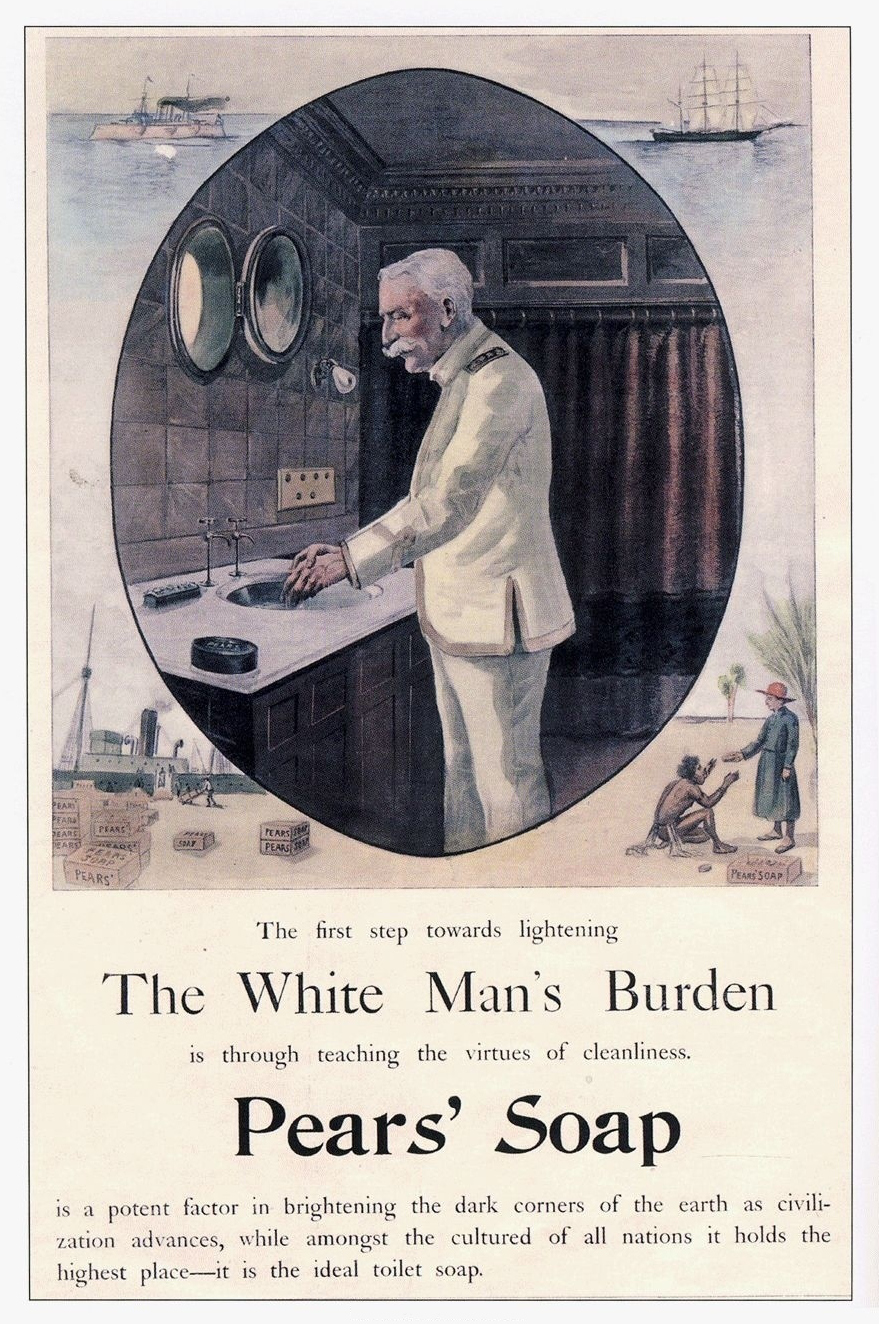
MF: In the summer I found an interesting article on Pears soap. It still has pretty much the same formula as it did in the 1800s. In the early 19th century soap production was a cottage industry that used animal fat. But then with the industrial revolution, there was a much higher need for soap to get rid of all the grime for people working with engines and in factories.
Because of the colonies, Britain had access to a large amount of vegetable fat, in the form of palm oil from tropical West Africa. There is this uneasy transition period, as the main export of West Africa changes from slaves to palm oil. On the one hand it was very positive, and was capitalised upon by the soap companies as a marketing strategy, i.e. people being freed because of the soap industry. But at the same time, the advertising for Pears also focused on the fact that their soaps could, 'wash a black boy white'. All the connotations of that are very uncomfortable, it brings to mind the idea of the white man's burden being to educate and civilise.
It is also that, to me, Pears soap looks like either precious amber, or frozen piss.
It is also that, to me, Pears soap looks like either precious amber, or frozen piss.

Studies For Monument to Bazalgette, pears soap, 2009. Mathilda Fowler
I just went to the shop to buy some sage, risotto rice, and bacon. First I went to Withington fruit and veg. They didn't have any sage, and as far as a I could tell, didn't have any rice. Then to Somerfield; possibly one of the saddest places in south Manchester. They didn't have any herbs at all. It took me ten minutes to locate the rice, and the best thing I could find for a risotto was pudding rice.
As I walked back, I could feel sometthing in between my toes. When I got home I found a one Euro cent coin inside my sock.
As I walked back, I could feel sometthing in between my toes. When I got home I found a one Euro cent coin inside my sock.


Click on the pages to view larger images.

That last post is from a text file I found on my computer. It was my first attempt at writing a sustained narrative. It failed terribly. There was to be a character called Geoff who was sort of a chaotic-psychotic-bird man, then a character who forced the main character to follow Geoff around in some metaphysical landscape. Mostly bollocks. But occasionally providing some nice moments, like the man shitting two eggs. Or the Albert Ayler dream.
Reading through the good and the bad, sifting through my detritus, my creative faecal matter; I realise that I have been interested in what comes out of my arse for a long time. The document I found was my first attempt at writing a long narrative, I'm now on my third (and most novel-like) attempt. Each of them contains many references to shitting. Why am I so fascinated? Well, apart from death or pissing it is something that human beings cannot escape. One cannot logic one's way out of going to the toilet, and yet, unlike death, we are unwilling to examine shitting in a critical or philosophical manner.
This blog is an attempt to take shitting as both a literal and metaphorical subject for examination. I hope to start interviewing people who are interested in the subject matter, and maybe people involved with the practical end of disposing of our waste. I wonder if it will be as fascinating as I hope? Maybe I will one day find this blog by mistake and think to myself, 'what a pile of shit'.
Reading through the good and the bad, sifting through my detritus, my creative faecal matter; I realise that I have been interested in what comes out of my arse for a long time. The document I found was my first attempt at writing a long narrative, I'm now on my third (and most novel-like) attempt. Each of them contains many references to shitting. Why am I so fascinated? Well, apart from death or pissing it is something that human beings cannot escape. One cannot logic one's way out of going to the toilet, and yet, unlike death, we are unwilling to examine shitting in a critical or philosophical manner.
This blog is an attempt to take shitting as both a literal and metaphorical subject for examination. I hope to start interviewing people who are interested in the subject matter, and maybe people involved with the practical end of disposing of our waste. I wonder if it will be as fascinating as I hope? Maybe I will one day find this blog by mistake and think to myself, 'what a pile of shit'.