I'm in a quiet room, on a make shift table upstairs in the studios. Today I'm going to do some serious drawing, maybe for the whole day. I haven't done that for years.
Yesterday: I wander the streets of Brum. It is sunny and warm and I wear my stupid sunglasses. They make me look like John Lennon or maybe just a dickhead. The first thing I do is visit Primark. I think about the ubiquity of brands as icons, as opposed to the physical specificity of monuments. Also I buy a towel. Joe Welden takes me to Eastside Projects, another space + studios round the corner from the Lombard Method, and he points out Grand Union, another space + studios. Around here there is also Ikon Eastside and Eastside Space (though I can't find Eastside Space on Google, so maybe I invented it...).
Later I give a little talk on my work. I talk about pissing, hypothetical objects, God machines, the stoned moment.
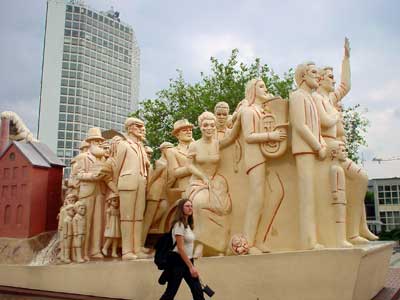
Tim Stock tells me about bad public sculpture in Birmingham and finds me this picture of a bad sculpture that was burned down.
Maybe I'll make a monument to the burning down of the monument.
In my talk I show this video to try and explain the heady brew of absurdity and empathy with which I want my work to be imbued.
From tomorrow I'll be on a studio residency at The Lombard Method, an independently run studio and project space in Birmingham. I'll be making maquettes for public monuments, drawings of hypothetical objects and detritus sculptures for two whole weeks. The residency will culminate in a performance lecture about comprehensibility, the chauvinism of the human scale, and the possibilities of inter subjective production.
While I'm there I will try and blog once a day, to help me prepare for my talk and as a way of reflecting on the days activities. Here is a visual taster of some of the research I've been doing on the topic so far.
Seagulls shit on pregnant women. It's hormones, or pheromones, or the minute change in the timbre of their voices. If you have a pregnant woman in your car, the birds will shit on your car. Even if the pregnant woman has left the car, the birds will still shit on it. If they shit on the pregnant woman, and then the pregnant woman gets in the car, the birds will follow the car, shitting. The shits on the pregnant woman will be small (a smaller target is harder to hit i.e. requires more shots i.e. more shit overall, but also it is out of a sort of respect, though not respect as we could understand it, obviously), but the shits on the car will be huge (bigger target, less attempts required for a direct hit, celebratory exuberance of an easy shot). The shitting on the car and the pregnant woman is a show of sexual prowess. The birds are not attempting to mate with the pregnant woman. The birds understand that the pregnant woman is a pregnant human, but there is a sexual/mating element to the power displayed through the shitting. Needless to day, it is only the males who shit on pregnant woman/cars in which pregnant women are travelling/have travelled.
The shitting increases in incidence at around the start of May, and happens most around seaside towns. It happens in May simply because mating season is over and the birds have more time on their hands (wings? Claws?) and start to go out and look for pregnant women. Also, May is the earliest time that most people, including pregnant woman, will attempt a trip to the seaside. It happens most commonly at the seaside, not only because there are more seagulls near the sea and hence more birds to do the shitting, but also, and more importantly, because this shitting is a collective response, not only to the pregnant woman, but also to the other birds that are shitting on her. So, on recognising the presence of a pregnant woman in the vicinity, there is a small chance that a seagull will begin to follow her from above, and attempt a shit. However, if a seagull recognises that another seagull is following a pregnant woman from above, then the seagull will almost certainly join his fellow seagull, and begin to shit. The group's size increases exponentially and once the size of the group becomes large enough, the birds experience a certain sense of carnival fever; that wild abandon and loss of interest in everyday activities that comes with the excitement and frenzy of group celebration. The birds begin to split in to subsections, divided by imperceptible (to us) differences of body size, skull shape and beak colour that signal their relative position within seagull society. These sub-flocks will now actively seek out pregnant women, and cars that pregnant women are in, and cars that have at one point contained pregnant women, and they will shit on them. There is, needless to say, a masculine competitiveness that defines these shitting competitions, though there is no winner as such. A full day of seeking out pregnant women and cars that have come in to contact with pregnant women will make a seagull incredibly tired (the gulls will not eat during the shitting) and it may well not leave its nest for a day or two after the event. This period of recovery is dangerous for seagulls and some will die through exhaustion and starvation.
Seagulls are revolted and repelled by the smells and sounds produced by newborn human infants. There is no biological evidence that this has anything to do with their attraction to pregnant women, but common sense tells us that there must be a causal link.
The shitting increases in incidence at around the start of May, and happens most around seaside towns. It happens in May simply because mating season is over and the birds have more time on their hands (wings? Claws?) and start to go out and look for pregnant women. Also, May is the earliest time that most people, including pregnant woman, will attempt a trip to the seaside. It happens most commonly at the seaside, not only because there are more seagulls near the sea and hence more birds to do the shitting, but also, and more importantly, because this shitting is a collective response, not only to the pregnant woman, but also to the other birds that are shitting on her. So, on recognising the presence of a pregnant woman in the vicinity, there is a small chance that a seagull will begin to follow her from above, and attempt a shit. However, if a seagull recognises that another seagull is following a pregnant woman from above, then the seagull will almost certainly join his fellow seagull, and begin to shit. The group's size increases exponentially and once the size of the group becomes large enough, the birds experience a certain sense of carnival fever; that wild abandon and loss of interest in everyday activities that comes with the excitement and frenzy of group celebration. The birds begin to split in to subsections, divided by imperceptible (to us) differences of body size, skull shape and beak colour that signal their relative position within seagull society. These sub-flocks will now actively seek out pregnant women, and cars that pregnant women are in, and cars that have at one point contained pregnant women, and they will shit on them. There is, needless to say, a masculine competitiveness that defines these shitting competitions, though there is no winner as such. A full day of seeking out pregnant women and cars that have come in to contact with pregnant women will make a seagull incredibly tired (the gulls will not eat during the shitting) and it may well not leave its nest for a day or two after the event. This period of recovery is dangerous for seagulls and some will die through exhaustion and starvation.
Seagulls are revolted and repelled by the smells and sounds produced by newborn human infants. There is no biological evidence that this has anything to do with their attraction to pregnant women, but common sense tells us that there must be a causal link.
I've been wanting to do a talk + slide show of erroneous street furniture for ages. It started off with photos of all the fenced off dirt you see in Parisian parks but has expanded to take a wider range of ad hoc arrangements.
This is a recent shot from Guildford train station. The sliding doors are broken, and it looks like the attempts to stop people trying to get through the door have been added one after the other. As though the tape was put on first, but people were ducking underneath, and then manoeuvring around the signs used as barriers, until, finally, someone found the big red barrier and attached tape to it to permanently block off the door.
I've been busy touring with Dogtanion, planning my residency at The Lombard Method and preparing my talk, The Sadness of Mark Speight, for my performance at Mill 24 at Islington Mill on the 29th May. The lack of updates on my faecal state is saddening.
BUT in exciting news, Mark Bell has made a video for the new Dogtanion single, Fringepot. Which you can watch below...
The Bowl.
I haven't been to a hairdresser's since I was 16. I finished my last day at school and in act of symbolic act of freedom from arbitrary school rules, went and got my head shaved. Since then I have yo-yo'ed between a shaven head and a long, unmanaged mess. I feel like something has to change, and so, I have recently started cutting my hair with scissors and a mirror, rather than just shearing it all off like a big human sheep. Now I feel like I can take this one step further, I need a style, I need a bowl haircut.
Like Rowan Atkinson in the first series of Blackadder. Serious Medieval vibes.
Or perhaps the guy from this band doing a floor windmill while he plays some excellent riffage. (This is from a story on Vice about bowl haircuts so maybe it doesn't count, though the article is very informative...) Look how it moves, so silky.
But really, the urge to get The Bowl is more fuelled by a sudden and drastic re-assesment of how cool I looked when I was a kid. A bit like this.
I have brown hair though. Also I didn't have to wear a dress.
I'm tempted by an undercut.
But the centre parting puts me off. I like the moustache though. I'd probably keep fairly clean shaven. Nothing should distract from The Bowl.
Jim Carey in Dumb and Dumber is an obvious reference point.
It is the clarity of The Bowl that is so alluring. Everyone knows what's happening with The Bowl. It is unmistakable.
Let us leave the final word to style icon Randy Taylor. Represented here through a poor quality youtube video made up of clips of him in Home Improvement, badly filmed off the telly with a camcorder. Thank you internet. Thank you.
I haven't been to a hairdresser's since I was 16. I finished my last day at school and in act of symbolic act of freedom from arbitrary school rules, went and got my head shaved. Since then I have yo-yo'ed between a shaven head and a long, unmanaged mess. I feel like something has to change, and so, I have recently started cutting my hair with scissors and a mirror, rather than just shearing it all off like a big human sheep. Now I feel like I can take this one step further, I need a style, I need a bowl haircut.
Like Rowan Atkinson in the first series of Blackadder. Serious Medieval vibes.
Or perhaps the guy from this band doing a floor windmill while he plays some excellent riffage. (This is from a story on Vice about bowl haircuts so maybe it doesn't count, though the article is very informative...) Look how it moves, so silky.
But really, the urge to get The Bowl is more fuelled by a sudden and drastic re-assesment of how cool I looked when I was a kid. A bit like this.
I have brown hair though. Also I didn't have to wear a dress.
I'm tempted by an undercut.
But the centre parting puts me off. I like the moustache though. I'd probably keep fairly clean shaven. Nothing should distract from The Bowl.
Jim Carey in Dumb and Dumber is an obvious reference point.
It is the clarity of The Bowl that is so alluring. Everyone knows what's happening with The Bowl. It is unmistakable.
Let us leave the final word to style icon Randy Taylor. Represented here through a poor quality youtube video made up of clips of him in Home Improvement, badly filmed off the telly with a camcorder. Thank you internet. Thank you.
"Once the first-person pronoun creeps into your agenda you’re dead, art-wise. That’s why fiction-writing’s lonely in a way most people misunderstand. It’s yourself you have to be estranged from, really, to work."
Great (and almost diarrhetically verbiose, obvs) interview with David Foster Wallace from 1993.
"I saw Wittgenstein as the real architect of the postmodern trap. He died right on the edge of explicitly treating reality as linguistic instead of ontological. This eliminated solipsism, but not the horror. Because we’re still stuck. The “Investigation's" line is that the fundamental problem of language is, quote, “I don’t know my way about.” If I were separate from language, if I could somehow detach from it and climb up and look down on it, get the lay of the land so to speak, I could study it “objectively,” take it apart, deconstruct it, know its operations and boundaries and deficiencies. But that’s not how things are. I’m “in” it. We’re “in” language."
Great (and almost diarrhetically verbiose, obvs) interview with David Foster Wallace from 1993.
"I saw Wittgenstein as the real architect of the postmodern trap. He died right on the edge of explicitly treating reality as linguistic instead of ontological. This eliminated solipsism, but not the horror. Because we’re still stuck. The “Investigation's" line is that the fundamental problem of language is, quote, “I don’t know my way about.” If I were separate from language, if I could somehow detach from it and climb up and look down on it, get the lay of the land so to speak, I could study it “objectively,” take it apart, deconstruct it, know its operations and boundaries and deficiencies. But that’s not how things are. I’m “in” it. We’re “in” language."
An interesting article on Viceland.com about farts. Say what you like about Vice magazine, their investigative reporting is second to none.
Matthew Breen and Buddy J. Finowicz
Buddy J. Finowicz (1944 - 2009 R.I.P) was a cult writer who divided literary critics. A Vietnam vet whose writing was as experimental as his drug use; Finowicz was the epitome of the hard working, hard living American novelist. He is also entirely fictional; a creation of Matthew Breen, an artist living and working in East London.
A few weeks ago I went to Matt's studio to speak to him about Finowicz's place in American counter culture. Matt showed me some of Finowicz's books while we drank two incredibly strong cups of coffee, and I helped myself to an unreasonable amount of biscuits...
---------------------------------------------------------------------
ashortdescriptionofmypoo: How did you come up with the idea for Buddy?
Matthew Breen: About a year ago, my work wasn't going well, I had no real idea of what I was doing. I had just read Pulp, by Charles Bukowski, which he wrote very soon before he died. It's this weird, hard boiled crime fiction pastiche. It's a real piss take of people like Micky Spillane and Dashiell Hammett. The main character is an idiot private eye, called Nick Belane, which is an obvious play on Micky Spillane. It's just so crazy and badly written - like all of Bukowski is, but brilliant and post-modern and referential. So I finished reading it and thought maybe I'd try and write one!
I wrote this twenty page short story called, 'Mary Lou in the Alien Desert', a sort of perverse Alice in Wonderland. I re-read it the other day and it is total crap. I came up with a pseudonym for the writer of the story, which was Buddy J. Finowicz, gave him a bit of a back story, and suddenly realised that he was far more interesting than the story I had written.
What I was putting together was an amalgamation of various writers, or artists behaviour. So you've got the typical things of... well he is just an absolute shit really. He's got a bad relationship with alcohol and drugs, he's a misogynist etc. I wanted to make him really American, so I made him a Vietnam veteran. He is from Texas, a real redneck, but he has these delusions of grandeur, he really believes he is an artist. So the whole thing is that he's caught in this limbo land between art and pop. He thinks his writing is changing the world!

asdomp: So is he set in a particular time period?
MB: Mescaline Rain was written soon after he returned from Vietnam in 1968, so he was very young when he wrote that. He died as soon as I created him, if that makes sense, so he died in April 2009 at the age 65. I didn't give him a 'big' death, what killed him off in the end was his lifestyle; his smoking and drinking.
But this is all real in a sense of what an artist could be, like Jackson Pollock. Pollock was a cowboy from Wyoming, that was his persona. When he first hit New York he would wear denim and a Stetson hat; it was part of his mid-west persona. Buddy is a rough neck, like Pollock, with this very American, protestant work ethic.
asdomp: He seems like a trashy writer, but maybe one with a certain level of ironic cool attached to him; almost exactly the sort of writer that would inspire contemporary art to be made about him!
MB: Well, he never had a hard back book published! It's all trash...
There is a kind of currency of knowledge in art. I've been reading No Brow, by John Seabrook about the breakdown of high and low culture – basically from Warhol onwards. You can trade in this knowledge. In order to form our identity, we collect all these found things - out in culture. We dig them out and put our name on them, or we put them there as our mascot. They are how we identify ourselves.
I like the idea of inserting Buddy in to all that. I've got this new piece I'm doing for Artvehicle. I've made a dictionary definition for 'Finowiczian', because I was thinking about terms like, 'Borgesian', or 'Tarantinoesque', these weird words. Once something become part of the language it can become part of the cultural currency.
asdomp: What about the faked element, are you hiding the fact that you have invented him?
MB: Sometimes when people ask about him, I play along with it and pretend that he is real. Or I say that he is just someone I'm really interested in; which isn't really a lie... apart from the fact that he is absolutely fabricated!
An important part of it is putting reality in to his story. His relationship with the world involves real people. I'm making a poster for a movie adaptation of one of his books, starring Dennis Hopper and directed by Francis Ford Coppola.
I have been weighing up the idea of whether to do things just to flesh him out, like setting up the online fan club etc. But I think I want everything to have a purpose; it needs to make a point about something, rather than just be arbitrary. I'm avoiding a museum thing, I'm trying to get away from that archive idea. All the things I present are second hand; supposedly mass produced and easy to obtain.
The deceitful impulse is definitely there. I always think of Borges' Ficciones, especially the re-written Quixote. Borges presents his invented authors as reality – out there as a proposition, it very much could be part of the world. I'm dealing with specifics like dates and names and events; certain things happened at certain times - real things. Almost as soon as I invented the name, the story became autonomous. The trick is communicating it effectively.
Part of the work is the viewer's realisation that Buddy isn't real. As soon as you realise something is fabricated you imbue it with meaning, it suddenly exists in a very different way. It can be an exhilarating change of perspective; to realise that you aren't looking at an incidental piece of trash but something created by someone.
---------------------------------------------------------------------
You can read more about Buddy J. Finowicz here and here.
A few weeks ago I went to Matt's studio to speak to him about Finowicz's place in American counter culture. Matt showed me some of Finowicz's books while we drank two incredibly strong cups of coffee, and I helped myself to an unreasonable amount of biscuits...
---------------------------------------------------------------------
ashortdescriptionofmypoo: How did you come up with the idea for Buddy?
Matthew Breen: About a year ago, my work wasn't going well, I had no real idea of what I was doing. I had just read Pulp, by Charles Bukowski, which he wrote very soon before he died. It's this weird, hard boiled crime fiction pastiche. It's a real piss take of people like Micky Spillane and Dashiell Hammett. The main character is an idiot private eye, called Nick Belane, which is an obvious play on Micky Spillane. It's just so crazy and badly written - like all of Bukowski is, but brilliant and post-modern and referential. So I finished reading it and thought maybe I'd try and write one!
I wrote this twenty page short story called, 'Mary Lou in the Alien Desert', a sort of perverse Alice in Wonderland. I re-read it the other day and it is total crap. I came up with a pseudonym for the writer of the story, which was Buddy J. Finowicz, gave him a bit of a back story, and suddenly realised that he was far more interesting than the story I had written.
What I was putting together was an amalgamation of various writers, or artists behaviour. So you've got the typical things of... well he is just an absolute shit really. He's got a bad relationship with alcohol and drugs, he's a misogynist etc. I wanted to make him really American, so I made him a Vietnam veteran. He is from Texas, a real redneck, but he has these delusions of grandeur, he really believes he is an artist. So the whole thing is that he's caught in this limbo land between art and pop. He thinks his writing is changing the world!

asdomp: So is he set in a particular time period?
MB: Mescaline Rain was written soon after he returned from Vietnam in 1968, so he was very young when he wrote that. He died as soon as I created him, if that makes sense, so he died in April 2009 at the age 65. I didn't give him a 'big' death, what killed him off in the end was his lifestyle; his smoking and drinking.
But this is all real in a sense of what an artist could be, like Jackson Pollock. Pollock was a cowboy from Wyoming, that was his persona. When he first hit New York he would wear denim and a Stetson hat; it was part of his mid-west persona. Buddy is a rough neck, like Pollock, with this very American, protestant work ethic.
asdomp: He seems like a trashy writer, but maybe one with a certain level of ironic cool attached to him; almost exactly the sort of writer that would inspire contemporary art to be made about him!
MB: Well, he never had a hard back book published! It's all trash...
There is a kind of currency of knowledge in art. I've been reading No Brow, by John Seabrook about the breakdown of high and low culture – basically from Warhol onwards. You can trade in this knowledge. In order to form our identity, we collect all these found things - out in culture. We dig them out and put our name on them, or we put them there as our mascot. They are how we identify ourselves.
I like the idea of inserting Buddy in to all that. I've got this new piece I'm doing for Artvehicle. I've made a dictionary definition for 'Finowiczian', because I was thinking about terms like, 'Borgesian', or 'Tarantinoesque', these weird words. Once something become part of the language it can become part of the cultural currency.
asdomp: What about the faked element, are you hiding the fact that you have invented him?
MB: Sometimes when people ask about him, I play along with it and pretend that he is real. Or I say that he is just someone I'm really interested in; which isn't really a lie... apart from the fact that he is absolutely fabricated!
An important part of it is putting reality in to his story. His relationship with the world involves real people. I'm making a poster for a movie adaptation of one of his books, starring Dennis Hopper and directed by Francis Ford Coppola.
I have been weighing up the idea of whether to do things just to flesh him out, like setting up the online fan club etc. But I think I want everything to have a purpose; it needs to make a point about something, rather than just be arbitrary. I'm avoiding a museum thing, I'm trying to get away from that archive idea. All the things I present are second hand; supposedly mass produced and easy to obtain. The deceitful impulse is definitely there. I always think of Borges' Ficciones, especially the re-written Quixote. Borges presents his invented authors as reality – out there as a proposition, it very much could be part of the world. I'm dealing with specifics like dates and names and events; certain things happened at certain times - real things. Almost as soon as I invented the name, the story became autonomous. The trick is communicating it effectively.
Part of the work is the viewer's realisation that Buddy isn't real. As soon as you realise something is fabricated you imbue it with meaning, it suddenly exists in a very different way. It can be an exhilarating change of perspective; to realise that you aren't looking at an incidental piece of trash but something created by someone.
---------------------------------------------------------------------
You can read more about Buddy J. Finowicz here and here.
The Brief Psychiatric Rating Scale (BPRS). Each symptom is rated 1-7 and depending on the version between a total of 18-24 symptoms are scored.
- 1 Somatic concern
- 2 Anxiety
- 3 Depression
- 4 Suicidality
- 5 Guilt
- 6 Hostility
- 7 Elated Mood
- 8 Grandiosity
- 9 Suspiciousness
- 10 Hallucinations
- 11 Unusual thought content
- 12 Bizarre behaviour
- 13 Self-neglect
- 14 Disorientation
- 15 Conceptual disorganisation
- 16 Blunted affect
- 17 Emotional withdrawal
- 18 Motor retardation
- 19 Tension
- 20 Uncooperativeness
- 21 Excitement
- 22 Distractibility
- 23 Motor hyperactivity
- 24 Mannerisms and posturing
"The British Library is trying to preserve defunct websites before they disappear."
http://news.bbc.co.uk/today/hi/today/newsid_8535000/8535927.stm
This is really nice. I love defunct internet sites - the sadness of uncared-for recent history is fascinating. I was worried when I first saw this story that the British Library was going to record every website that is defunct, which would
a) be mental, and totally wasteful,
b) start a sort of dystopian future where history is totally recorded and categorised as it happens,
c) mean that my adventures through the jungle of defunct websites would be usurped by a bland stroll through an official archive of web-crap.
But luckily they are only taking important web sites, like MP's blogs and old companies' websites. It shows how little old institutions understand the uber-flat landscape of the internet, but also means that I still get to feel interesting and exciting when I spend hours trawling through sites like these...
Tom Smith’s Blog
Tom Smiths Wife's Blog
Tom Smith's daughter's Leprechaun Page
I did a talk about Dead Websites that included these. Tom Smith's Wife's blog is probably my favourite - completely untouched but totally filled with Tom Smith's frustrated enthusiasm for a form of media that he was never going to stay interested in for long.
http://news.bbc.co.uk/today/hi/today/newsid_8535000/8535927.stm
This is really nice. I love defunct internet sites - the sadness of uncared-for recent history is fascinating. I was worried when I first saw this story that the British Library was going to record every website that is defunct, which would
a) be mental, and totally wasteful,
b) start a sort of dystopian future where history is totally recorded and categorised as it happens,
c) mean that my adventures through the jungle of defunct websites would be usurped by a bland stroll through an official archive of web-crap.
But luckily they are only taking important web sites, like MP's blogs and old companies' websites. It shows how little old institutions understand the uber-flat landscape of the internet, but also means that I still get to feel interesting and exciting when I spend hours trawling through sites like these...
Tom Smith’s Blog
Tom Smiths Wife's Blog
Tom Smith's daughter's Leprechaun Page
I did a talk about Dead Websites that included these. Tom Smith's Wife's blog is probably my favourite - completely untouched but totally filled with Tom Smith's frustrated enthusiasm for a form of media that he was never going to stay interested in for long.
Single Lions by Graeme Patterson. 2010.
Graeme 'Pattie' Patterson is an animator from Newcastle. He also used to play samplers and turntables for the original incarnation of Dogtanion. As I remember, he suggested that we should be called, 'Dogtanion and the 70's Plate', I always liked that name.
You can see his whole Youtube selection here.
I went to Sainsbury's for a prawn mayonnaise sandwich. Nothing beats a hangover like a Sainsbury's prawn mayonnaise sandwich. All those tiny bodies swimming in viscous white. While I was waiting in the queue I saw a guy next to the magazine rack. He was drinking a can of Red Bull like it was medicine - quickly and deliberately, dealing with the burps as they came.
Later, at a gallery opening, I watched a middle aged business man take photos with his mobile phone; on his face I recognised a similar grim determination.
The Kebab
I wrote a list today, it was titled, 'Things I Like And Would Like To Fill My Life With'. I won't bore you with the details, but one part of it was about occasionally being able to eat a kebab after drinking several pints of lager in a pub. I discussed the idea of a perfect kebab with a few people. There were various ideas about what constitutes a great kebab, and I came to realise that there is no 'perfect' kebab. The kebab is an experiential object, and qualitatively relativistic. Here, for the record, is the sort of kebab that would fulfil its role, for me, after several pints of lager.
b) It looks like a substantial amount of food, i.e. more than one skewers worth of meat*.
-Onion
-Cucumber (not slimy, if possible)
a) Does this look like exactly the right amount of food for me?
b) Is this, in reality, way too much food for me?
I wrote a list today, it was titled, 'Things I Like And Would Like To Fill My Life With'. I won't bore you with the details, but one part of it was about occasionally being able to eat a kebab after drinking several pints of lager in a pub. I discussed the idea of a perfect kebab with a few people. There were various ideas about what constitutes a great kebab, and I came to realise that there is no 'perfect' kebab. The kebab is an experiential object, and qualitatively relativistic. Here, for the record, is the sort of kebab that would fulfil its role, for me, after several pints of lager.
- Doner, possibly shish if:
b) It looks like a substantial amount of food, i.e. more than one skewers worth of meat*.
- Naan bread, rather than pita.
- Lots of salad
-Onion
-Cucumber (not slimy, if possible)
- 2 large pickled chillies.
- Good, hot, chilli sauce
- Good, garlicky garlic sauce (mainly for chips, see below)
- Chips - eaten ALWAYS with meat and sauce, plus possibly salad and naan if quantity allows.
a) Does this look like exactly the right amount of food for me?
b) Is this, in reality, way too much food for me?
Little review of 'Modern Romance', the gig I played on Sunday with House of Strange, Judas Zero and Robin Ince. Along with a scan of a biro comic I drew while I was there for 'We Are Words and Pictures'
What I think about when I think about Haruki Murakami
I just finished reading What I Think About When I Think About Running, by Haruki Murakami. I just finished reading it, about three minutes ago. I also just started reading it. I started reading it on a train earlier, and finished it just now.
I found the book in a friend's rucksack. His rucksack was in a gallery. I went to the gallery to take down an exhibition of work that had been made by my friend and myself. It was a sort of collaboration. We made an installation together - my bit was some sound that I made out of computerised voices, and his bit was a slide projection of some photos he had taken. To put the work up, all I had to do was come along with an mp3 player and plug it in. My friend on the other hand, had to carry a slide projector all the way to the gallery in a rucksack. He isn't in London any more, and the exhibition has finished, so I had to go down to the gallery, pack away the slide projector in his rucksack and carry it on the train back to my house. And that is when I found the book.
What I Think About When I Think About Running, is a short book, about 180 pages long. Murakami is a good writer, and he has a good translator, so it was easy to read. I find all his books easy to read. He makes me feel reasonable. I said this to my girlfriend on the phone. I had just eaten lunch, and my girlfriend phoned me. She said, "What are you doing?", and I said, "I'm reading a Murakami book I found in Ben's bag. Murakami makes me feel reasonable."
He does make me feel reasonable. He makes me feel that the world is reasonable - or, he makes me feel like that the world is not, or should not be, unreasonable. There is a lovely moment in the book. He runs from Athens to the town of Marathon in Greece, and writes about it for a magazine. They send a photographer along to take pictures, and as Murakami prepares to start running, the photographer asks him if he is going to run the whole thing, or just run for a while, get the photos, and then go back to the hotel. That is what normally happens with the these sorts of things, the photographer says. Murakami is totally astonished - the thought had never even crossed his mind that he could fake it. Of course, thinking about it, Muakami could be lying, he might not have run the marathon. He might never have run any marathons, or even run at all. The book could be some sort of hyper-meta-critique of fiction, a commentary on membrane between the real and the unreal. On further reflection, as I don't intend to do any research while I write this,
a) I'll probably never know for sure
and therefore
b) It probably doesn't matter whether it is or isn't real, as I'll never know anyway.
But if someone suggested to me that Murakami wasn't really a runner, that he hadn't run at least 26 marathons in his life as well as an ultra-marathon (65 miles), and that he had faked the book as a sort of hyper-meta-critique of fiction, then I would be just as astonished as Murakami had been when the photographer had suggested the possibility of faking the run from Athens to Marathon. That would be so unreasonable. Murakamai wouldn't have even thought of it.
Murakami is so reasonable, and his writing is so reasonable, that it rubs off on me, and make me feel reasonable. The title of the book is a rejigged version of the title of one of Raymond Carver's books, What We Talk About When We Talk About Love. Murakami has translated several of Carver's books, and before he published this book, he contacted Carver's widow to ask permission to us the title, What I Think About When I Think About Running. How reasonable of him. And, of course, Carver's widow, being similarly reasonable, said yes.
When ever I read Murakami, I start thinking like his prose reads. I get all cool and calm, and like I said, I feel reasonable. I begin to crave the things he craves, mainly a cold beer. I like cold beer, and Murakami really likes cold beer. He mentions it a lot. In the summer of 2009 I was in France and they sell beer in small cans. Not like the big cans we have in Britain, probably about the size of a can of Coke. It is super cold and in the heat of the afternoon when you are thirsty, nothing (and I mean absolutely nothing) beats drinking a small, cold, can of beer.
In this book he mentions that when he is thirsty, he doesn't normally drink water, he just eats a piece of fruit. This accounts for the apple core sitting next to the headphones on my desk. It wasn't as good as I had hoped it might be. I think I prefer water for quenching my thirst. That though, is no fault of his. In the book he writes that he never recommends running to other people. He writes that he just happens to enjoy running, and other people might not enjoy running. That didn't stop me thinking that maybe I might enjoy running as much as he does, even though I'm pretty certain I don't enjoy running at all.And it didn't stop me thinking that I might prefer to eat an apple rather than drink a glass of water.
As you may have also noticed, when I read Murakami I get the urge to write like Muakami. This piece of writing probably isn't as concise and clear as a piece of writing by Murakami, but it probably aims towards something like how I think he writes, if that makes any sense.
So anyway, the reason I wrote this was to say that Murakami makes me feel reasonable. I'm not sure I know exactly what I mean by that. And, if it doesn't really make sense when I think about it, then it probably won't make sense when I write about it. If you read Murakami you might feel reasonable too, but maybe you won't. I'm not going to recommend that you read any of his books, it doesn't feel very Murakami-like to do so. And although I won't start running, and I'll probably go downstairs in a minute and drink a glass of water to quench the thirst that the apple could not quench, I'm still going to go and drink a cold beer later, and I can gaurantee that it will be the best thing I do all day.
I just finished reading What I Think About When I Think About Running, by Haruki Murakami. I just finished reading it, about three minutes ago. I also just started reading it. I started reading it on a train earlier, and finished it just now.
I found the book in a friend's rucksack. His rucksack was in a gallery. I went to the gallery to take down an exhibition of work that had been made by my friend and myself. It was a sort of collaboration. We made an installation together - my bit was some sound that I made out of computerised voices, and his bit was a slide projection of some photos he had taken. To put the work up, all I had to do was come along with an mp3 player and plug it in. My friend on the other hand, had to carry a slide projector all the way to the gallery in a rucksack. He isn't in London any more, and the exhibition has finished, so I had to go down to the gallery, pack away the slide projector in his rucksack and carry it on the train back to my house. And that is when I found the book.
What I Think About When I Think About Running, is a short book, about 180 pages long. Murakami is a good writer, and he has a good translator, so it was easy to read. I find all his books easy to read. He makes me feel reasonable. I said this to my girlfriend on the phone. I had just eaten lunch, and my girlfriend phoned me. She said, "What are you doing?", and I said, "I'm reading a Murakami book I found in Ben's bag. Murakami makes me feel reasonable."
He does make me feel reasonable. He makes me feel that the world is reasonable - or, he makes me feel like that the world is not, or should not be, unreasonable. There is a lovely moment in the book. He runs from Athens to the town of Marathon in Greece, and writes about it for a magazine. They send a photographer along to take pictures, and as Murakami prepares to start running, the photographer asks him if he is going to run the whole thing, or just run for a while, get the photos, and then go back to the hotel. That is what normally happens with the these sorts of things, the photographer says. Murakami is totally astonished - the thought had never even crossed his mind that he could fake it. Of course, thinking about it, Muakami could be lying, he might not have run the marathon. He might never have run any marathons, or even run at all. The book could be some sort of hyper-meta-critique of fiction, a commentary on membrane between the real and the unreal. On further reflection, as I don't intend to do any research while I write this,
a) I'll probably never know for sure
and therefore
b) It probably doesn't matter whether it is or isn't real, as I'll never know anyway.
But if someone suggested to me that Murakami wasn't really a runner, that he hadn't run at least 26 marathons in his life as well as an ultra-marathon (65 miles), and that he had faked the book as a sort of hyper-meta-critique of fiction, then I would be just as astonished as Murakami had been when the photographer had suggested the possibility of faking the run from Athens to Marathon. That would be so unreasonable. Murakamai wouldn't have even thought of it.
Murakami is so reasonable, and his writing is so reasonable, that it rubs off on me, and make me feel reasonable. The title of the book is a rejigged version of the title of one of Raymond Carver's books, What We Talk About When We Talk About Love. Murakami has translated several of Carver's books, and before he published this book, he contacted Carver's widow to ask permission to us the title, What I Think About When I Think About Running. How reasonable of him. And, of course, Carver's widow, being similarly reasonable, said yes.
When ever I read Murakami, I start thinking like his prose reads. I get all cool and calm, and like I said, I feel reasonable. I begin to crave the things he craves, mainly a cold beer. I like cold beer, and Murakami really likes cold beer. He mentions it a lot. In the summer of 2009 I was in France and they sell beer in small cans. Not like the big cans we have in Britain, probably about the size of a can of Coke. It is super cold and in the heat of the afternoon when you are thirsty, nothing (and I mean absolutely nothing) beats drinking a small, cold, can of beer.
In this book he mentions that when he is thirsty, he doesn't normally drink water, he just eats a piece of fruit. This accounts for the apple core sitting next to the headphones on my desk. It wasn't as good as I had hoped it might be. I think I prefer water for quenching my thirst. That though, is no fault of his. In the book he writes that he never recommends running to other people. He writes that he just happens to enjoy running, and other people might not enjoy running. That didn't stop me thinking that maybe I might enjoy running as much as he does, even though I'm pretty certain I don't enjoy running at all.And it didn't stop me thinking that I might prefer to eat an apple rather than drink a glass of water.
As you may have also noticed, when I read Murakami I get the urge to write like Muakami. This piece of writing probably isn't as concise and clear as a piece of writing by Murakami, but it probably aims towards something like how I think he writes, if that makes any sense.
So anyway, the reason I wrote this was to say that Murakami makes me feel reasonable. I'm not sure I know exactly what I mean by that. And, if it doesn't really make sense when I think about it, then it probably won't make sense when I write about it. If you read Murakami you might feel reasonable too, but maybe you won't. I'm not going to recommend that you read any of his books, it doesn't feel very Murakami-like to do so. And although I won't start running, and I'll probably go downstairs in a minute and drink a glass of water to quench the thirst that the apple could not quench, I'm still going to go and drink a cold beer later, and I can gaurantee that it will be the best thing I do all day.
A poem for the woman who reluctantly moved out of my seat on a (not uncrowded) train from Manchester to London.
I'm sorry
about all that with the seat.
I could have moved somewhere else
but I've done that before,
out of politeness,
and it's ended badly.
Also,
I did book that seat;
specifically requesting
to be facing
forwards
and to have a table
(with power socket).
Not that I wanted those things
that badly back then.
Or now, for that matter
as I have forgotten
to bring my laptop.
I'm sorry
about all that with the seat.
I could have moved somewhere else
but I've done that before,
out of politeness,
and it's ended badly.
Also,
I did book that seat;
specifically requesting
to be facing
forwards
and to have a table
(with power socket).
Not that I wanted those things
that badly back then.
Or now, for that matter
as I have forgotten
to bring my laptop.