The Black Swan Dinner

In October 2013 I curated a dinner event at Rhubaba Gallery in Edinburgh.

The evening consisted of a series of interviews and presentations around chance, luck and low-probability high-impact events known as Black Swans.

We spoke to invited guests such as Helen Limon, who has survived a plane crash, and Will Evans who survived a knife attack by a man with severe mental health issues. We presented interviews with Rachel Krische who has been struck by lightning, and Stuart Bell, who has been struck by lightning, hit by a car, and broken 13 bones.

We also heard from Will Donovan, a mathematician at Edinburgh University who spoke about statistical probability, Adam Moore, a psychologist at Edinburgh University who spoke about the way humans understand probability and John Amoore, Head of Medical Physics at two hospitals who talked about about "never events" and how an understanding of low-probability events informs decisions made in the NHS.

--

Below are some pictures from the event, and below those are transcriptions of the interviews with Rachel and Stuart.

--


--

Interview between Rachel Krische (R) and Matthew de Kersaint Giraudeau (M)

M: Could you tell me in as much detail as you remember about the day of the lightning strike.

R: Well, we're talking about 1999, so that's almost 15 years ago. I can't remember much of the day, but the kind of build up to it was that a really close friend of mine just got back from LA, and he'd just got back the day before. And he'd been in LA for three months and he hadn't seen a single cloud, not even a little whispy, cotton wool puff.

Anyway, and he popped round to see me and it started like, this thunderstorm started up and he went “oooh let's go out in it” and I went “yeah let's go out in the thunderstorm, let's do it”. I was living on the edge of Clapham Common at that time, like literally, walk out the front door and there it was. And I can't remember anything else about that day but he came round, we decided to go out and enjoy the beautiful storm and the rain and I took.... I mean I laugh at myself now, but stupidly I carried an umbrella with a metal arm [laughs] so...

And it was one of those summery storms, so I had Birkenstocks on and probably a very light jacket, and I was carrying a little umbrella, and I was walking ahead of him going “ooohh, how lovely lovely”. And all of a sudden there was – the thunder and the lightning happened at the same time, and so what happened next was that it felt like time really slowed down. I can imagine that what really happened, all happened within a split second, but it felt like...

[pause]

Sometimes when I've read up about the brain, of course it's not time slowing down, but it's the brain – so many layers of information are being accumulated in the brain that it feels like time starts stretching.

I'll get up and demonstrate.

[gets up]

Ok, there we go. So I'm like this and what's important is that I'm really holding my arm at a big angle. Like, at my elbow, because it went: Flash. Sound – and then I went “ahh isn't there meant to be a gap?”, and I looked across to the metal arm of the umbrella and a mini bolt of lightning was travelling down it like this, but like in a

[does movement and noise of it slowly travelling down the umbrella arm]

Like in slow mo, and at that point I thought “oh my god am I going to be hit by lightning?” and then I went like this [acts out convulsions, sort of coming from the umbrella], and then it stopped.

And then I thought, “fuck did I just get hit by lightning”, and I remember looking at my feet and thinking, logically, if I really had been hit by lightning I would have been thrown or something, but I was still standing, so I thought “ooohhh, don't be silly of course I haven't”, and I turned around and looked at my best friend, and he was on his knees just in shock, behind me. And he said that underneath the umbrella it had just lit up, like “whoosh”.

I think what actually happened was because I was holding my arm at such an acute angle I think that the lightning travelled through my arm and shot out my elbow.
I didn't feel it in my body, but the power of the bolt going through my arm was like someone grabbing my arm and shaking me, so I think that's why my whole body shook was actually cos my arm was shaken so much that it shook everything else. So I think it shot out my elbow and earthed itself in the grass behind me really quickly.
And then we just started pissing ourselves laughing, just... and we laughed for about six hours, every time we looked at each other, we were just laughing and laughing and laughing and laughing.

And he said the really weird thing that happened before was that I was, I don't know, six steps ahead of him, I'd just marched off with great enthusiasm. And before the lightning struck, this thought flashed through his brain, “God I wonder what would happen if Rachel got hit by lightning?”, and then it went DOOSH, BOOF like that and I got hit by lightning.

M: Did you have a wound?

In the crook of my elbow, there was a circle of skin there that was red, like a little when your skin blushes, not a scab or anything just a little red circle. And a whopping headache, but I wonder if that was just cos I was laughing for so many hours – I'm not sure.

And obviously I went and bought a lottery ticket the next day. It happened on a Tuesday, and the next day I went and bought a lottery ticket and I didn't win

So that was it. Obviously since that time I don't go out in a rainstorm with a metal umbrella anymore, cos that was a really stupid idea. And, that's that.

I think two nights later there was another thunderstorm in the middle of the night and I woke up, and I was all like, in this magical place of storms and I was like, “oooh, look at the lightning?”. I was lodging with a family friend, so in the middle of the night she found me, I was wandering through the apartment and I'd climbed into the windowsill and I was looking at the lightning, and then she walked in and it must have been three in the morning and I was like stark naked. So she was quite amused by that obviously.

I don't go out seeking lightning, and similarly when there's a thunderstorm I tend to avoid it, I don't want to tempt fate.

M: But you're not a superstitious person in general?

R: pffft, well, mildly superstitious.... my husband's throwing me a look. Maybe a little bit, I'm of that age

M: What do you mean?

R:  Well, I think people younger than me are less superstitious, but maybe that's me.

I touch wood, but it's like, not super serious, and I don't mind little superstitions, like you enjoy any type of folk stories or folk rituals. I think it's nice to think of those things cos you know...

Sometimes I have superstitions that are connected to my parents because they had that superstition. Also that's a little link for me to have with them.

M: So what are the superstitions connected with your parents?

R: Off the top of my head, I remember walking into town with my mum when I was 10 or something and we walked over the footbridge and there was a  glove on the floor and we picked it up and she said, “that's very lucky, it means you'll receive a gift”, and we placed it on a railing or whatever, and then I find out that some people think it's really bad luck to find one glove on the floor. So, either way I don't walk under ladders, but I don't want a bucket of water dropped on my head!

M: Is this the most unlikely thing that's ever happened to you?

R: ooh, [pause] [laughs] I don't know? Being born? Becoming a dancer? I don't know? Living in Yorkshire? [laughs]

I mean, I've been hit by a car once, but was totally fine and that reminds me - my father - I suppose I always remember him talking to me about this because I was very close to my father, and he had some really close shaves in his life. He was born in 1920 so he lived through the whole of world war two and various things. He spoke about several near death experiences that he had, including when he was a kid – he grew up in rural Slovenia- and he was out riding and then suddenly the horse went ...

[makes braking/skidding noise]

...sort of put on the brakes and he flew over the top of the horses head and held on to the reigns, and he was dangling over a cliff, and he managed to talk the horse into reversing and drag him back onto the cliff edge.

During combat in World War Two, he said he ran from three trenches, and one after the other, each trench got bombed just as he left it. My father always believed he had a guardian angel, always. Like it was absolute fact, even though he wasn't massively religious. I never saw him in church ever, only photos of his wedding and my mother's funeral. But he did believe in god and he absolutely believed in his guardian angel. And also, this is another... hmmm, I wouldn't call it superstitious... But I suppose it's a sense I carry with me, because I'm a lone twin – I had a twin that miscarried. And I always, for a lot of my life, always felt like... When I've lived in dodgy areas in dodgy cities – like I lived in New York for a bit and in London, late at night, dark streets. I'm not an idiot, I'm streetwise – but I've always felt a certain confidence in being out and about on my own because I've always felt like I've had my guardian, my twin with me.

[background, husband says “what about that premonition?”]

Yeah, one time I had this weird premonition. I was walking down this dark street that one side was houses and the other side was the wall of a bus depot, and I just saw this light go on at the end and I thought “hmmm, this isn't right. A guy's going to step out” and sure enough, this guy stepped out from the street and stopped and stood, waiting for me to get to him. And I knew it wasn't right, and so I just ran and as I passed him he leaned into me to push me, and I pushed him and took off the other way...

I am very practical and pragmatic, but I don't ignore my intuition and I think there's value, even creative value in listening to something that you sense or feel even if... I don't care if it's codswallop, I like listening to it, and I can trust my intuition at certain times if I can sense something... Though I didn't sense the bloody lightning. So it doesn't work all the time, but do you know what I mean? I'm not weird or “wooooohohhh”

M:  So, do you think you get the guardian angel thing from your dad?

R: Slightly, the guardian twin... I would never state that as a certainty either, I would always say that to me that's... in certain times in my life that's an aspect of the way I'm using my imagination, other times... To me, those thoughts are part of being creative about how you understand life. Because being here on this planet is kind of bonkers, and it's a bit meaningless. I mean, boof your born, doof you die and events happen to you, between thos two spots. And it doesn't need a meaning, I don't think, but I think you're creative imagination is really a part of being human that in this day and age isn't as respected as much as it could be, I think. Thoughts and beliefs are fluid. To me, nothing is black and white, it's kind of playing and shifting. I truly respect that other people believe in very different things, and those things are very real to them, and who am I to question what is real to others, and I think for me, having a guardian twin is like... nothing's taken away, that's like an added  thing for me to carry in my experience of being alive, whether it's true or not, who gives a shit.

I think it I find the meaning of it for myself – it's kind of beyond language because it's something else. You can experience these things like you experience art – they can be narratives, kinaesthetic experiences that enrich your life. But I can imagine – I'm lucky I don't suffer from delusions or things like that, if the brain starts confusing things from empirical reality then it's more difficult to manage, but I think it can be a really special space in your mind.

--

Interview between Stuart Bell (S) and Matthew de Kersaint Giraudeau (M)

Intro: I met Stu through a guy called Jussi. I work with Jussi and Jussi knew Stu from the music scene. Jussi and Stu are both in quite heavy bands – though Stu has just quit his band.

Jussi had said that Stud had been stuck by lightning and been in a plane crash. When I spoke to him  on the phone to arrange the interview, Stu had said that he couldn't say too much about the plane crash because of an ongoing legal dispute with the airline, but also alluded to a much wider set of coincidental events in his life.

M: So, could you tell me, in as much detail as you remember, about the day when you were struck by lightning?

S: I was brought up in Spain, I lived in Spain, Southern Spain where it's very hot and very dry and pretty much every summer you get forest fires and – a lot of it is arson – but nine times out of ten, it's storms and lightning.

One day, me and my brother were up in the hills behind our house and it just started chucking it down with rain, pretty much just like in a film, just absolute sheet rain, from nothing. We could see fires sort of starting, around on the hills. You could see loads of small fires and we said 'oh we probably shouldn't stick around for much longer', but we did stick around for a little longer, and pretty much as we decided to leave – this is us just messing around playing hide and seek, I was only 13 and he was 10 – well, the way I perceive it is an explosion, to me it felt like an explosion at that moment, but it transpired it was lightning that hit a bush that was stood next to me, so it wasn't a direct hit on me, you know. It was on to a bush which I was a foot away from.

That's pretty much the last thing I remember for a few minutes, not long. I wasn't out cold or anything like that for too long. Next thing I remember is I was about six feet away from where the bush was. I had no idea what was going on and I was deaf and my brother was sort of frantically shaking me. I had a pair of shorts on and I remember the sensation of being extremely hot as well, like really hot - like really hot. I don't know how else to put it.

Yeah and he ran off and got one of our neighbours and took me to hospital, still completely deaf. You could see where it had hit, it was on my leg, there was slight singing on my shorts. As I started to understand what the hell had happened, we got taken to hospital and was, not there for very long... It was essentially a burn. That was the injury, but it took about a week, two weeks,  for the hearing to come back. And even after that there was still a high pitched ringing, pretty much constant, that lasted another month or so. But that went away by itself, there was no real treatment.

The burn scarred. Well, it didn't really scar, it went blotchy which is a bit weird, and no hair would grow on that part of my leg, it's just this weird patch. But oddly, about two and half years ago the hair started to grow back.

M: So, you didn't know what had happened at the time of the lightning strike, but what have you pieced together?

S: Well, only from my brother's account. It was an explosion like a bang. I didn't see a flash of light or anything like that, but my brother did see it, he told me it was lightning, and he started to write it down on a bit of paper – because I couldn't hear anything.

But to be honest, it wasn't the first time anything really bad had happened you know, there were lots of... we were a couple of kids who were always in some sort of trouble...

You know, I've broken 13 bones in my body, throughout my life.

M: 13?

S: Yeah, in total. All separate incidents.

To be honest, it was only about three of them happened before the lightning strike, all the rest are since then, weirdly.

They're not weird situations, most of it's just drunken stupidness, but the tally of broken bones is just extraordinary.

One of them, I was just in the crowd at a gig, messing around. I poured a load of beer over one of my friends, and then I slipped in my own beer and fell on the floor and broke my tailbone, and... how shall I put it? I erm, released (my bowels), at the exact same time... I dunno how you... you bruise your colon I guess, I don't know how it happened, but that was one of the most painful ones actually.

The pain was like... and this is someone's warehouse you know? You go to the toilet and it wasn't even my house... [laughs] It was pretty disgusting.

M: So, back to the lightning. The deafness, what was that caused by?

S:  Well, probably the explosion, I don't know... This is 1989, back in those days we didn't really... and also, in the south of Spain, they didn't exactly do therapy for you, I mean they did physiotherapy, but for hearing loss... It came back after a while so we didn't really follow it any further.

The tintitus was probably worse than the deafness. It was just constant.

M: So... You don't remember the details of the lightning, but you didn't see it happen because you were facing away from the bush?

S: My brother was the one that told me what happened. I had no perception of it at all, apart from being really hot and deaf [laughs].

M: Not two adjectives that go together that often.

S: Yeah, there probably aren't that many situations in which the outcome is that you're hot and deaf...

M: So, when did you actually find out you'd been hit by lightning?

S: When my brother wrote it down on a piece of paper in the car on the way to the hospital. He wrote “lightning” down in his phonetic English. He speaks English but he was a lot younger than me when he moved there, so his written English was not the best in the world. He spelled it, L I T N E N, or something like that.

M: How you did you begin to process the event after it happened?

S: I've thought about that quite a lot, but only because there have been so many things since then and, a couple of things before then... By that age I'd broken a leg, and I'd broken both my arms, and obviously my mum had passed away in a car crash a few years before in 1987, so, at the time it just became another thing to add to the collection, and there's been lots of things since then as well so... It kind of makes you think about what bad luck is and what, I suppose destiny is – not too put it in such a dramatic term!

When things just keep happening, I've found myself just saying, 'oh right, just another thing'. Even just small things like. It's just another one of those things, but if you put it through the filter of having had pretty serious things happen to you.. I dunno, I don't know how other people deal with it but I just put it on the pile.

M: What are the other things that you would put on that pile?

S: Pffttt. I dunno – a lot of them are to do with injury to be fair. I have to put it down to basic clumsiness cos I am just pretty clumsy. A lot of them are my own doing, so I don't know if you make a separation for that. Do things happen to you, or do you make things happen to you? Obviously you never win the lottery until you play the lottery – you make that happen to you...

Actually, just around the corner from here, I broke my ankle, cos I got drunk and I – I've got this thing of getting drunk and jumping off things that are ridiculously high – I jumped off this mezzanine in a warehouse, and I shattered my ankle. I was really pissed and I didn't think about it. I couldn't walk on it but it didn't hurt for a couple of hours, and then a friend, who'd become a city worker – the only person I know who works in the city – who was absolutely loaded, ordered a limousine to take me to Homerton Hospital.

[laughs]

It's just stupid things... but there's thousands of things like that that have happened.

I forget most of them, to be honest. Until someone says 'Hey do you remember that time you were walking along with your hands in your pockets and you fell down the stairs and you couldn't get them out as you fell?'

M: Did that actually happen?!

S: Yeah!

M: Do you see yourself as living a life that involves a lot of strange things happening to you?

S: Yeah, definitely. I've kind of... I wouldn't say I've accepted that but I've concluded that. And a lot of other people have implied that. Someone asked whether subconsciously you do it to yourself, but there's none of that as far as I know... I mean that's the conscious me speaking... But I don't hate myself or anything like that, I don't think!

M: Well, I mean you definitely can't get hit by lighting on purpose.

S: Yeah, there's definitely a lot of things you can't do on purpose. But because they're all in that same pile I kind of think about them in that same way.

This sounds a bit hippified, but if you think about things that are supposed to happen to you, and you think about them in the same scope as things that do happen to you...

You know, I got run over in Nottingham, but that was me not looking, crossing the street, but the guy was also speeding, so I don't really know how to filter them, how to archive them in my head. They're just all in one big thing of “stuff that happens”.

M: Could you just outline what happened when you got run over?

S: I didn't get run over actually, I got run under – I went over the car.

I was waiting to cross the road by a big shopping centre in the middle of Nottingham where I lived, and they used to use it as a boy racer track, going around the roads. And this guy came flying round the corner and went under me and I was fine! No injuries at all.

I just rolled over it, and he was flying past – not really sure how that worked out. I mean, I got grazed but nothing broke. But I've fallen over wheelie bins and broken two ribs... It's just, how do you quantify things like that?

My dad always says 'if it wasn't for bad luck you'd have no luck at all'.

M: So that's an event where you were “unlucky” in one sense, because you were hit by a car, but you were “lucky” in another because you were completely fine.

S: Yeah, bar being extremely shaken. All these things shake you up, and they are events in and of themselves, so you don't say 'oh well, I broke my ankle today, that's funny because two years ago I broke two ribs – something must be going on!'. It doesn't happen like that , it's only afterwards I started to go, 'oh god, there's another one', I really should just stop leaving the house!

M: Maybe you can clarify what you can and can't say about the plane crash? Can you even talk about being in a plane crash?

S: Well, it's not really a place crash. I wasn't in a plane that crash landed. It was a plane in Thailand that I was on, going from Bangkok to Chiang Mai in the north, the planes landing gear didn't open properly. So the plane just skidded into the forest at the end of the runway, and caught fire. And all the passengers were all over the place – there were no injuries. I was fine. Someone said that one of the stewardesses broke an arm, but, there were no mass injuries.

You say to people you've been in a plane crash, the instant thought is – ball of fire crashing into the earth, but they're not all bombs or malfunctions.

I was on holiday – it sounds trivial, but I just wanted to get on with it. It's just another one of those things. I was fine, no one was injured. I was absolutely terrified at the time, obviously. But we didn't go to hospital. We went to the hospital area in the airport and that was it. There were no injuries and everyone was walking.

The worst bit of it was being in the plane and coming coming to a halt, I remember that, from the moment of the landing gear going back in.

We went down the whole runway, and went off the end of it, and into the trees. That's what stopped the plane.

There was a small fire by one of the engines, I'm not sure if it was the engine or friction or what caused the fire though.

We saw the fire when we got out of the plane. I was relatively calm until I saw the fire. Then you could see what had happened and the remnants of the plane. And we had to come down the emergency chute, which is the only time I ever want to do that as well. [laughs]

M: When did you start to think about probability or luck?

S: Not that long ago. It wasn't any single event or injury or bad luck or good luck. It was probably quite recently. I think it was when other people started to ask me how many bones I'd broken or asked me if I'd ever thought why these things happen.

Philosophically, I just put it down to not really good luck or bad luck. My wife is always talking about regrets but I always say to her, 'What is the point of that?' It's a ludicrous concept, regret. You can be sad about something, but you can't regret something cos you can't change it.

M: So are you a determinist?

S: Yeah, to a certain extent. I don't see how things could have been different.

If it had all been self inflicted then I guess I'd just try and keep my eyes a bit more open, look where I'm going or not get so drunk or whatever. But there's a series of things that aren't just me, that aren't that common. So I've always tried to be philosophical about it.

Not a lot of people have lost a parent when they're young, and that was the first major thing. But, even that, some people have. It's not that big a deal. It's not that I've dealt with it, or that I'm over it, it's just that things happen – shit happens.

You could sit there and contemplate it but there's no fun in that. Who would want to do that?

M: So, you only started to think of all these things as something you had to come to terms with after other people started mentioning it?

S: Yeah, up until people started to question it. I don't really think about it that much really. A parent dying when you're a child is a good example as that's not so out of the ordinary – it does happen. And you do go over that sort of thing in your mind. You do pore over the circumstances. But it's done you know?

If I was able to formulate some sort of equation where I could prevent things happening, I would do it. Yeah. If I could go [clicks his fingers], 'well you've identified all the causes and all the circumstances and studied everything that ever happened and here's the solution. You've just got to do this', I'd probably do it. But that doesn't exist, I don't have that mathematical equation.

The danger of looking at these things... I went through a long period of recognising daily things. You start to focus on the likelihood of everyday, really small things and you start to lose your mind a little bit.

M: What do you think you're trying to do when you focus on these things?

S: I don't know – I guess because of the history of everything else... I mean I don't know, I don't do it any more. It's that thing of when you're a kid and you roll up a ball of paper and go to throw it in the bin and you go, 'If this goes in the bin I'm going to have a great week, and if it goes out of the bin I'm going to have a shit week'.

It's like an adult version of that, quantifying every tiny small thing that happens.

M: My feeling is that you'll always try and make sense of events, even if you can't make sense of them.

S: Well, the concept of good and bad is only our perception of it. I know breaking my arm is bad because, ok - I've broken my arm, that can't be perceived by me as a good thing - but in terms of things that happen every day in the universe, why is that a bad thing? It's just a thing.

M: But this does come from thinking about things in your own life/

S: Yeah, exactly, I've recognised that a lot of things that could be perceived by most other people as bad have happened to me, but then I've had lots of good things.

I'm happy, I've got a job, I've got a wife, I've got a flat. Those are good things.

I wish I could put the whole philosophy thing a bit more succinctly but I don't know how to simplify it any further. I guess “go with the flow” is the simple way of putting it.

These things happens. And they have happened. And they will. Undoubtedly.

Micro-trauma #3: Kingsland Fire Station


10 fire stations around London closed yesterday. I'd heard on the radio that there would be firemen protesting at each site.

I'd seen previous protests at Kingsland fire station and heard about the local campaign to save it. I thought I'd head down and chat to some of the firemen. R. said we should take them biscuits. I asked why and he said, 'Dunno, you get cold don't you? Protesting. Hungry.'


As we walked down we talked about the possibility that the fire service might be the first emergency service to be privatised. First shut down the fire stations to make the service worse, wait a year and then demonise it with scare stories of slow response times drip fed to the newspapers. It's the prime service to be privatised too - it doesn't have the complexity of the Police or the NHS as there is less human contact involved. Just a bit of water isn't it?

The Hackney Gazette ran a story about generations of local firefighters meeting in the Duke of Wellington on the night before the closure.


At the back of the fire station there is a tower - built like the stairwells of the De Beauvoir estate to train the local firemen. We talked about the possibility of getting into the tower and doing a Radio Anti broadcast at the top.


When we got to the front no one was protesting. I'd got it wrong. It turns out that the protests were all at Clerkenwell fire station which is a bit more architecturally distinguished,  has more history.

There were all these signs on the building saying 'THIS FIRE STATION IS NOW CLOSED'.


R. said there was something a bit passive-aggressive about them, like the designer was part of the union and thought he'd take the opportunity to make a point.


How much of that is true?

I get asked that question a lot about my performances and my writing.

I struggle with the idea of truth and fiction and how much people should be able confirm as "true". My work isn't meant to trick anyone, but it does present itself as some form of authentic experience being retold to an audience.

So what's my responsibility to the questioner? How should I respond when people ask me 'How much of that was true?'

I've been looking for people to speak at The Bad Vibes Club and someone suggested Nicholas Ridout. I read this essay of his, Performance in the Service Economy: Outsourcing and Delgation (it's on page 126 of the linked pdf), and in the final section he kind of sums up my ambivalence about answering the question, or maybe gives a good reason not to answer it.

'Theatre is, most of the time, a kind of delegated performance, in which actors or performers appear as representatives of or stand-ins for others and in which they carry out their actions as agents of higher powers, such as authors and directors. When a theatrical performance seeks to disrupt this familiar system of representation — such as, for example, someone appears on stage either as themselves or in such a way as to lay claim to a specific identity whose story or plight is being dramatised — a muddle often breaks out. This might be considered as a confusion between outsourcing and delegation, in which the right to present the representation of a certain identity is assumed to belong only to those actors or performers who can claim the authentic possession of that identity, so that they may plausibly and perhaps legitimately make the public claim that ‘this is my story’. This confusion arises out of a misrecognition of the function of theatre — albeit a misrecognition that much theatre and theatrical criticism has sought to encourage. Even when theatre is making no claim about the authenticity of its performers in respect of the story or situation they are representing, it tends to make the implicit and inclusive claim, addressed to the audience, that ‘this is our story’: the story enacted, such as the story of the House of Atreus or the tragedy of Oedipus, is the story of the polis that is supposedly gathered in the theatre. But at one and the same time the structure of the theatre itself makes the exact opposite claim, that ‘this is not our story’. This establishment of minimal distance is, I think, one of the preconditions of theatrical representation and so pervasive that even when the performers enacting the representation really are the very people they purport to represent, they are, in the theatre, only delegates at best'


Bananas

I got back to London yesterday, dropped my bags off and went straight back out to meet someone for a drink. This morning I had to go to the corner shop with a hangover to buy something for breakfast. After a really bad lunch made from things I had left in the cupboard I walked down to Sainsbury's to do a proper shop.
  I wandered slowly around the aisles, buying the same things that I normally buy, but taking a little more time than I needed to. This bit between Christmas and New Year is almost unreal, which makes me want to bask in it when I get the chance.
  I normally go to the self service tills, but I saw a short queue for a manned checkout and decided to go with it. The checkout assistant was being really nice to the man in front of me, asking him about his Christmas and that sort of thing, but when it came to my turn she was a bit less friendly.


She tried to weigh my bananas and something seemed to be wrong. She kept picking them up and putting them down again, pressing the buttons on the till. She tutted and I said, 'What's up with the bananas?' and she said, 'They won't weigh, they keep flipping between weights.'
  She called a manager over who said something like, 'Not again'. They kept weighing the bananas, moving them on and off the scales.
  I said, 'What's happening?' and the manager said, 'They won't stay still. Look.' and she span the screen around so I could see. It was true, when the bananas were on the scale they flipped rapidly between numbers, which meant that the machine wouldn't confirm a price for them. The manager took the bananas off the scales and put my leeks on. I said, 'I don't think it makes a difference what's on the scales.' I was trying to be light hearted but I think it came off as sneering because they gave each other a look. And then when the screen showed a stable weight, they both gave me a triumphant smile. I laughed and said, 'Ok good, glad it's working now' and the checkout assistant said, 'It works just fine, it's the bananas, see?' She put the bananas back on the scales and the screen showed the weight flipping back and forth. Then she put the leeks on and the screen showed the correct weight.
  'What do you want to do?' said the manager and I made a face like I had zero idea what the options might be. 'Well, we can try another bunch, but it might not be worth it. It's been happening all week. Or, you can just get a pre-priced bag of bananas.'
  In the end I just left it, I don't like the bagged bananas, they are always a bit overripe by the end of the week.

Tinnitus

The conifer trees surrounding the house like a wall might seem like a metaphor for something but they aren't. Several reasons:

1) The conifers used to be everywhere on the housing estate. A lot of people had them at the edge of their gardens. My family’s house had two of them in the front garden, one next to the pavement and one right outside the front door. A lot of residents got rid of them in the 80s and 90s. The housing estate was built in the 70s on what was previously wooded land. They cleared the woods, built the houses, and then laid grass and planted conifers on the gardens. On some of the bigger green areas they planted other types of tree, but in the gardens it seemed to be conifers. Probably because they grew fast.
That was the problem with the conifers - they grew too fast to keep a handle on. For obvious reasons, you don’t necessarily notice the day to day growth of a tree but then suddenly it’s undermining the foundations of your house and then you have to deal with it. Or maybe you sell your house with the giant conifer, and then someone new moves in and is like what the fuck is with this giant tree? and has it cut down.
But the conifers still line their garden, not close enough to the house to be a problem for the foundations, and Ken still lives there. I guess although he knows that the trees are much bigger than they were when him and his wife and two children moved in, they aren’t shockingly big (to him) or out of proportion with the rest of the garden and the house (to him).

2) You have to remember that I’m writing this maybe 10 (?) years after she killed herself and so the trees have grown a lot higher since then. Maybe 10 years ago they wouldn’t have looked so imposing, so much like the wall of a castle or a prison. They wouldn’t have blocked out so much light, or engulfed the street light on the pavement in front of them. They still would have been tall, then. They still would have blocked the house from view. (From certain angles. Maybe half of the 180° that you can normally see a house from. The house is actually on a corner, so you should be able to see it from more than just 180°, but it has a high wall running down the alleyway beside it which blocks the view of the side and back of the house. With a wall, it’s just there and you don’t really have a choice. You could replace it with a lower wall, but who would do that? The conifers have this point of meaning for me where I know that most people on the estate have chosen to get rid of them because they block the light, and because they got so tall so quickly.)

3) As I mentioned, the conifers do block the view of the house, but only half of it. When you walk past the house from the other direction you can look straight across the front garden and into the living room. They never had net curtains and when she was alive, she was often sat on the couch, staring out of the window. You saw that the TV was on but she wasn't watching it. Or she was only half watching it, and then she noticed you walking past and she caught your eye but didn’t smile. She was a pale woman and she had glasses and short red hair. Her pupils seemed very large and black.

4) Also, when she killed herself, they’d divorced and she lived in a flat in town. She didn’t even live in that house. So when she made the decision to do what she did she was in another place, without conifers surrounding the garden.

So the conifers might seem like a good thing to write about when you are writing about her death but they aren’t. They can’t really work as a structural metaphor.

She was not a sympathetic woman. I don’t remember her being very nice or kind or beautiful. Not that women should be beautiful to be sympathetic, but I find that I’m more sympathetic toward beautiful people. It’s either a personal weakness, or one of those anti-democratic traits of being human that are occasionally flagged up by some dubious, over-reported study by psychologists or market researchers.

She had tinnitus so the TV was always on in the living room and the radio was always on in the kitchen. Quite loud. She sat in the living room, and then we arrived with Joel and took over the living room to watch MTV and play on the PC at the back of the room. She moved into the kitchen and sat at the table. She read magazines and the radio was on loud, but it wasn’t drowning out the things she needed drowning out. She got up and cleaned the house, but the house didn’t need cleaning. Or it did, but not the sort of cleaning she could face doing. Then it got later in the afternoon and it started getting dark and she started making their dinner and eventually we left.

They say our ears are good at tuning out buzzes and hums. An evolutionary response to a noisy world. We need to ignore some sounds and pick out others - the dog’s bark, the voice saying hello, the car horn, the knock at the door, the stone in the water. You tune out the noise of your own ear’s machinery, but also more importantly, you tune out the external stuff. So, the buzzing of the dimmer switch in your living room. Or the high pitched whirring of your phone charger. And a lot of the time, you tune out noises that aren’t really constant, but that you don’t need to be consciously aware of. Like your own breathing, or a distant motorway, or the soft rustling squelch of your footsteps as you walk alone across a wet field, huddling into your jacket with your arms folded across your chest, cutting a strange figure, if anyone could see you, which they can’t. Or maybe someone did see you but they disregarded you. They tuned you out.

I was the same age as one of their sons. Me and Richard were friends at primary school for a while, but never really outside of school. He played football well and I did not. At different points when growing up I was both the bullied and the bully. Children are cruel.
The other son Joel was a year older than me but because I had a neighbour who was the same age as him, we ended up being friends. More like we were in the same drifting group of children who congregated in the streets, or in one living room or another, to play computer games, make jokes and occasionally have very organised wrestling matches instigated by a boy called Omar who was fun but obviously emotionally damaged in some way.
I never really liked Joel. He was very particular. He had his own opinions, which seemed to me very uptight and pretentious. He wouldn’t wear trainers or tracksuit bottoms because he didn’t like them. He got angry when you teased him, which meant that as we got older and more vicious in our piss-taking he was often an easy target. I think he is in IT now. Spends a lot of time in America for work.

One year I came home from university and my mum told me that Richard had been hit by a motorbike on the high street and broken his neck and all I could think was that it was pathetic that Richard still lived here and hadn’t gone to university like me.

We all thought Joel was gay and I can’t remember if it turned out he was or not. Maybe he just hasn’t had a partner of either sex for a long time. Maybe there were some teenage girlfriends and then not much after that. Like, he stopped pretending he was interested.

With both of these things, by this point Cathy was dead anyway so they are, like the trees, not as relevant to the story as they might at first seem.

I just looked at Beachy Head on google maps. I switched it to the satellite view and for a second imagined that I might be able to see someone jumping from the edge of the cliff but I couldn’t.
I didn’t really know where Beachy Head was, though I knew it was famous. I thought it might have been because of a scene in a film or maybe a celebrity suicide but it’s just the numbers. The figures. The amount of people tumbling through the air down toward the sea.

When I heard she’d gone to Beachy Head I kept thinking was it not a bit far? Google says it takes about two and a half hours to drive there from the town in Essex where she lived. But maybe it was practical in other ways. Like she knew that Beachy Head was a place where she could be pretty certain that if she tried to kill herself then she would succeed. Like she did her research and she knew that there weren’t any barriers or fences. That she could drive there on a weekday in the late autumn, park at the car park, and walk huddled over the sodden grass up towards the South Downs way and then instead of walking along the footpath in one direction or another, she could just carry on walking towards the edge. Or she walked for a while along the path, looking out across the sea but also keeping an eye out for a sheer drop. Because she wanted a sheer drop. She didn’t want to stumble off the edge to be bounced and broken and split by the rocks on the way down. Into the sea at terminal velocity please. Straight in. Maybe the impact breaks her neck if she’s lucky. Hopefully it knocks her out and she drowns.

I was maybe 17 or 18 and walking to college the day after bonfire night and I saw a long blackened wound in the conifers where someone had set off a firework and it had torn straight up through the trees, burning the foliage on its way. It stayed black for longer than it seemed like it should.
I remember coming home from university one summer and it had gone brown and the branches were bare. It was like that for years. Eventually the wound scarred up. The foliage is no longer discoloured, but nothing grows in the gap.

It’s the day after Christmas. As I walked back from town towards my parents’ house I noticed that all the lights in the house were off. Ken must be at his second wife’s place for the holidays. Maybe the boys are there too, or maybe Richard has his own family now. They aren’t boys any more.

The conifers are trimmed regularly. Maybe once a year. I think the council does it. The foliage is cut away round the streetlight that would otherwise be swallowed up by the branches. They cut back the lower part of the trees so that people can use the pavement.

Photos of wrapped things near my parents' house

I've totally fallen for someone who is, consciously or unconsciously, making me lose my mind via our sporadic email/text communication. To try and stop myself checking my phone every three minutes I decided to leave the warmth of my parents' sofa and wander around their estate.

On my way back from the pub yesterday I'd seen that the Roman wall that surrounds the edge of the park was covered with white tarpaulin, probably for repairs to the stonework. In the dark it looked pretty good - like a huge ghost ship - so I thought I'd walk up there and take some photos.

As I was putting my shoes on I saw that my parents' garden table was wrapped up in black tarp.


And at the bottom of the garden, I saw that my dad had tried to wrap this palm.


In the summer my parents' estate crackles in the heat and buzzes with memories that jostle for position in my head. It's an overwhelming feeling, but exciting. In December, with the dampening drizzle under a white-grey sky it just made me despondent. The paths were covered in dead leaves, everything looked dirty and sad.

When I come home for Christmas I'm always struck by how the houses covered in Christmas lights are in little groups or huddles. A row of four houses with glowing Santas or light-up animatronic reindeer, as though they'd been inspired by each other's festive luminescence.

I'd never noticed this little cul-de-sac where four houses facing each other all had caravans sitting on their driveways. The other three had their metal tow-bars wrapped, but this one was fully covered for the winter.


Then there was this barbecue on someone's drive, packed away until summer. I know that they are covered to protect them from the weather, but there is a particular aesthetic effect delivered by these wrapped things, like they are being hidden from view and yet at the same time, brought to our attention. A ritual humiliation of the objects that remind us of another time. Or maybe it's for their own good, they've been temporarily blinded so that they shouldn't see the damp, pathetic winter that renders them useless.


I'd noticed these rose bushes last year, but they were wrapped up again this year, poking out of the ground like frozen dancers or Guantanmo'ed plants.


And then I got to the wall. There was a guy with a can of lager and a dog. He spoke to himself or the animal in a rolling, aggressive way. Like he was angry at the dog for being dependant on him to throw the tennis ball.

The wall was being repaired. It gets mossy and chunks of it occasionally break away. Every now and again they erect a fence and fix up the ancient stones with new cement and salvaged brick.


The modern repairs will eventually take over from the Roman stonework as the structural support of the wall. Then what will they be saving when they repair it? It's a question that doesn't get asked here. Things need preserving because things need preserving.

Giant Inflatable Video Dump

You can thank Chloe Cooper for this. I woke up this morning and her and Bella were sitting in the living room watching these videos.


This guy has maybe 25 different videos, all shot in the same way. He is technical - he has loads of tutorial videos about how to modify your inflatable so that it's a "single chamber", so then it can take more pressure and hold your weight. He is kind of passive as well, in the way that he lays on the animals face down as they inflate.

His garden looks nice though.


These seem to be the more typical style of video - selfied rides on big inflatable horses.


There aren't many of these - it seems like this uploader is coming from a different subculture of girls popping things by bouncing on them, but has just ticked a few boxes for a different set of viewers. One commenter says, 'She got me all hot and bothered riding that blowup zebra. Why did she have to pop it and spoil this video?'

Actually, I tell a lie. Seems like there's quite a bit of popping.


And this one won't let me embed it, but it's totally worth it, it's a guy who dresses up as a tiger and plays with inflatable animals - http://youtu.be/SL1ZJQ4JelU

Happy Christmas one and all.

Fully indulging your bourgeoisosity

I just read this book.


My Struggle 1 by Karl Ove Knausgård.

Karl Ove Knausgård is a Norwegian author and he looks like this.


Some kind of Scandinavian lion.

My Struggle is a six book series - the first one was published in Norwegian in 2008, and the last in 2011. The title is the same as Hitler's - Mein Kampf. (In Norwegian, it translates as Min Kampf.)

People are really into it. In Norway the series has sold 450,000 copies (which is a lot, and in a country of fewer than 5 million people it's loads).

More than a few people have described the writing as Proustian. This is kind of an obvious reference point because My Struggle and In Search of Lost Time are long, autobiographical works. Both writers deal with memory, time and autobiography. They both use narrative to give lived experience the quality of coherence, whilst at the same time critiquing the possibility that lives can be coherent; that they can be made sense of, or reduced to a story.

But they are similar in another way, and that's because in his writing, Knausgård, like Proust, fully indulges his bourgeoisosity.

Here is Proust, by the way.


The indulgence becomes a form of confrontation. This confrontation is not political in a traditional sense - it is not a rejection of a value system. But it is a thorough critical analysis of what it is to be bourgeois. The critical analysis emerges naturally through a patient engagement with subject matter that is necessarily narcissistic and self-indulgent to write about. (The subject matter is the writers' lives and childhoods - which in different ways, were as middle class as their respective contexts allowed.)

I've read the first book of each - Proust's Swann's Way, and Knausgård's My Struggle 1. They are structured in similar ways. The first half of each is an uninhibited meandering through childhood memories, which seem to be revealed to the authors as they write them. At points the stories overwhelm you with banal detail. Both books make you very bored, and sometimes kind of angry at the writer for even daring to write about their childhood in that kind of detail. 'Who cares?' I kept thinking. 'I don't want to read these things!'. But in both cases it turned out I did want to read those things, and in fact the reason I wanted to read those things was because of the amount of detailed attention given to uninterrupted reminiscences.

 The second half of each book deals with another person, significant for the writer. This is where the books diverge in content, but not - I think - in spirit.

The second half of Swann's Way deals with slow decline of a family friend who drifts in and out of love and high society. It is a meditation on how people become attached to each to one another, what love might be made of, and how people trick themselves into believing the stories that they tell other people.  It is a melancholic story, but it is slightly detached from Proust and his life.

The second half of My Struggle 1 is about Knausgård's father who - while we readers were indulging in the details of Knausgård's childhood - became a hopeless drunk, moving back in with Knausgård's grandmother and ruining both their lives before dying on the sofa. Knausgård goes back to where he grew up, and with his brother, cleans up the house where his grandmother now lives in total squalor because of his father's behaviour in the last years of his life. It depicts the graphic reality of what happens when someone dies, and the physical and emotional mess they leave behind.

Different vibes admittedly. Knausgård's book is written in a different time - he uses the real names of people in his life, and he exposes himself to the reader in ways that Proust could never have done. But for me, the important similarity is that both writers prepare for telling the story of another person - whose stories are more "worthwhile" or "important" or "real" - by unflinchingly telling their own.

This unflinchingness is about unapologetically exploring the details of their own lives. The unflinchingness isn't just about representing the unappealing, shameful or horrific things that happen, but also the boring, comfortable, or banal things.

The title of Knausgård's book is a joke, if you hadn't already realised, My Struggle is meant to imply a mock heroic story. "What struggle?", it seems to say.

There is no excuse for writing books like Proust's and Knausgård - who wants a 3500 page autobiography of another Medium Rich White Guy? And both writers know this. But by fully indulging their bourgeoisosity, they manage to travel through some kind of ethical wormhole and turn that indulgence into a kind of self-reckoning. Both writers manage to convince you that hyper-indulgence is the only adequate response to the question of how they might go about writing a book.

Ambient Notes #9 (Gerard Byrne)

Yesterday I went with J. and R., two friends from Open School, to a Visual Cultures Lecture at the RCA. Gerard Byrne (GB) was speaking about the work A Thing is a Hole in a Thing it is Not.

--

-I force J. to speed eat an apple before the lecture starts because I feel like an apple is the most disruptive food to eat in a lecture situation.

-The lecture theatre has leatherette seats. They are comfortable, but sweaty.

-According to J., GB has got 'something of the Matthew Barney about him'.

-The room is very well equipped, AV wise. There are eight speakers evenly mounted around the room. There is high quality theatre lighting, plus fluorescent strip lights mounted vertically on the sound proofed walls. (They look "cool"/"stylish".)

-A man and his young daughter sit in front of us eating mini-muffins.

-GB has has a lot of exhibitions - that is the gist of the introduction.

-The man w/ daughter in front pulls out a one litre carton of Tropicana. Him and and the daughter start to drink directly from the carton.

-It feels like the person doing the introduction isn't really that invested in its presentation. It is a long introduction.

-The lights dim, we are expected to clap.

-GB is spotlit, the "stylish" vertical fluorescents dim slightly.

-GB says the lecture might be a bit "non-linear". Some people in the audience look at each other.

-GB says, 'detritus of the mediasphere.'

-It is warm in the lecture theatre, the sweat is flowing freely down my back.

-GB says, 'Brechtian doubling.'

-The daughter is really going for that Tropicana.

-I remove my jumper, but it doesn't help. The sweating is just more present, visible.

-I'm not having a go, but the man really shouldn't be letting the daughter drink all that juice.

-A student looks at the side of another student's face and yawns - more at the student than at the lecture.

-It's just that orange juice is mainly sugar. Just eat an orange! You know what I mean?

-One weird thing about the lighting is that GB looks like he's got a moustache even though he hasn't.

-GB says, 'temporal collapse.'

-I keep having to expend mental energy on remembering that GB doesn't have a moustache.

-GB says, 'dangerously adequate.'

-Another thing about the lighting is that it flickers ever so slightly, as though GB is just about to teleport. 

-Or, maybe, he is a hologram. Like Tupac.

-GB says, 'modularity, repetitiveness, endlessness', 'reclaiming my ancestry, for artists.'

-A film plays, but GB is still on mic - he pours some water from a glass bottle and it is relayed to us via the mic and it is a wonderful sound; close and rounded and soft.

-Like, just give the kid some water and a chocolate bar - that would be better than all this juice.

-GB's films make me really want to smoke.

-The daughter finishes the Tropicana and almost immediately tells her dad that she needs the toilet and wants to leave. They leave.

-GB talks about the resistance of the "minimalist" artists to being categorised as a movement.

-I wonder if the Open School artists will end up being categorised as a movement?

-I wonder if I will be seen as the figurehead of the movement. Who can really say? Probably.

-GB explains the theological idea that the world around us is an indexical image of the Old Testament. 

-People start leaving the lecture. People are always leaving lectures like they didn't realise it was going to be longer than 20 minutes.

-On screen: a picture of Donald Judd reading a Donald Judd book.

-GB says, 'the contemporary situation of temporality.'

-GB says, 'prop-like', 'hollowness', 'theatre'.

-The Q&A starts, the lights gently rise, people stretch and look around the room.

-GB has really enjoyed giving the talk and is really generous to the people asking questions. It's hard not to warm to him as a person. I sometimes wonder how much that has to do with success - like, just people warming to you and thinking you're nice and easy going. Probably a lot.

-Students are kind of beautiful nowadays. When I was a student everyone was a bit of a mess, but these days people are looking great. Or maybe I'm just older and I equate youth with beauty.

-There is a balcony in the lecture theatre that I didn't even realise existed until someone asks a question from it and GB's eyes are drawn up above my head.

-Oh, no. Wait. it wasn't the lights, he does have a moustache.


"The" Olive

I went out to get some food and on my way back into Open School I decided to use the toilet. I normally use the ones on the first floor near our studios, but this toilet - which I hadn't used before - is right next to the back door so it made sense to pop in before I went back upstairs.

As I turned on the tap I realised there was an olive in the sink. A black olive. I noticed it because it was positioned on the plughole, directly under the stream of water that came out of the tap. It wobbled ever so slightly as the water ran over it, and it looked shiny. It gleamed.


I thought, 'that's funny' and for a second I didn't know what to do, but then, obviously, I took the olive out of the sink and put it in the bin.

--

About half an hour later, Glen came upstairs and knocked on the studio door. He came in and said, 'Has anyone touched The Olive?'

and I said, '"The" Olive?'

And he said, 'Yeah, The Olive in the sink downstairs'

I told him I'd thrown it away and he asked me why, which was confusing. Eventually he asked me if I was going to go out and buy another one and I was like, 'I'm not going out to buy a jar of olives, just to put an olive in the sink of the downstairs toilet.'

And he said, 'The Olive.'

I like Glen, me and him get on, but I've got a lot of work on at the moment, so I told him to get fucked.

He's not one to make an argument so he just left and said 'Well, I'll have to tell Nick.'

Nick is alright too, actually, but he is a bit more senior than Glen and he runs the building. About half an hour later he came upstairs and told me I had to go and buy olives to replace The Olive and I didn't want to get on his bad side so I just went out and did it.

Micro-trauma #2: Dead Pets and Detachable Ears

For me, everything is synecdochal - parts of a thing can stand for the whole of a thing, and the whole of a thing refers to its parts.

In this way, an ethics of negativity can be drawn from tiny moments of local trauma, just as it can from recognisable, large scale crises.

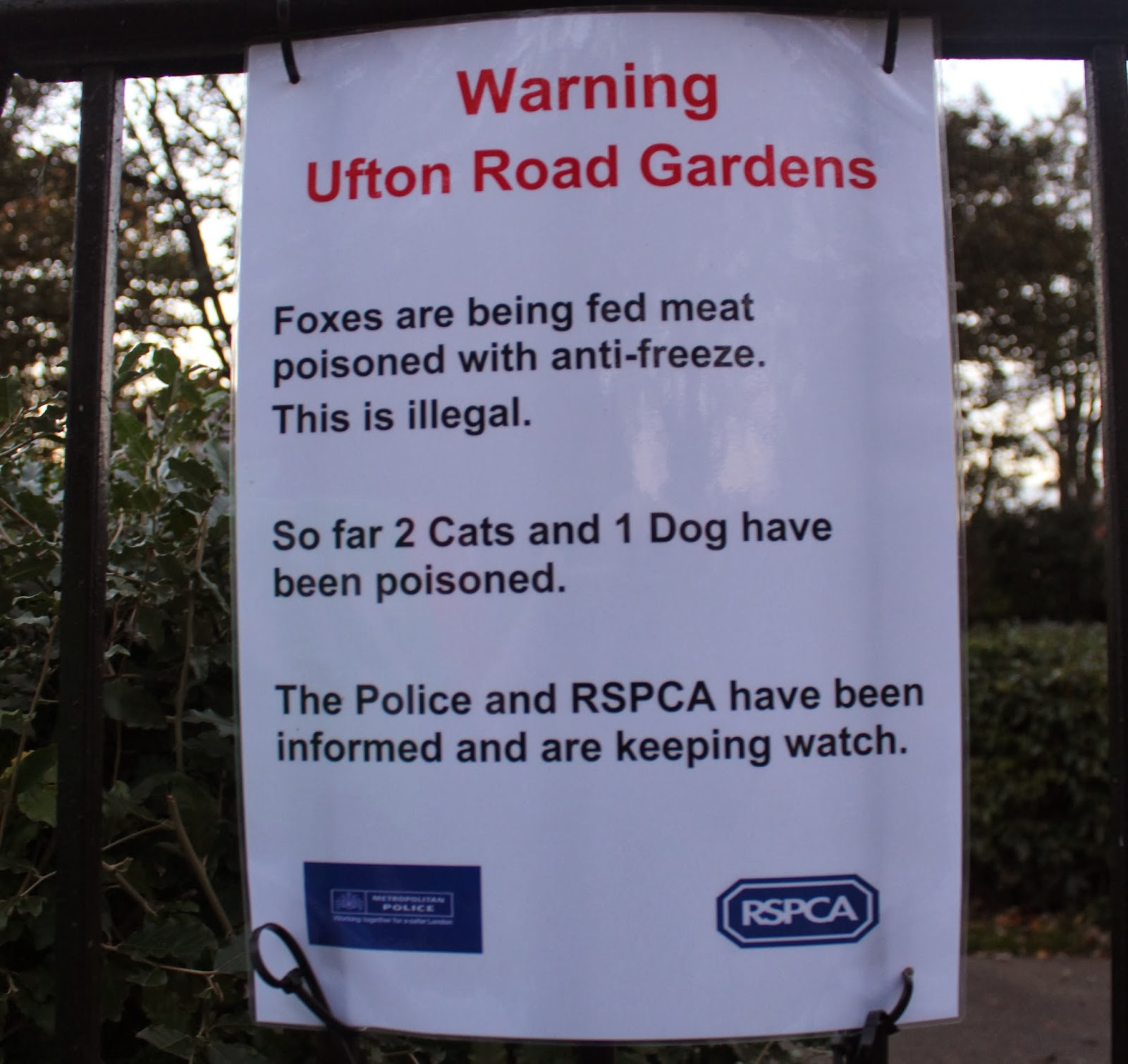
And that's why yesterday, I wandered down to a small, unlovely patch of concrete and haphazardly trimmed greenery called Ufton Gardens to search for evidence of death.


I found the story on the Hackney Post and thought it looked interesting. The picture explains the story quite succinctly, but to summarise: someone had been leaving poisoned meat in Ufton Gardens in an attempt to kill off the local foxes. Unfortunately for local pet owners, two cats and a dog had died from eating the meat. The story didn't say how the fox population had been affected.

According to the story, a man living on Ufton Road had 'openly confessed to setting out poisoned meat, after he caught foxes eating carp from his pond'.

I couldn't find Ufton Gardens on google maps, so I put on my coat and went out to find it. It took two minutes to get there, and after walking around the small patch of concrete and finding no meat and no dead animals, I realised there wasn't much to research. The laminated sign that features in the photo was nowhere to be seen.

From across the road, three teenagers standing outside the off licence watched me with little to no interest as I circled the non-space trying to think what could be gained from being there.

I wanted to speak the man with the carp. I wanted to see where the pets had been buried. I wanted to know what sort of meat was used for bait. This was the location where the meaning of those things converged, but no meaning could be squeezed from this place today.

So I went into the off licence and bought some chocolate.

When I went back into the building, Glen had a trolley full of stuff that he was taking out of an upstairs cupboard and moving into storage.

He showed us a sports bag full of someone's eraser collection.


I have vague memories of school friends who "collected" stuff like this. I collected cereal box toys for a while, in the mistaken belief that they would accrue some material value. I have the box at my parents' house, I never quite manage to throw it out.

We searched through the bag, picking out erasers shaped like vinyl records, animals, a lip balm. Cultural detritus of the lowest order. 


We found this rubber bust of Van Gogh. He was depicted with one ear, but on the wrong side of his head. (He - or Gaugin, according to the latest theories - cut off his left ear, not his right.) It was nice to think of this tiny piece of kitsch interfering with the reception of a historical narrative.

Glen said that he'd seen Van Gogh doll with a detachable ear.


The label says, 'I'm Van Gogh, my ear comes off!', which presumes the British pronunciation of Van Gogh ('goff', rather than 'goh'), if it's meant to rhyme.

At least it's the correct ear.


Micro-trauma #1: De Beauvoir Crash

On Monday morning I walked up towards Open School from Haggerston station. As I approached our building, which is on the corner of De Beauvoir Road and Downham Road, I realised that police tape was blocking the entrance to the building, and policemen were blocking off De Beauvoir Road.

At first I thought there had been a murder, but then as I passed the police tape, I could see a smashed up car in the middle of the road. I couldn't go through the front doors of the building as they were taped off so I went round to the back entrance.

--

E. arrived for rehearsals and I told her about what I'd seen and she told me what she had seen and we spoke about it for a bit and then stopped speaking about it. We were rehearsing and writing for this thing we're doing in Wales in November.

--

At about 3pm we weren't getting anywhere with writing the thing and E. suggested we go for a walk. We came out of the back doors and saw G. and M. the two guys who manage our building in the day. G. told us that the crash had happened late the previous night. The car had been travelling at 50mph in a 30mph zone, hit ten different cars, thrown the passenger through the front window and spun around into the middle of the road. The driver, realising that he had killed his friend, fled from the scene, and threw his jacket down the stairs to our building's basement, which was why the front of the building had been taped off. G. said that the forensics team had taken hours to do their work, much longer than they'd said they would.

We walked around to the front of the building. The policemen were gone, and the police tape had been taken down, with just a few remaining strands fluttering from a lamppost. We walked along De Beauvoir road. Down each side of the road, all the cars that had been hit were lined up nose to tail, very close to each other - wing mirrors hanging off, dents in the side, wheel arches crumpled. A big Turkish guy was talking to a small audience on the pavement, claiming to have seen the whole thing. He said that there had only been the driver, and that the driver had died, but that he hadn't come through the windscreen. A woman said that she'd heard different, but the guy was sure he'd seen it. A thin man complained and pointed at one of the cars that had been hit. It was his car. It didn't look too badly damaged, but I nodded and made appropriate noises. As we made to leave a young white guy with a nice camera turned up on a bike, he looked sheepishly at us and the group we were with. I kept expecting him to ask something, but he didn't and we walked on.

We stopped for a minute to look at the patterns made on the road by the forensics team: yellow chalk ovals surrounding vague skid marks. The ovals all sort of pointed up the road, towards where I'd seen the smashed car that morning. The car was gone now. Everyone and everything was gesturing to something that was no longer there.

--

Yesterday, while waiting to meet a friend outside school, I saw a roadside memorial to the guy who died in the crash: Anthony "Tony" Clarke. There were flowers and messages on bits of A4 paper in plastic wallets. The messages had that slightly impersonal feel of a public declaration and it was sad to think of his family and friends not knowing what else to do. A violent death.

--

Today I looked at the news stories written about the crash. It seems like the Turkish guy was right, the police believe Anthony had been driving the car alone. All the news stories were based on the same information from the police. No one had printed any interviews. Only the Hackney Gazette had bothered to get any photos, and the photographer must have arrived after the car had been taken away because the pictures were of nothing.


The Embeddedness of Being Robbed


Yesterday, Maria Lind, Director of the Tensta Konsthall gave a public talk at Open School East.

She spoke about the Konsthall's process of 'becoming an institution'. The Tensta Konsthall is already an institution in a few obvious ways: it's a contemporary art centre in a poor suburb of Stockholm that opened in 1998 and gets most of its funding from the Swedish Government. But Maria spoke about the need to become something more like a 'local player'- an institution more like a school, or a sports centre, or a local restaurant - that is woven into the social fabric of the area and has enough stability to make long term planning possible. She said the three things she wanted for the Konsthall were embeddedness, inhabitation (of the local area) and autonomy.

One part of the talk particularly interested me. Maria was speaking about the Tensta Konsthall's café which opened in 2011, when she took over as director. It provides coffee and food at reasonable prices and to enter the exhibition spaces you have to walk through the café . There is a market on the same square as the Konsthall and many of the market traders get their hot drinks from the café   It gives the Konsthall visibility and presence in an area where it might otherwise seem quite alien.

And then she mentioned that since the café had opened, the Konsthall had been robbed twice, and they'd had several attempted break ins. The way she spoke, it sounded like she was talking about the robberies as part of the same process of becoming a "local player". Like, they started the café and only when people started robbing them did they know that the café was doing its job.


This made total sense to me - if the café was well known enough for people to rob it, then it was doing its job of providing the gallery with local visibility. It was kind of an impressive commitment to the idea of being part of a local community: the idea that to be embedded is to be robbed.

The reason you can rob a café is because it has cash and to enter it you just walk in the door. Imagine a commercial gallery in West London. Opaque windows and a buzzer entry system with a single intern on the front desk. Who has cash there? Probably no one. Maybe just the intern actually, when they get sent for coffee.

To even have a café to be robbed is to define yourself in very different terms to the model of the private, commercial gallery.

I spoke to a friend about it and he said someone he knew in New York spoke about being mugged as a rite of passage. It's crass - being mugged is totally shit and traumatic - but it's true in a way. It's only tourists who "worry" about being mugged in New York. A bit like how in London its hard to find someone who worries about getting burgled. You live in a city, it will happen at some point.

Bad things are necessary, not because they are part of a process, or that experiencing them makes you stronger, but because bad things exist. For bad things not to happen to you, you have repress or ignore a certain section of reality. A public institution should be embedded in reality as much as it should be embedded in the community.

Two things

BELLYFLOP published my review of two Dance Umbrella FRINGE events: Road Postures by Roberta Jean, and the FRINGE Cabaret.

You can read it here.

--

And, tomorrow - Saturday 12th October - ACKROYD (Matthew de Kersaint Giraudeau & Andrew Sunderland) are exhibiting a new installation called MEAT-PARTY, comprising new sound/sculptural/video works at Fly Me Through the Night, a one night show at Pilot in Primrose Hill.


Here is a sneak peek at a new ACKROYD video which will be part of the installation.


Field Broadcast: Asterix & Obelix & a Menhir

http://fieldbroadcast.org/

Click the link. Download the software.

Tonight at 8pm, I'll be broadcasting a new work called Asterix & Obelix & a Menhir.


The ARKA group: Talks about dreams

On Thursday 12th September, the ARKA group held an evening of talks and discussion about dreams and dreaming as part of our exhibition at Baltic 39, Rapid Eye Movement (Paradoxical Sleep).

Images from the talk are below the soundcloud player.