Here is a link to a BBC Radio Guernsey program featuring Tim. Click through to 1 hour and 35 minutes to hear the interview - http://www.bbc.co.uk/iplayer/console/p009lr19

Being interviewed alongside Tim is Heyward Quevatre.


Heyward is veteran of the outdoor pools, and a 94 year old Sarnian who swims in the sea at the same beach on the north-west coast of the island every day.


Tim popped over to pick up Heyward before they went to the radio station. Heyward chatted about the pools, told a few stories, showed a few pictures, and demonstrated his tuck dive.


Next week we'll be going back to visit Heyward, Tim is going to swim with him (in the sea) and I'm going to record him speaking about the pools (in his house, hopefully).

I forgot to say yesterday, in the first blog, exactly why we were travelling to Guernsey, which seems ridiculous now, but at the time I didn't think about it.

We are making a film about the outdoor swimming pools on the east coast of Guernsey. On Thursday and Friday night we will film the pool under floodlights, and recreate a procession of torches that were part of the night time swimming galas that took place there in 1960s/70s.

---

Today we drove around looking for a microphone cable; getting stuck in traffic jams and staring at people with bad tattoos. We picked up our flaming torches and then spent some time wandering round a builders merchant. I like builders' merchants, and this one was a classic. I saw two well thumbed soft porn magazines, a man calling another man a gaylord, and a machine that sold coffee and tea for 15 pence a go.

Later on we went down to the pools to test out some shots and see if we could get any audio recordings.


We had also been told about an excellent vantage point from which to film the pools so we carried all of our equipment up several hundred stairs and got some amazing shots of the pool.


We waited for the sun to set, hoping to catch the moon.  Eventually we settled for some long exposure shots of the pool in the dying light.


Text by Matthew Giraudeau
Photos by Tim Bowditch and David Angus
I've finally finished writing my performance. I was really worried yesterday, I felt like it wasn't hanging together at all. Today it feels different - maybe because I read it out loud. The reason I enjoy the lecture format is because, when spoken aloud, ideas are more easily related. When you are speak with someone, the conversation naturally jumps around; trains of thought are allowed to run on, and intimations of meaning or association - inflexion, physical gestures - are just as important as the words you say.

Although a lecture isn't a conversation, it allows for the same thing to happen. Ideas hang in the air, waiting for something relevant to give them meaning. I'll have images (my incredibly bad powerpoint slide show) that give space to the words spoken over them, a pictorial space that both pins down what I'm saying, and yet adds more context that frees up possible associations.

---

All I have for you today is some pretty bleak Wikipedia links.

The Behavioural Despair Test. A really unlikely way of testing anti-depressants - http://en.wikipedia.org/wiki/Forced-swim_test

and

The Pit of Despair, which pretty much does what it says on the tin. A sure fire way to create psychosis - http://en.wikipedia.org/wiki/Pit_of_despair

I don't want to get in to a debate on the ethics of animal testing (because it is a complex debate and I don't have time, not because I'm not interested in it), but I find it fascinating that these tests were/are deemed to adequately replicate human psychological conditions, and in the case of the Behavioural Despair Test, to prove the worth of drugs

---

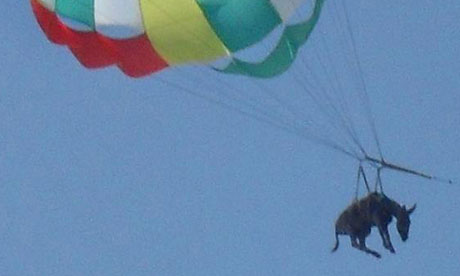
And just as an afterthought, here is the youtube video of the paragliding donkey that was in the papers a few weeks ago. The image of the gliding donkey inspired a work that will be in the show on Monday, so I've been following the story with some interest.

I was going to post the original footage, but I prefer this version, because it has bad metal and pointless extra editing.

I used this image as the basis for a proposal for a piece of public art.


It must be the best 'silly-season' picture of 2010. A paragliding donkey in Russia.

I'm fully writing my performance for Monday now, so not much time to blog, but here is an interesting link to a follow up story about the donkey that appeared in the photo.

http://www.guardian.co.uk/media/2010/aug/06/the-sun-russian-donkey-stunt

I like the duplicate donkeys - the faked identities of animals with no interest in identity. W.G Sebald would have liked it, very Borgesian.
BLOODY HELL.

I've only got two days of writing/practising before I present all my work at the Royal Standard on Monday.

I was back in London yesterday playing a gig in Kilburn. The name 'Kilburn' sounds sort of pathetic. I wrote a poem about Kilburn once. Here it is, for reference.

Kilburn

I've got this new toothbrush.
It's like cleaning my teeth with a razorblade;
but in a good way.

“Where are your shoes?”
Says a girl opposite me on the bus.
I nod towards the bus driver, who turns, smiles and winks.
“He has them” I say
“I swapped them for this toothbrush”

“Where are you going?” She asks.
“Kilburn” I reply.

In normal circumstances that would have killed the conversation,
but luckily my gums were bleeding;
she was intrigued.

We spoke for a while,
until we reached Kilburn.
I stood up to leave,
but passed out,
before I could get off the bus.

I have faint memories of her stealing my wallet,
but obviously,
as someone without any shoes,
she didn't find much.

She did however,
steal my toothbrush,
which, though the root of today's problems,
was the only one I had.

------

I'd never been there before, but it's quite an accurate portrait of the place.

Actually that isn't true. I quite liked it. We ate noodles at a place with formica tables, and then we drank in a beautiful pub (actually, we drank rum that we bought from the offy, but we did drink it in the pub). And we used the Overground to get there, and as I may have mentioned, the Overground is my favourite mode of London transport. It's for poor people who want to get round the city without going through zone 1 and it goes to semi-ridiculous places and it's a bit slow and annoying and always busy but without anyone ever understanding why. Fantastic.

Kilburn High Road reminded me a bit of Green Lanes between Manor House and Wood Green. Good kebab houses and a constant stream of human traffic - it's a mainline between two stations (Brondesbury and Kilburn) and it feels like it is both a destination and also a pit-stop between places.

And, obviously, it is home to the 'Kilburn Bandits'.

I went to the Walker gallery the other day. It wasn't great, though it did have more pre-renaissance painting than I was expecting, which was good to see. I liked the room of sculpture and plaster casts - how they were all shoved together in one space, flailing limbs and frozen screams.

They had a few of George Stubbs' paintings. I like it when people paint animals, especially horses. There is something absurd about horses.

This one particularly caught my eye. If you can see below, Stubbs was responsible for bringing a new genre, 'Animal Terror', to British painting.


The human-faced-Lion doesn't look very terrifying. It looks like a teddy bear.


"Stubbs borrowed one of the King's horses and produced the expression of terror in the animal by pushing a brush on the ground towards it".

Terrifying.
I just had a trip to A Foundation. I saw three good exhibitions.


Artur Zmijewski has an exhibition called Following Bauhaus, in which the artist known for his creation of situations in which conflict arises and is then examined, set up an art school based on the Bauhaus school that operated in inter-war Germany.

I might come back and write some more about Artur. I was interested in setting up a free art school, and I like the idea that someone so hyper-critical could suddenly begin to make productive (as opposed to deconstructive) art.


Tatsumi Orimoto is exhibiting a wealth of photos relating to his singular practice in a show called, Live In Translation. I like that he uses his Mother in his work, it is sort of sweet/disturbing. There is something alluring about his bread man persona. I'm instantly reminded of Bedwyr Williams.


Jon Fawcett also has a show there (it's a big old gallery - comprising an old furnace, knife factory and coach shed).


Jon's work explores techno-mysticism, science-fiction made real and unreadable functions. I particularly liked Wheel, a video of an overtly technical machine being assembled in paradoxical locations by a group of men.

I would love to write about Jon's work more - I love all the references to conspiracy theories and writers like JG Ballard. The work has this hyper-finish that brings to mind Heideggerian techno-fear and prelapsarian longing.

But I don't have time. I've suddenly realised that I have loads of work to do and I've not even had lunch yet.
As I've finished making the videos for my presentation on the 9th, I thought I'd present a load of the source material here, in its original form, as well as related videos that I looked at but never used.


Obviously, this isn't representative of Liverpool. It's more representative of how Youtube operates as a filter. The stranger the title of the video, the higher up the listings it comes on a generic search term like 'Liverpool' or 'Toxteth'. The shorter the video, the easier it is to watch and comprehend. And the weirder the content, the more I'm drawn towards it.
I've been alone all weekend, it's taken me about three hours to get the wi-fi working, I need a wee and I'm sitting on the side of the table which means that I can't stretch my legs. I'm having a bad day

I've been working until late in the studio since Friday. I finally met Harry Lawson - I think he is the only one of the Royal Standard crew that I hadn't already met.

He wears a fine moustache, and when I met him he was also sporting this rather brilliant space shuttle t-shirt.


What a fine shirt.

I was going to write about the exhibition at A Foundation, which looks really interesting. It was only when I got down there today that I realised (by virtue of the sign on the front door) that A Foundation is open Tuesday - Saturday.

Yeah, it's been a real shitty day. I'm drinking wine and soda in pint glasses.

So, instead of that, I'm just going to present this documentary on Paul McCarthy.


A fair amount of the work I've been doing over the past two weeks has used the Viennese Actionists' various events and performances as source material. I feel like Paul McCarthy was the American inheritor of their disturbing and anti-value approach to art making. He feels like a 90s artist to me - even though he has been making his performance to camera stuff since the 70s. There is something very post-modern and self-reflexive about his approach to his art work as 'psychological', or 'cathartic'. But the ironic finger flex quotation marks are only in the telling of it, when I watch his films I'm genuinely filled with horror and sickly fascination.


Anyway, here is the link. I can't embed it because my computer keeps asking me to install Quicktime so I can't check if it's working. Yeah, it's been that sort of shitty day.

http://www.ubu.com/film/mccarthy_destruction.html
Most of my childhood memories are based on television. Forgotten television programs/films/adverts form a substantial part of my sub-concious. I was speaking to someone about psychoanalysis the other day, and I got on to the idea of nostalgic group conversations ("Oh, you mean The Raccoons? [sings theme tune] What about Trap Door? Do you remember that? NO WAY!!! Knightmare? Yeah of course!! etc. etc.) as a form of naive psychoanalysis, or group therapy.

We root around in our childhood, dragging half-buried ideas and images from our long term memory, we parade them around and re-position them as value-objects. We assign certain images trauma value, holding others to us like comfort blankets or pop-culture mascots.

Turns out I'm not the only one to think of this...

kindertrauma.com is a website which encourages people to send in 'Traumafessions' about things that scared the shit out of them as children.


"KINDERTRAUMA is about the movies, books, and toys that scared you when you were a kid. It’s also about kids in scary movies, both as heroes and villains. And everything else that’s traumatic to a tyke!

Through reviews, stories, artwork, and testimonials, we mean to remind you of all the things you once tried so hard to forget…"

Like most websites recommended in the Guardian Guide, it sounds way funnier than it actually is. It is interesting to see how this idea of the trivial-as-life-forming is being played out online. I agree with the essence - that trivial things can have meaningful psychological impact. It is strange how these things become a form of 'sharing', where discussing your suppressed memories is deemed necessarily therapeutic, even if the therapy is based in humour.
Yesterday I made loads of work in the studio - it was raining and I got soaked on my ride to town, so there was no way I was going back in to the city with wet thighs - that is risking some serious chaffage.

So, seeing as I didn't do anything of blogging value yesterday (I'm trying not write about the work I'm doing - I'm scripting a performance so it gets a little self-referential if I write about writing...), I thought I'd put these photos up. I took them on my trip down to the Albert Dock.

If I looked up from here, I could see the Liverpool Big Wheel


When I looked down I could see this ominous black buoy, covered in tires and held together by chains. It looks like a naval mine, or a giant floating punch bag.


I like it when developed, tourist centred zones have 'wrong' elements in them. They look so out of place in a polished, clean, cultural attraction, and at the same time somehow manage to be made invisible to visitors through their incongruity.


I love the attitude of the placement of this tape. Firstly, there is no step, secondly these things are surely their own warning - their very presence tells you that you should not walk directly in to them.

They are objects deprived of their obvious meaning, and given a new, visitor concious meaning. These functional objects have been re-interpreted as obstacles to tourism. They have been de-objectified and reconstituted as referential signifiers; their meaning is subject to our presence.

Quantum objects, post-modern objects, impotent objects.
Yesterday I went to meet David Jacques at his studio.


All images are from his website, and the videos are from his youtube channel.

Penny and Dan were interested in seeing his new work, and thought I might like to speak to him - he deals very much with the edges of the city, the abandoned non-places that used to have meaning, such as the docks and industrial estates north of the centre.

His latest work, North Canda - English Electric, documented in this video (in two parts), deals with just such places, and has just won him the Liverpool art prize. He has also been nominated for the Northern Art Prize.


We spoke about the ownership of the city and private spaces (Liverpool One, Grosvenor, the church, university campuses). We also spoke about a collaborative piece of performance he is working on with two other artists and a drama group. The piece is inspired by Hansel and Gretel, and a book by W.G Sebald called, Austerlitz.

I won't say too much about what David told us about the piece, as it is being performed as part of this years Liverpool Biennial. It was a strange coincidence that the piece of work I'll be performing on the 9th of August at the Royal Standard will be loosely based on ideas contained within another of Sebald's books, The Rings of Saturn.
I went home for the funeral of Keith Colquhoun, my girlfriend Jessie's Father. I arrived back in Liverpool yesterday, with a throbbing headache and an unshakable sadness. Funerals are cathartic, but that sense of relief doesn't last for long.

Before I got my train (actually, I missed my train by about 30 seconds, which meant that I had to wait at Liverpool Lime Street for an hour, staring at the giant electronic billboard across the street), we went down to Crosby beach to see Another Place by Antony Gormley.


The piece consists of 100 cast iron figures, spread over two miles of coastline. They face out to sea, and, as per usual with Gormley, are cast from the artists body.


They were meant to go to New York in November 2006, but after a petition by local people and Another Body Place Ltd, a charitable body set up to campaign to keep the iron men on the beach, they were granted a reprieve and will now be permanently posted at Crosby.

I can't find much info on Another Body Place Ltd. Perhaps that might warrant some extra research in to exactly who set up the lobbying body, what funding was needed, and where it came from. Antony Gormley certainly benefited financially from Crosby keeping hold of the statues.


Crosby is pretty bleak. It was so windy that our mile long walk along the beach completely knackered me. Richard took his shoes off and almost instantly his feet were covered in a thick, black sludge. You could see the edge of Liverpool's industry, towards the south, and wind farms out to sea.

You could also see these, which I thought were much nicer than Gormley's men.


Maybe there should be100 of those.

I'd heard that the men closest to the shore had smooth heads and smooth penises, from where visitors rub the statues.


I like the idea that this could become the function of the men. Good luck talismans for a post-industrial mythology. Maybe in a post-cultural landscape, this could become their meaning. For now they are unmistakably linked to Gormley. A large sign at the entrance to the beach explains exactly how they came to be here, and what the artist was thinking when he proposed the idea.

As the tide comes in and out, the figures are submerged at various heights. It is both affecting, and also slightly absurd. People sometimes dress the figures up - one iron man we saw had gold underwear spray painted on him.


This is a jelly fish we found on the sand. Andy is poking it with a stick. This is the colour and feel of the British coastline: rubbish, dead jelly fish, mackintoshes, dog walkers, wind. The iron men fit in somehow. I'm not a fan of Gormley as an artist, but maybe public art requires a different sort of language. His work is certainly basic enough to acquire meaning without too much trouble. You can ignore it or place it within the landscape without having to modify what you are looking at.


Hamish Mclain mounted a man halfway down the beach. He didn't look too comfortable.


This is the local swimming pool as seen from the beach. It looks like a space craft. Maybe they could convert it in to a UFO museum if tourism picks up as much they hope it will.


This is the Lee Shan Kung Fu Club, as seen on the way up from the beach to the town. You can't quite make it out on the picture, but he teaches many styles. Impressive.

When I was finally on the platform for my train, (after a good breakfast, a missed train and an hours wait) I saw a glove on the roof of the station.


I suppose it got there from someone working on the roof. It's funny how the trace of something we recognise as human always intrigues us.
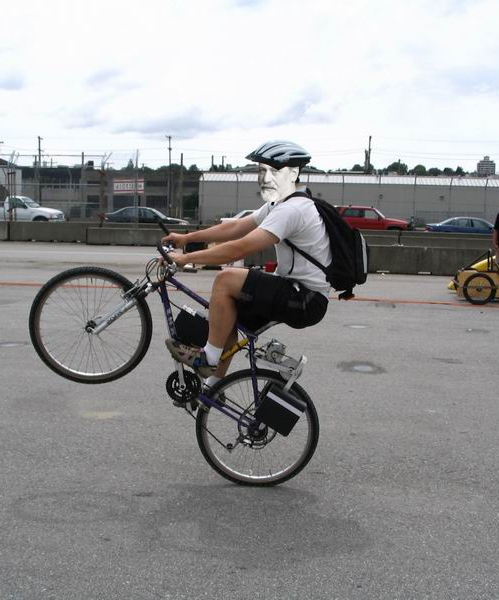
Right, I'm back in Liverpool. I'll do a proper blog tomorrow, featuring Antony Gormley's smooth penis. Until then you'll have to make do with this.


It's Sigmund Freud doing a wheely.
 I'm off to Crosby Beach today, and then I'm going back to Essex until Tuesday. I haven't really got time to blog, so you'll have to make do with these pictures.


This is a girl in a brain costume.


This is a girl in a brain costume on my bike.
A few additions to yesterday's post on the Beatles: Alan's surname is Williams, and you can see his artwork here. Kevin Hunt also sent me a link to this page about the Beatles' homes across Liverpool, which clarifies a few things.

I promise I won't write about the Beatles any more, though they do have a habit of creeping up in conversation. I was in the pub last night having a huge conversation about the Beatles with Dan, when we both suddenly realised that neither of us either a) cared about the Beatles or b) knew very much about them.

This is Superlambanana.


It is a piece of public sculpture, designed by Taro Chiezo, commissioned for the Art Transpennine Exhibition of 1998. It is seventeen feet high, and made of concrete and steel. I found all that information at the Superlambanana fansite.

The site promotes products related to Superlambanana, mainly mini-replicas, including this Beatles design...


Tasteful no?

Anyway, I'm getting ahead of myself really. The reason that there are products to buy, and people who would buy them, is because in 2008, a project called Go Superlambananas was launched by the public art production company Wild in Art as part of the Liverpool's year as the European Capital of Culture.

This is from the website.

"For ten weeks during this summer, hundreds of thousands of tourists, visitors and residents had fun exploring the city and discovering 125 Superlambananas, beautifully created by artists and communities from Liverpool." 

And I must also say that most of the information I have about this is from a piece of writing by Penny and Dan called Mutiny on the Periphery, which is published in Culture and Agency, Contemporary Culture and Urban Change, ed. Monica Degen and Malcolm Miles, University of Plymouth Press, 2010.

So basically, a load of fibreglass copies of Superlambanana were placed around the city, artists were paid to decorate them, and companies sponsored them, and were allowed to wrap them in company colours. They formed a sort of trail around the city, and people would walk around the city 'discovering' the mini-superlambananas in different situations.

Most of them were auctioned off - with a lot of the money going to local charities, but a not insubstantial chunk going back to the organisers, Wild in Art. Wild in Art are not a charity, and, I presume, were already paid for the production and management of the superlambananas.

Wild in Art have produced and managed several other events along the same lines as Go Superlambanas. Including Go Elephants in Norwich, another event in Merseyside called Go Penguins, and my personal favourite, a project with pigs in Lalin, Spain, called, Lalin Pork Art.


Here is another quote from the Wild in Art website, about the Go Penguins project.

"Liverpool’s Go Penguins event was a huge success, with over 500,000 people visiting the trail over the ten weeks, plus a further 4,000 more coming to bid a fond farewell to their beloved penguins at the special auction preview at St George’s Hall. Generating a whopping £5.6 million in media stories, the event enjoyed incredible celebrity support, with Paul O’Grady, Johnny Vegas, Graeme Le Saux, the cast of Hollyoaks and Liverpool legend Ken Dodd among those getting behind the event."

There are a few things I don't like about that statement. Firstly, when did getting Graeme Le Saux and Ken Dodd involved in a piece of public art ever make it successful? Secondly, what does '£5.6 million in media stories' mean? Those figures, at best, are invented, the worth of the project to the city is overblown, and the idea of parades of fibreglass animals being distributed around a city for seemingly no reason is presented as an intrinsically good thing.

Superlambanana was not a brilliant piece of art, but it did have a critical function - it was designed as a comment on the genetic modification of food (lamb-banana, fish-tomato). The Go Superlambananas 'event', and the other replicated Go events have no such critical basis. Wild in Art have taken a piece of art and turned it in to a palatable piece of marketing.

Ironically, the Go Superlambanas have become an unofficial, and unlikely, icon of the city. A few of them were 'generously donated' to local charities or community groups by Wild in Art (a direct quote from the website - by generously donated I assume they mean paid for by the local council and centralised government funding), so some of them are hanging about, generating publicity for the company who were paid to make them.

Liverpool council must have bought one for Liverpool Parkway (which I wrote about yesterday - sort of a fancy bus shelter-cum-train station for people travelling from the airport to the city).


I suppose I did take a picture, but hopefully it won't become part of Wild in Art's perpetual marketing cycle.

Later on, we were in a take away, and I noticed this.


I did actually have that deal. I also bought some chips, but I'm not sure how relevant that is.

I suppose all this sounds a bit curmudgeonly (I always wonder where that word comes from, is the curmudgeon a medieval grumbling bird?). I'm not trying to shit on the superlambananas, or their adoption by the people of the city as a mascot. It just seems unfortunate that the way the 'events' were managed benefited Wild in Art - a private company - in real, monetary terms, way more than they benefited the city, despite all the talk of 'media value'.