A few additions to yesterday's post on the Beatles: Alan's surname is Williams, and you can see his artwork here. Kevin Hunt also sent me a link to this page about the Beatles' homes across Liverpool, which clarifies a few things.
I promise I won't write about the Beatles any more, though they do have a habit of creeping up in conversation. I was in the pub last night having a huge conversation about the Beatles with Dan, when we both suddenly realised that neither of us either a) cared about the Beatles or b) knew very much about them.
This is Superlambanana.
It is a piece of public sculpture, designed by Taro Chiezo, commissioned for the Art Transpennine Exhibition of 1998. It is seventeen feet high, and made of concrete and steel. I found all that information at the Superlambanana fansite.
The site promotes products related to Superlambanana, mainly mini-replicas, including this Beatles design...
Tasteful no?
Anyway, I'm getting ahead of myself really. The reason that there are products to buy, and people who would buy them, is because in 2008, a project called Go Superlambananas was launched by the public art production company Wild in Art as part of the Liverpool's year as the European Capital of Culture.
This is from the website.
"For ten weeks during this summer, hundreds of thousands of tourists, visitors and residents had fun exploring the city and discovering 125 Superlambananas, beautifully created by artists and communities from Liverpool."
And I must also say that most of the information I have about this is from a piece of writing by Penny and Dan called Mutiny on the Periphery, which is published in Culture and Agency, Contemporary Culture and Urban Change, ed. Monica Degen and Malcolm Miles, University of Plymouth Press, 2010.
So basically, a load of fibreglass copies of Superlambanana were placed around the city, artists were paid to decorate them, and companies sponsored them, and were allowed to wrap them in company colours. They formed a sort of trail around the city, and people would walk around the city 'discovering' the mini-superlambananas in different situations.
Most of them were auctioned off - with a lot of the money going to local charities, but a not insubstantial chunk going back to the organisers, Wild in Art. Wild in Art are not a charity, and, I presume, were already paid for the production and management of the superlambananas.
Wild in Art have produced and managed several other events along the same lines as Go Superlambanas. Including Go Elephants in Norwich, another event in Merseyside called Go Penguins, and my personal favourite, a project with pigs in Lalin, Spain, called, Lalin Pork Art.
Here is another quote from the Wild in Art website, about the Go Penguins project.
"Liverpool’s Go Penguins event was a huge success, with over 500,000 people visiting the trail over the ten weeks, plus a further 4,000 more coming to bid a fond farewell to their beloved penguins at the special auction preview at St George’s Hall. Generating a whopping £5.6 million in media stories, the event enjoyed incredible celebrity support, with Paul O’Grady, Johnny Vegas, Graeme Le Saux, the cast of Hollyoaks and Liverpool legend Ken Dodd among those getting behind the event."
There are a few things I don't like about that statement. Firstly, when did getting Graeme Le Saux and Ken Dodd involved in a piece of public art ever make it successful? Secondly, what does '£5.6 million in media stories' mean? Those figures, at best, are invented, the worth of the project to the city is overblown, and the idea of parades of fibreglass animals being distributed around a city for seemingly no reason is presented as an intrinsically good thing.
Superlambanana was not a brilliant piece of art, but it did have a critical function - it was designed as a comment on the genetic modification of food (lamb-banana, fish-tomato). The Go Superlambananas 'event', and the other replicated Go events have no such critical basis. Wild in Art have taken a piece of art and turned it in to a palatable piece of marketing.
Ironically, the Go Superlambanas have become an unofficial, and unlikely, icon of the city. A few of them were 'generously donated' to local charities or community groups by Wild in Art (a direct quote from the website - by generously donated I assume they mean paid for by the local council and centralised government funding), so some of them are hanging about, generating publicity for the company who were paid to make them.
Liverpool council must have bought one for Liverpool Parkway (which I wrote about yesterday - sort of a fancy bus shelter-cum-train station for people travelling from the airport to the city).
I suppose I did take a picture, but hopefully it won't become part of Wild in Art's perpetual marketing cycle.
Later on, we were in a take away, and I noticed this.
I did actually have that deal. I also bought some chips, but I'm not sure how relevant that is.
I suppose all this sounds a bit curmudgeonly (I always wonder where that word comes from, is the curmudgeon a medieval grumbling bird?). I'm not trying to shit on the superlambananas, or their adoption by the people of the city as a mascot. It just seems unfortunate that the way the 'events' were managed benefited Wild in Art - a private company - in real, monetary terms, way more than they benefited the city, despite all the talk of 'media value'.
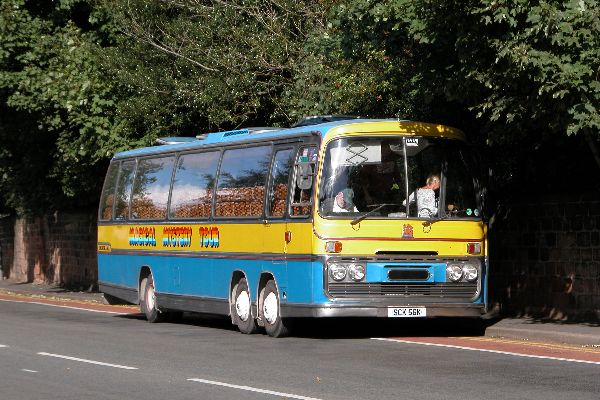
Yesterday, Richard Proffitt gave me a Magical Mystery tour of all the Beatles' related sites in the city. Sam Venables drove, and Kevin Hunt and Alan Williams came along for the ride.
On the way to pick up Richard and Alan from Tesco (egg and cress triple sandwich + tropicana), we saw the actual Magical Mystery Tour bus. People pay a lot of money to get on a bus and drive round suburban Liverpool. But we did it for free (apart from Sam's petrol, and the fact that Richard had previously done the Magical Mystery Tour so that's how he knew where to take us...).
First off we went to George Harrison's house in Wavertree. I didn't take any photos because, frankly, I was scared of the children.we stood there for a minute and Richard told us about a childhood friend of the Beatles - when they became successful, they bought him a supermarket somewhere down south. After a while, they could afford to give him a job with the band, but he freaked out and went back to running the supermarket.
Next stop was Strawberry Fields. Again not much to see. Richard had brought a stereo and played the relevant song as we drove up to the gates. There was quite a lot of bad graffiti, and it looked as though people had stolen parts of the gate, which reminded me a bit of the guys who stole the Auschwitz sign, only less impressive.
Through the gates we could see a development of new build homes - yellow bricks and uPVC windows. It was hard to get excited. I'm not a big Beatles fan anyway, but it must be pretty depressing to travel from Japan or Brazil just to stand next to a red gate next to a busy road.
Next up was John Lennon's house (at no point did we get from one place to the next without missing a turning or having to perform a dangerous/ridiculous manoeuvre in the car). John's house, as you can imagine, is better kept that George's, and definitely Ringo's (I still can't work out whether or not it's been demolished). It is owned by the National Trust, though someone does live there. We saw an old man peeking through the curtains, and there was a Ford Fusion in the drive. Just like the one John drove.
We saw this woman outside the house. We were at a bit of a loss as to what we should have been doing when looking at the house. She seemed more dedicated to the task, but after a minute or so of reverential looking, even she gave up. She walked across the road, probably to Paul's house, which was also our next stop.
I'm already really bored recounting this. It was quite enjoyable, but probably only because we all recognised that the whole thing was completely absurd. Also, Richard promised us that in Paul McCartney's house, there lived a camp alcoholic, who not only regaled tourists with invented tales of the Macca's last visit ("he brought his own PG Tips, he likes to check up on the place" etc. etc.), but also looked exactly like Paul McCartney, if Paul McCartney was a camp alcoholic.
He didn't appear, and again, we were left wondering what we were meant to do. Luckily a car full of tourists turned up and asked us if we knew which one Paul McCartney's house was. We pointed at the sign and told them that John Lennon's house was much nicer. He had a Ford Fusion.
This is the topiary sculpture of the Beatles that stands on a roundabout at Liverpool Parkway. We probably wouldn't have bothered, but it was close, and I wanted to see how Ringo's head was doing since a vandal had decapitated it last year. Poor Ringo. I'm not sure if you can see from the photos, but instead of growing a new head, the gardeners have just chopped off a bit of his shoulders and sculpted a new head from what was his neck. It looks totally insane, like they hired a Goomba to play them the drums.
The sculpture (or feature, or whatever. What do you call it when it's made out of hedge?) also had a single CCTV camera pointing directly at it. I'm assuming it has been installed since the vandalism attack, but it seemed like overkill. I suppose the tourists won't notice just one more camera.
Actually, the whole Liverpool Parkway development seemed absurd, it is such a small interchange, but such a huge building. So much technology for what is essentially a bus shelter. I suppose the idea is that tourists are impressed as they are carried seamlessly from the airport to the city. Lots of metal and glass and automatic doors.
Finally, we went to Penny Lane where we startled a man and his child by playing the song Penny Lane at full blast from the car window. We were meant to be playing it at a group of lost looking tourists, but they didn't take any notice. Sam thought they weren't Beatles tourist, and might just be looking for the carvery.
With our last job finished, we drove to the pub and talked about non-Beatles related things for a while. Then we noticed that the whole pub was covered in bad oil paintings of the band. It is hard to escape their presence here. Richard spoke about how they overshadow the city. He spoke about how no one from Liverpool will ever be as famous as the Beatles were. He is right in a way. The shifting economics of pop music mean that no musician will dominate western music in quite the same way. And, as Richard said later in a different pub, with less Beatles paintings, but more alligators on the walls, the Beatles were actually a product of the last phase of Liverpool's industrial period. They were a product of a city that had wealth, before the bad old days of the 70s and 80s. They were confident and able because of Liverpool's success as a city, and in a way that is why people are still so reverent of them. They are a hangover from Britain's industrial past.
The Beatles: A story of Victorian Britain's industrial prowess.You don't hear that very often.
On the way to pick up Richard and Alan from Tesco (egg and cress triple sandwich + tropicana), we saw the actual Magical Mystery Tour bus. People pay a lot of money to get on a bus and drive round suburban Liverpool. But we did it for free (apart from Sam's petrol, and the fact that Richard had previously done the Magical Mystery Tour so that's how he knew where to take us...).
First off we went to George Harrison's house in Wavertree. I didn't take any photos because, frankly, I was scared of the children.we stood there for a minute and Richard told us about a childhood friend of the Beatles - when they became successful, they bought him a supermarket somewhere down south. After a while, they could afford to give him a job with the band, but he freaked out and went back to running the supermarket.
Next stop was Strawberry Fields. Again not much to see. Richard had brought a stereo and played the relevant song as we drove up to the gates. There was quite a lot of bad graffiti, and it looked as though people had stolen parts of the gate, which reminded me a bit of the guys who stole the Auschwitz sign, only less impressive.
Through the gates we could see a development of new build homes - yellow bricks and uPVC windows. It was hard to get excited. I'm not a big Beatles fan anyway, but it must be pretty depressing to travel from Japan or Brazil just to stand next to a red gate next to a busy road.
Next up was John Lennon's house (at no point did we get from one place to the next without missing a turning or having to perform a dangerous/ridiculous manoeuvre in the car). John's house, as you can imagine, is better kept that George's, and definitely Ringo's (I still can't work out whether or not it's been demolished). It is owned by the National Trust, though someone does live there. We saw an old man peeking through the curtains, and there was a Ford Fusion in the drive. Just like the one John drove.
We saw this woman outside the house. We were at a bit of a loss as to what we should have been doing when looking at the house. She seemed more dedicated to the task, but after a minute or so of reverential looking, even she gave up. She walked across the road, probably to Paul's house, which was also our next stop.
I'm already really bored recounting this. It was quite enjoyable, but probably only because we all recognised that the whole thing was completely absurd. Also, Richard promised us that in Paul McCartney's house, there lived a camp alcoholic, who not only regaled tourists with invented tales of the Macca's last visit ("he brought his own PG Tips, he likes to check up on the place" etc. etc.), but also looked exactly like Paul McCartney, if Paul McCartney was a camp alcoholic.
He didn't appear, and again, we were left wondering what we were meant to do. Luckily a car full of tourists turned up and asked us if we knew which one Paul McCartney's house was. We pointed at the sign and told them that John Lennon's house was much nicer. He had a Ford Fusion.
This is the topiary sculpture of the Beatles that stands on a roundabout at Liverpool Parkway. We probably wouldn't have bothered, but it was close, and I wanted to see how Ringo's head was doing since a vandal had decapitated it last year. Poor Ringo. I'm not sure if you can see from the photos, but instead of growing a new head, the gardeners have just chopped off a bit of his shoulders and sculpted a new head from what was his neck. It looks totally insane, like they hired a Goomba to play them the drums.
The sculpture (or feature, or whatever. What do you call it when it's made out of hedge?) also had a single CCTV camera pointing directly at it. I'm assuming it has been installed since the vandalism attack, but it seemed like overkill. I suppose the tourists won't notice just one more camera.
Actually, the whole Liverpool Parkway development seemed absurd, it is such a small interchange, but such a huge building. So much technology for what is essentially a bus shelter. I suppose the idea is that tourists are impressed as they are carried seamlessly from the airport to the city. Lots of metal and glass and automatic doors.
Finally, we went to Penny Lane where we startled a man and his child by playing the song Penny Lane at full blast from the car window. We were meant to be playing it at a group of lost looking tourists, but they didn't take any notice. Sam thought they weren't Beatles tourist, and might just be looking for the carvery.
With our last job finished, we drove to the pub and talked about non-Beatles related things for a while. Then we noticed that the whole pub was covered in bad oil paintings of the band. It is hard to escape their presence here. Richard spoke about how they overshadow the city. He spoke about how no one from Liverpool will ever be as famous as the Beatles were. He is right in a way. The shifting economics of pop music mean that no musician will dominate western music in quite the same way. And, as Richard said later in a different pub, with less Beatles paintings, but more alligators on the walls, the Beatles were actually a product of the last phase of Liverpool's industrial period. They were a product of a city that had wealth, before the bad old days of the 70s and 80s. They were confident and able because of Liverpool's success as a city, and in a way that is why people are still so reverent of them. They are a hangover from Britain's industrial past.
The Beatles: A story of Victorian Britain's industrial prowess.You don't hear that very often.
On the 10th of July of this year, my girlfriend's father, Keith Colquhoun, died at the age of 82. He was an incredible man, full of facts, fictions, and tales of his journalistic travels. He also sported a particularly fine beard, and though it took me some time to gain his approval with regards to his daughter, he always appreciated my attitude to facial hair.
His wife, Sara, has written an obituary which appeared in the Guardian. There is also an obituary in The Economist, where he had worked on the Asia section and where he had also been, strangely enough, in charge of the obituaries.
As well as a journalist, Keith was a novelist - his most successful being Goebbels & Gladys, first published in 1981. You can buy his latest book, Five Deadly Words, published just before he died, on Amazon.
Whilst I was reading Goebbels & Gladys, I used to read Jessie my favourite lines from the book. She asked me if I could remember any of the passages that I had quoted from. I couldn't. So, today I have been going through the book finding bits that I like, in the hope that I'll stumble upon the quotable quotes that I discovered on my first reading. I thought I'd present a little selection here.
"Noel looked particularly pink this morning, although it might have been the light. I wondered if I would be doing him an ill-service if I took him to the pub this early. It would probably make little difference. Only an expert could tell Noel pissed from Noel unpissed. It would be a rare chance for Noel to do something useful for the newspaper. I raised my eyebrows interrogatively and made a drinking gesture. I don't know why I didn't just ask him to have a drink. I suppose television has made all of us visual."
"The operator said she wasn't getting any reply on Brooke-Kate's extension and she put me through to the features department. I spoke to one of the subs and asked him to tell Brooke-Kate that I was off to Tunis and would call him on Monday. 'My name is Verity, V as in virtuous. That's right. Thanks.' I hung up. To phone someone you don't want to speak to and discover he is out is a timely piece of luck."
"On the way back to the hotel I had a thought as we passed the crowds of Tunisians watching the caravan of cars. I said to Paul, 'A couple of owls like us have just shaken their president's hand and regarded it as part of the day's work. Yet had it happened to any of them they would have remembered it all their life.' Paul didn't say anything. He probably thought I was being facetious, but I wasn't.
Smith said, 'I think that is a noble thought, Mr. Verity.' I hadn't meant it to be noble either. I sometimes feel I am misunderstood."
"Experience is pretty humdrum. It is art that gives it glamour. The spacemen made the moon sound like Little Rock. H.G. wells never went there and made it sound like Arcadia"
"Each one of us survives at the expense of others."
"The confidential euphoria inspired by alcohol is best left until the evening."
His wife, Sara, has written an obituary which appeared in the Guardian. There is also an obituary in The Economist, where he had worked on the Asia section and where he had also been, strangely enough, in charge of the obituaries.
As well as a journalist, Keith was a novelist - his most successful being Goebbels & Gladys, first published in 1981. You can buy his latest book, Five Deadly Words, published just before he died, on Amazon.
Whilst I was reading Goebbels & Gladys, I used to read Jessie my favourite lines from the book. She asked me if I could remember any of the passages that I had quoted from. I couldn't. So, today I have been going through the book finding bits that I like, in the hope that I'll stumble upon the quotable quotes that I discovered on my first reading. I thought I'd present a little selection here.
"Noel looked particularly pink this morning, although it might have been the light. I wondered if I would be doing him an ill-service if I took him to the pub this early. It would probably make little difference. Only an expert could tell Noel pissed from Noel unpissed. It would be a rare chance for Noel to do something useful for the newspaper. I raised my eyebrows interrogatively and made a drinking gesture. I don't know why I didn't just ask him to have a drink. I suppose television has made all of us visual."
"The operator said she wasn't getting any reply on Brooke-Kate's extension and she put me through to the features department. I spoke to one of the subs and asked him to tell Brooke-Kate that I was off to Tunis and would call him on Monday. 'My name is Verity, V as in virtuous. That's right. Thanks.' I hung up. To phone someone you don't want to speak to and discover he is out is a timely piece of luck."
"On the way back to the hotel I had a thought as we passed the crowds of Tunisians watching the caravan of cars. I said to Paul, 'A couple of owls like us have just shaken their president's hand and regarded it as part of the day's work. Yet had it happened to any of them they would have remembered it all their life.' Paul didn't say anything. He probably thought I was being facetious, but I wasn't.
Smith said, 'I think that is a noble thought, Mr. Verity.' I hadn't meant it to be noble either. I sometimes feel I am misunderstood."
"Experience is pretty humdrum. It is art that gives it glamour. The spacemen made the moon sound like Little Rock. H.G. wells never went there and made it sound like Arcadia"
"Each one of us survives at the expense of others."
"The confidential euphoria inspired by alcohol is best left until the evening."
This is a photo of some road works near The Royal Standard.
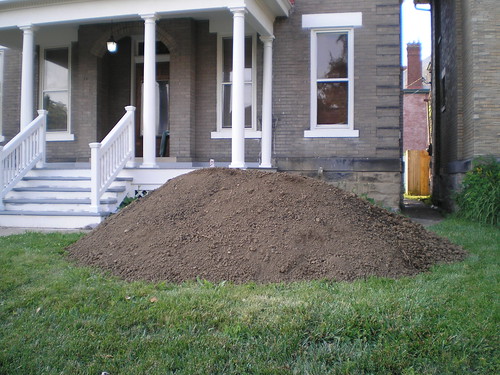
This is a photo of some dirt in a box in the gallery space I'm using as a studio. It is left over from the last show they had here (an exhibition inspired by Robert Smithson - hence the dirt). I've positioned myself right in the corner of the space; jammed up against a window, back to the door like some Feng Shui nightmare.
The rest of the gallery is empty apart from the box of dirt. I'm in opposition to it. It feels notionally more real than me. Like a memento mori; dirt, burial, graves, etc. But maybe it's not a metaphor for death, maybe its just a metaphor for itself - like all objects, they just are what they are. We attach the meaning, the signifying arrows. In that sense all objects are metaphors for death, because when you die you become an object - you become meaningless to yourself, incomprehensible.
An obsession with truth is an obsession with objectivity - how do we see things as they are, not as we think they are? The thinking is inextricably bound up with the seeing - the perceiving. Objects inhabit truth, human subjects fail to perceive it. Once you die, you become an object, and you inhabit truth. You fulfil the dreams of scientific enquiry and cross the border from subjectivity in to objectivity.
I always think that ideas of God are bound up with philosophical ideas of truth. The very impossibility of knowledge is a direct reference to our belief in knowledge; our belief in the existence of objects, in the stability of physical laws, etc.
For those who believe in God, the very incomprehensibility of an infinite, omnipotent being predicates his existence. One of Descartes' proofs of God's existence hinges on the definition of God as something that necessarily exists. The whole rationale of scientific enquiry is predicated on our definition of truth as something that exists, outside of our definition of it.
What I'm basically saying, is that I might keep the box of dirt.
This morning I bought a prawn sandwich from Asda (I've now tried prawn sandwiches from all the main supermarkets - Sainsbury's is the clear winner, but Asda's wasn't too bad. Tesco's has a shameful prawn to mayonnaise ratio.) and then walked to the bus stop. I like getting buses when you don't quite know where you are. I always have to fight the urge to jump off as soon as I see a recognisable landmark.
I walked through town in the vague direction of The Royal Standard and noticed the usual things: empty shop fronts next to hyper branded commercial 'spaces', metal studs on street furniture to stop skaters re-interpreting its use, desperate, windswept for-sale banners hanging forlornly from new build apartments ("Bright, Modern Two Bed Apartment on this Popular Waterfront!").
I like the Radiocity tower that looms over St. John's Garden.
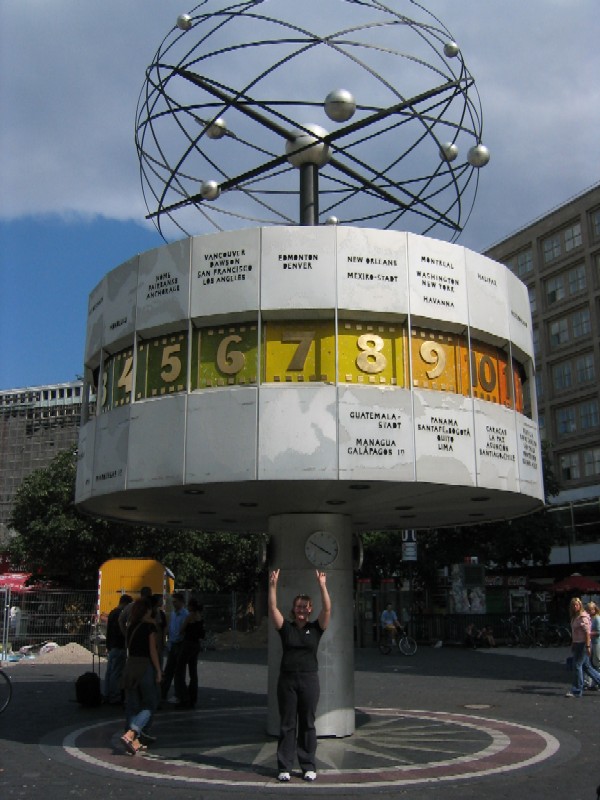
It reminds me a bit of the clock in Alexanderplatz, Berlin.
The communist government always claimed it was an atomic clock, but it was actually just a regular clock with some fancy detailing...
I strolled through the museum quarter and saw these meaty flowers installed in the balconies of the World Museum.
Apparently, at night their air-pumps are turned off and they slowly deflate.
I'm staying with Penny Whitehead and Daniel Simpkins (where I'm sleeping in a bed on stilts - incredibly comfortable until you smack your head off the ceiling), and Penny was talking about how the local council assigns a theme to each year, so 2010 is 'Year of Health and Wellbeing'
I noticed these flags in various places, maybe I'll try and search out as many as I can.
I don't know if you can read the text, but it says, "Connect... Be Active... Take Notice... Keep Learning... Give..."
It even has its own annoying website where you can meaninglessly pledge your support to "acknowledge the importance of the health and wellbeing of our communities".
The only other example of time being branded of which I can think is in the book Infinite Jest by David Foster Wallace. Most of the action takes place in "subsidized time", where each year is known by its corporate sponsor - here is a list I stole from the wiki page on Infinite Jest.
If he paid enough they might even put his head back on...
I walked through town in the vague direction of The Royal Standard and noticed the usual things: empty shop fronts next to hyper branded commercial 'spaces', metal studs on street furniture to stop skaters re-interpreting its use, desperate, windswept for-sale banners hanging forlornly from new build apartments ("Bright, Modern Two Bed Apartment on this Popular Waterfront!").
I like the Radiocity tower that looms over St. John's Garden.
It reminds me a bit of the clock in Alexanderplatz, Berlin.
The communist government always claimed it was an atomic clock, but it was actually just a regular clock with some fancy detailing...
I strolled through the museum quarter and saw these meaty flowers installed in the balconies of the World Museum.
Apparently, at night their air-pumps are turned off and they slowly deflate.
I'm staying with Penny Whitehead and Daniel Simpkins (where I'm sleeping in a bed on stilts - incredibly comfortable until you smack your head off the ceiling), and Penny was talking about how the local council assigns a theme to each year, so 2010 is 'Year of Health and Wellbeing'
I noticed these flags in various places, maybe I'll try and search out as many as I can.
I don't know if you can read the text, but it says, "Connect... Be Active... Take Notice... Keep Learning... Give..."
It even has its own annoying website where you can meaninglessly pledge your support to "acknowledge the importance of the health and wellbeing of our communities".
The only other example of time being branded of which I can think is in the book Infinite Jest by David Foster Wallace. Most of the action takes place in "subsidized time", where each year is known by its corporate sponsor - here is a list I stole from the wiki page on Infinite Jest.
- Year of the Whopper
- Year of the Tucks Medicated Pad
- Year of the Trial-Size Dove Bar
- Year of the Perdue Wonderchicken
- Year of the Whisper-Quiet Maytag Dishmaster
- Year of the Yushityu 2007 Mimetic-Resolution-Cartridge-View-Motherboard-Easy-To-Install-Upgrade For Infernatron/InterLace TP Systems For Home, Office Or Mobile [sic]
- Year of Dairy Products from the American Heartland
- Year of the Depend Adult Undergarment
- Year of Glad
If he paid enough they might even put his head back on...
The Royal Standard
I'm the resident artist at The Royal Standard, Liverpool from today until the 9th August. As I did for my residency at The Lombard Method, I'll be blogging daily.
I'm not sure quite what I'll be doing for the next three weeks, but I know that I want to present a short performative lecture, and possibly a series of videos. I might even do a few drawings.
Anyway, just saying hi for now. I'll be back tomorrow.
I'm the resident artist at The Royal Standard, Liverpool from today until the 9th August. As I did for my residency at The Lombard Method, I'll be blogging daily.
I'm not sure quite what I'll be doing for the next three weeks, but I know that I want to present a short performative lecture, and possibly a series of videos. I might even do a few drawings.
Anyway, just saying hi for now. I'll be back tomorrow.
Graeme Patterson is an animator based in Newcastle. I've put his stuff on here before. This is a video he made for a band called Ever Since the Lake Caught Fire.
He is going to make a video for a Dogtanion single that will come out in October called Islam. I look forward to it...
Obviously, it isn't Saturday, which is the day I should have been writing this for it to really count as relevant, but hey ho. I had a really busy weekend. On Saturday we took down the show at the Lombard Method, and then drove straight to Manchester where I was giving a lecture about Mark Speight at Islington Mill's Mill24 event. On Sunday we drove back down to London for the Artists in Conversation event at {Empty Sets} (Which is still on by the way - till Sunday 13th of June), which I compered and thoroughly enjoyed. Then yesterday Tape Club Records took part in the D.I.Y Day event at the Old Queens Head. I played four sets, one as Dogtanion, and then helping out Mr. James Bright, Peter Lyons and Kerry Leatham. It was nice to catch up with the Tape Club peoples after what felt like a long musical hiatus.
But, as this is technically the Lombard Residency blog, I'll focus on that...
Installation view of Possible Monuments at The Lombard Method
The opening was great - boozey and interesting. Gavin Wade from Eastside Projects came early and gave a very positive twitter review!
I feel like the idea of artworks as monuments or public sculpture is a really exciting way of re-imagining objects. A new way of contextualising ready-mades. I was thinking of a group exhibition, maybe called Possible Monuments again, I'd definitely include some of Graham Hudson's proposals for public works.
Monument to Cliff Richard's Eternal Flame (pissing fire), drawing, 2010 + detail
Monument to the Varied Failings of Our Public Transport System, drawing and maquette, 2010 + detail
I'll get more photos up when I have the hi-res versions. In that room, I had three maquettes and 8 drawings. In the other room, I had a video installation. With a digital projection of a video (which you can watch below), a crap fan and a Dora the Explorer balloon.
No Public Right of Way, digital video, 2010 + installation shot
I met a Polish curator who was shocked that the Solidarity union in the U.K. was a nationalist group with racist affiliations. She was doing a project on the Polish Solidarity union, the first non-communist trade union in Poland, whose actions helped semi-free elections happen in Poland in 1989. Apparently the U.K. Solidarity has copied the style of the Polish Solidarity's insignia, even down to the typeface used.
---
Thanks very much to The Lombard Method, and everyone who came to see the show. I really enjoyed my time in your city and I hope to be back soon.
But, as this is technically the Lombard Residency blog, I'll focus on that...
Installation view of Possible Monuments at The Lombard Method
The opening was great - boozey and interesting. Gavin Wade from Eastside Projects came early and gave a very positive twitter review!
I feel like the idea of artworks as monuments or public sculpture is a really exciting way of re-imagining objects. A new way of contextualising ready-mades. I was thinking of a group exhibition, maybe called Possible Monuments again, I'd definitely include some of Graham Hudson's proposals for public works.
Monument to Cliff Richard's Eternal Flame (pissing fire), drawing, 2010 + detail
Monument to the Varied Failings of Our Public Transport System, drawing and maquette, 2010 + detail
I'll get more photos up when I have the hi-res versions. In that room, I had three maquettes and 8 drawings. In the other room, I had a video installation. With a digital projection of a video (which you can watch below), a crap fan and a Dora the Explorer balloon.
No Public Right of Way, digital video, 2010 + installation shot
I met a Polish curator who was shocked that the Solidarity union in the U.K. was a nationalist group with racist affiliations. She was doing a project on the Polish Solidarity union, the first non-communist trade union in Poland, whose actions helped semi-free elections happen in Poland in 1989. Apparently the U.K. Solidarity has copied the style of the Polish Solidarity's insignia, even down to the typeface used.
---
Thanks very much to The Lombard Method, and everyone who came to see the show. I really enjoyed my time in your city and I hope to be back soon.
I am sitting on a stool (we had to take all the chairs back to Eastside Projects) in a room full of cardboard and ripped up paper. I feel like an art gerbil. An art gerbil that has been forced to clear up its mess and is realising that its careless abandon wrt/ its placement of waste paper and cardboard could now be construed as somewhat of a mistake. No matter, that is what the day of an opening is all about - doing all the shit jobs.
I'm re-editing my film, so it won't quite be the nine minute marathon that I was planning. But it might make more sense.
Then I just have to change out of my dusty clothes, and nervously talk to people whilst secretly looking at them looking at my art and cursing them/myself/the art for not putting the effort in/enjoying the art/being easier to enjoy.
---
Last night we went to a curators' talk at Eastside Projects. Robert Blackson, who is the public programme curator at Nottingham Contemporary and Morgan Quaintance, the Inspire fellow at IKON Gallery from MA in Curating, RCA. I've met Morgan before,at 176 who have close links with RCA curation students. Robert Blackson was a curator at the Baltic between 2007-2009, so I'm sure I would have seen some of the shows he worked on when I was in Newcastle.
They were both really interesting guys. Morgan explained how his background is in music and his move in to curating art was guided by an interest in contemporary dance and theatre. He spoke about his intuitive approach to art and his love of 'new interiorities', which from what I can gather, means the explication of an entire subjective world. He showed part of Matthew Barney's Cremaster as an example of what he meant by this, and it seemed to me that what he meant was maybe a more technically explained version of Dave Hickey's theories of art as cool stuff in a room. He did then mention the idea of taste ("you either have taste or you don't), which seemed a bit odd as the concept of taste feels to me less like a natural state and more like aesthetic sparring between the classes.
Robert Blackson gave some readings from books and spoke about a few projects he had been working on. He asked us to fill out forms to become blood donors, so that he could apply to get Nottingham Contemporary turned in to a blood bank for an upcoming exhibition. As Jo later said, he had a soothing voice and it was nice to just listen to him speak. I asked him whether the recession would mean slashed budgets for 'public programming' (events, live art, interactions), and what that meant for a field of art making and curation that has become more and more prominent within large institutions, but never seems to take centre stage. He made some defensive noises about this being an interesting and useful time, but also said that he would never subjugate what he did to education, which is the one thing in art that is guaranteed funding. I felt that was laudable, and something I certainly agree with in principle, but the pragmatic nature of artistic careers (especially for curators on good salaries) means that I couldn't totally believe him.
Then we moved on to the Florian Hecker show at Ikon Eastside which was great. Though we didn't have enough time to appreciate the whole exhibition piece by piece (and, I think, there were probably too many people in the room to really experience it), I was really impressed by the seriousness with which the show was curated and the sound allowed to stand alone, with very little accompanying information, and no distracting information panels. Sparse and beautiful. And also painful at times. It reminded be a little of Louie Rice's piece at {Empty Sets}, but maybe that's a lazy comparison and an easy plug...
---
Right I suppose I better do some work, otherwise the blog doesn't mean a damn thing.
see you tonight!
Matthew de Kersaint Giraudeau
Possible Monuments
6pm-9pm,
The Lombard Method
68a Lombard St
Digbeth
Birmingham
B12 0QR
I'm re-editing my film, so it won't quite be the nine minute marathon that I was planning. But it might make more sense.
Then I just have to change out of my dusty clothes, and nervously talk to people whilst secretly looking at them looking at my art and cursing them/myself/the art for not putting the effort in/enjoying the art/being easier to enjoy.
---
Last night we went to a curators' talk at Eastside Projects. Robert Blackson, who is the public programme curator at Nottingham Contemporary and Morgan Quaintance, the Inspire fellow at IKON Gallery from MA in Curating, RCA. I've met Morgan before,at 176 who have close links with RCA curation students. Robert Blackson was a curator at the Baltic between 2007-2009, so I'm sure I would have seen some of the shows he worked on when I was in Newcastle.
They were both really interesting guys. Morgan explained how his background is in music and his move in to curating art was guided by an interest in contemporary dance and theatre. He spoke about his intuitive approach to art and his love of 'new interiorities', which from what I can gather, means the explication of an entire subjective world. He showed part of Matthew Barney's Cremaster as an example of what he meant by this, and it seemed to me that what he meant was maybe a more technically explained version of Dave Hickey's theories of art as cool stuff in a room. He did then mention the idea of taste ("you either have taste or you don't), which seemed a bit odd as the concept of taste feels to me less like a natural state and more like aesthetic sparring between the classes.
Robert Blackson gave some readings from books and spoke about a few projects he had been working on. He asked us to fill out forms to become blood donors, so that he could apply to get Nottingham Contemporary turned in to a blood bank for an upcoming exhibition. As Jo later said, he had a soothing voice and it was nice to just listen to him speak. I asked him whether the recession would mean slashed budgets for 'public programming' (events, live art, interactions), and what that meant for a field of art making and curation that has become more and more prominent within large institutions, but never seems to take centre stage. He made some defensive noises about this being an interesting and useful time, but also said that he would never subjugate what he did to education, which is the one thing in art that is guaranteed funding. I felt that was laudable, and something I certainly agree with in principle, but the pragmatic nature of artistic careers (especially for curators on good salaries) means that I couldn't totally believe him.
Then we moved on to the Florian Hecker show at Ikon Eastside which was great. Though we didn't have enough time to appreciate the whole exhibition piece by piece (and, I think, there were probably too many people in the room to really experience it), I was really impressed by the seriousness with which the show was curated and the sound allowed to stand alone, with very little accompanying information, and no distracting information panels. Sparse and beautiful. And also painful at times. It reminded be a little of Louie Rice's piece at {Empty Sets}, but maybe that's a lazy comparison and an easy plug...
---
Right I suppose I better do some work, otherwise the blog doesn't mean a damn thing.
see you tonight!
Matthew de Kersaint Giraudeau
Possible Monuments
6pm-9pm,
The Lombard Method
68a Lombard St
Digbeth
Birmingham
B12 0QR
WOW I am hungover. I just ate some food and now I feel slightly else nauseous.
Writing this today is just a way of putting off the inevitable cleaning and arranging of the two exhibition spaces. I finished the film yesterday. It's a bit epic for me, almost nine minutes long. I need to arrange wooden boards around the room to which I'll stick my drawings, and create a plinth-esque shape out of this trestle table and some cardboard. So that is the situation.
---
Ikon Eastside opening tonight of Florian Hecker's audio installation. I missed it at the Chisenhale space, so I'm glad I've got the chance to see/hear it.
Urgh, I promise I'll write more tomorrow, but at the moment I'm just trying not to vomit on the screen.
Writing this today is just a way of putting off the inevitable cleaning and arranging of the two exhibition spaces. I finished the film yesterday. It's a bit epic for me, almost nine minutes long. I need to arrange wooden boards around the room to which I'll stick my drawings, and create a plinth-esque shape out of this trestle table and some cardboard. So that is the situation.
---
Ikon Eastside opening tonight of Florian Hecker's audio installation. I missed it at the Chisenhale space, so I'm glad I've got the chance to see/hear it.
Urgh, I promise I'll write more tomorrow, but at the moment I'm just trying not to vomit on the screen.
So, Xu Zhen last night at Ikon. I got it slightly wrong yesterday when I said Xu Zhen was impersonating a fictional group of Middle Eastern artists. Actually, Madeln, which is an artists' collective, based in Shanghai and founded by Xu Zhen (but with no other known members...) are impersonating a fictional group of Middle Eastern artists.
I thought the idea of impersonating a group of Middle Eastern artists would be an interesting way to explore the political, economic and religious assumptions that outsiders make when assessing the region as a whole. I really enjoyed Keep Me Calmed (Down), 2009, a carpet of rubble that undulates and rolls as if it was breathing (achieved with a lot of bricks, a very strong water bed and a motor, apparently). The way it moved was like the stomach churning hallucinations of food poisoning or a mushroom trip.
I wasn't so sure about the various wall hangings; quilted pieces called Collages (2009). They are satirical and cartoonish, but totally chaotic. The way they play with the conventions of newspaper cartoons remind me of the 'physical cartoons' from The Day Today, or maybe the editorial cartoons from The Onion.
But I was a little unsure if they are meant to be a satire on bad satire, or whether they are just bad satire?
The other worrying thing about the exhibition as a whole is the idea of the fictional group being Middle Eastern, rather than having specific nationalities, either as a group, or as (pretend) individuals. It feels to me as though Xu Zhen (or Madeln, if they are more than just Xu Zhen) made the work and then applied the fictional context of the Middle Eastern artists as a safety mechanism; like an irony filter for the gallery visitors. It is though he/they are worried that gallery visitors might get upset at the crass depictions of suicide bombers, as though Middle Eastern artists have more of a right to be simplistic about their own situation.
Another problem is with Ikon's website. They can't decide whether 'Madeln', or 'MadeIn' is the correct spelling of the artists' collective founded by Xu Zhen. 'MadeIn' references the idea of things being 'made in China', but the spellings seem to be interchangeable on the site.
But The Colour of Heaven, 2009, reproduced below, was beautiful, and the wine was cold. So apart from my easily understandable (and perhaps expected, or courted?) misgivings about the origins of the work, I was pretty happy.
The Colour of Heaven, 2009. Image via Ikon's site, courtesy of the artist and ShangART gallery, Shanghai.
Then I went back to the studios, cooked a microwavable cottage pie, and dropped it on the floor.
---
Yesterday I took many photos of many bad public sculptures. I saw Nick Griffin speaking at a meeting of the nationalist trade union, Solidarity (wouldn't want them representing me at a race discrimination tribunal...). I also got given a Scientology personality test. Most of the questions are designed to make you feel uneasy, positioning quite natural human responses as possible causes of unhappiness. Some of the questions have completely unwarranted quotation marks and some of them make no sense at all. Here are a few examples.
Q43: If you saw an article in a shop obviously mistakenly marked lower than its correct price, would you try to get it at that price?
Q162: Would you like to "start a new activity" in the area in which you live?
Q81: Are you usually undisturbed by "noises off" when you are trying to rest?
---
Today I'm going to put the film together, assemble the last of the sculptures and start clearing up the space for tomorrow's install.
I thought the idea of impersonating a group of Middle Eastern artists would be an interesting way to explore the political, economic and religious assumptions that outsiders make when assessing the region as a whole. I really enjoyed Keep Me Calmed (Down), 2009, a carpet of rubble that undulates and rolls as if it was breathing (achieved with a lot of bricks, a very strong water bed and a motor, apparently). The way it moved was like the stomach churning hallucinations of food poisoning or a mushroom trip.
I wasn't so sure about the various wall hangings; quilted pieces called Collages (2009). They are satirical and cartoonish, but totally chaotic. The way they play with the conventions of newspaper cartoons remind me of the 'physical cartoons' from The Day Today, or maybe the editorial cartoons from The Onion.
But I was a little unsure if they are meant to be a satire on bad satire, or whether they are just bad satire?
The other worrying thing about the exhibition as a whole is the idea of the fictional group being Middle Eastern, rather than having specific nationalities, either as a group, or as (pretend) individuals. It feels to me as though Xu Zhen (or Madeln, if they are more than just Xu Zhen) made the work and then applied the fictional context of the Middle Eastern artists as a safety mechanism; like an irony filter for the gallery visitors. It is though he/they are worried that gallery visitors might get upset at the crass depictions of suicide bombers, as though Middle Eastern artists have more of a right to be simplistic about their own situation.
Another problem is with Ikon's website. They can't decide whether 'Madeln', or 'MadeIn' is the correct spelling of the artists' collective founded by Xu Zhen. 'MadeIn' references the idea of things being 'made in China', but the spellings seem to be interchangeable on the site.
But The Colour of Heaven, 2009, reproduced below, was beautiful, and the wine was cold. So apart from my easily understandable (and perhaps expected, or courted?) misgivings about the origins of the work, I was pretty happy.
The Colour of Heaven, 2009. Image via Ikon's site, courtesy of the artist and ShangART gallery, Shanghai.
Then I went back to the studios, cooked a microwavable cottage pie, and dropped it on the floor.
---
Yesterday I took many photos of many bad public sculptures. I saw Nick Griffin speaking at a meeting of the nationalist trade union, Solidarity (wouldn't want them representing me at a race discrimination tribunal...). I also got given a Scientology personality test. Most of the questions are designed to make you feel uneasy, positioning quite natural human responses as possible causes of unhappiness. Some of the questions have completely unwarranted quotation marks and some of them make no sense at all. Here are a few examples.
Q43: If you saw an article in a shop obviously mistakenly marked lower than its correct price, would you try to get it at that price?
Q162: Would you like to "start a new activity" in the area in which you live?
Q81: Are you usually undisturbed by "noises off" when you are trying to rest?
---
Today I'm going to put the film together, assemble the last of the sculptures and start clearing up the space for tomorrow's install.
Matthew de Kersaint Giraudeau
Possible Monuments
at THE LOMBARD METHOD
Private view: Friday 28th May 6-9pm
For Possible Monuments, Matthew de Kersaint Giraudeau will present a one day exhibition at The Lombard Method consisting of proposals and maquettes for commemorative sculptures, as well as a video installation examining the role of sculpture in the public realm.
The proposals include a Monument to Sir Cliff Richard’s Eternal Flame (Pissing Fire) and a Maquette for a Monument to the Travellers who Stole a Henry Moore Sculpture and Melted it Down and Sold it For Scrap. The video installation uses videos and a spoken narrative to explore questions such as; why is there a Frank Zappa sculpture in Vilnius, Lithuania? And why does the Cerne Giant in Dorset have such an enormous erection?
------------------------------------------------
Actually, the video installation probably won't explore those questions, but it's a bit late to change it now. Hopefully no one will read the press release too closely.
The work I've been doing over the past week and a half is very different from the work I had planned to do. I had envisaged a lot of large detritus sculptures, displayed alongside drawings of hypothetical objects, and then a short performance lecture on the problems of scale. Instead of that I have focused exclusively on public sculpture and monuments. The lecture has become a video installation and the sculptures have become cardboard maquettes.
On my first night at the Lombard I gave a short presentation on my previous work, and then tried to explain the general themes of the residency. We ended up exchanging stories of the worst public sculpture we had seen, with everyone giving me local examples that I could look up. I'm not sure how conversation turned to public sculpture. I suppose I must have used it as an example of the problems of scaling up work, and then the example became much more meaningful than the more abstract idea that it was meant to illustrate.
I'm glad I found a specific theme, I'm not very good with generalities. I do enjoy grappling with the slippery ghost of abstraction, but I find that there is more humour and certainly more humanity in the soft, dusty skin of specific events and objects.
http://en.wikipedia.org/wiki/Synecdoche
Good word that.
---
So today I might take a walk through the city, taking the photos for the video, buy a cheap fan to blow a single balloon around the installation, put together my cardboard bus and perhaps make it a shelf to sit on.
Then tonight we are going to Ikon to see the new Xu Zhen exhibition in which he impersonates a fictional group of artists from the Middle East. What interests me is the void at the centre of that work, the emptiness at the heart of every fictional context. Not only because of the possibilities of what could fill such a vacuum, but also because it allows me to shamelessly plug the show I have curated, {Empty Sets}, that is still running at Waterside Projects in London. In fact, there is an Artists in Conversation event that I am chairing on Sunday at 3pm. How convenient.
Possible Monuments
at THE LOMBARD METHOD
Private view: Friday 28th May 6-9pm
For Possible Monuments, Matthew de Kersaint Giraudeau will present a one day exhibition at The Lombard Method consisting of proposals and maquettes for commemorative sculptures, as well as a video installation examining the role of sculpture in the public realm.
The proposals include a Monument to Sir Cliff Richard’s Eternal Flame (Pissing Fire) and a Maquette for a Monument to the Travellers who Stole a Henry Moore Sculpture and Melted it Down and Sold it For Scrap. The video installation uses videos and a spoken narrative to explore questions such as; why is there a Frank Zappa sculpture in Vilnius, Lithuania? And why does the Cerne Giant in Dorset have such an enormous erection?
------------------------------------------------
Actually, the video installation probably won't explore those questions, but it's a bit late to change it now. Hopefully no one will read the press release too closely.
The work I've been doing over the past week and a half is very different from the work I had planned to do. I had envisaged a lot of large detritus sculptures, displayed alongside drawings of hypothetical objects, and then a short performance lecture on the problems of scale. Instead of that I have focused exclusively on public sculpture and monuments. The lecture has become a video installation and the sculptures have become cardboard maquettes.
On my first night at the Lombard I gave a short presentation on my previous work, and then tried to explain the general themes of the residency. We ended up exchanging stories of the worst public sculpture we had seen, with everyone giving me local examples that I could look up. I'm not sure how conversation turned to public sculpture. I suppose I must have used it as an example of the problems of scaling up work, and then the example became much more meaningful than the more abstract idea that it was meant to illustrate.
I'm glad I found a specific theme, I'm not very good with generalities. I do enjoy grappling with the slippery ghost of abstraction, but I find that there is more humour and certainly more humanity in the soft, dusty skin of specific events and objects.
http://en.wikipedia.org/wiki/Synecdoche
Good word that.
---
So today I might take a walk through the city, taking the photos for the video, buy a cheap fan to blow a single balloon around the installation, put together my cardboard bus and perhaps make it a shelf to sit on.
Then tonight we are going to Ikon to see the new Xu Zhen exhibition in which he impersonates a fictional group of artists from the Middle East. What interests me is the void at the centre of that work, the emptiness at the heart of every fictional context. Not only because of the possibilities of what could fill such a vacuum, but also because it allows me to shamelessly plug the show I have curated, {Empty Sets}, that is still running at Waterside Projects in London. In fact, there is an Artists in Conversation event that I am chairing on Sunday at 3pm. How convenient.
I'm tired. I'm wearing nylon trousers and it is really hot. I have to have the windows open but the roadworks outside are oppressively loud. I am hitting a wall. An art wall. Like when you run a marathon. This is an art marathon. I can't think straight, my movements are sluggish and I am sweating like cheese in a plastic bag.
Today I'm going to do more drawings, possibly inspired by a book of Roald Dahl's erotic fiction, possibly not. I'm definitely going to plan a monument to waste of some kind (maybe plastic bags or dog poo), and maybe expand an idea about preserving iconic parts of our natural landscape by boxing them in with MDF and providing a viewing window made of plexi-glass.
Yesterday we went to Manchester to pick up a bit of Sarah's work that was in a Future Everything exhibition. The we ate an ice cream. Then we drove to Tatton Park and looked at sheep and deer. I ate a large sandwich and then we drove home. It was good to have a break from making, but I feel like I have a lot to do this week. I've got write and record the narration for the video, take pictures for the visual element of the piece, find a fan to install along with the video (+ plastic bags + balloons), make more drawings with which I'm happy enough to display and possibly make another maquette. Blimey o'fucking riley.
Anyhow, best not get bogged down in what I've got to do. Go about your business. Here is a picture of a cow with six legs and dog with three heads.
Today I'm going to do more drawings, possibly inspired by a book of Roald Dahl's erotic fiction, possibly not. I'm definitely going to plan a monument to waste of some kind (maybe plastic bags or dog poo), and maybe expand an idea about preserving iconic parts of our natural landscape by boxing them in with MDF and providing a viewing window made of plexi-glass.
Yesterday we went to Manchester to pick up a bit of Sarah's work that was in a Future Everything exhibition. The we ate an ice cream. Then we drove to Tatton Park and looked at sheep and deer. I ate a large sandwich and then we drove home. It was good to have a break from making, but I feel like I have a lot to do this week. I've got write and record the narration for the video, take pictures for the visual element of the piece, find a fan to install along with the video (+ plastic bags + balloons), make more drawings with which I'm happy enough to display and possibly make another maquette. Blimey o'fucking riley.
Anyhow, best not get bogged down in what I've got to do. Go about your business. Here is a picture of a cow with six legs and dog with three heads.
Not much time to write today, I'm off to Manchester with a few of the Lombardiers. Here is some text that might end up as part of the narration in the video installation I do for the show.
There are no chips
no cigarettes
no fanta orange
and no plastic chairs.
There is no man on crutches
with an open shirt,
tattoos,
and an impressive moustache.
There is no girl in denim pedal pushers,
in high heels that visibly cause her pain,
near a man who sells the helium balloons.
There is no smell of vinegar.
---
And here is a youtube video of an artist messing around with a computer program that turns him in to a crap sculpture. Note the odd noises he makes to change the arrangement of the objects.
There are no chips
no cigarettes
no fanta orange
and no plastic chairs.
There is no man on crutches
with an open shirt,
tattoos,
and an impressive moustache.
There is no girl in denim pedal pushers,
in high heels that visibly cause her pain,
near a man who sells the helium balloons.
There is no smell of vinegar.
---
And here is a youtube video of an artist messing around with a computer program that turns him in to a crap sculpture. Note the odd noises he makes to change the arrangement of the objects.
SATURDAY, SATURDAY... SATURDAY!!!
What do you do on a residency on a Saturday? I feel a bit cheeky laying around the studio in my pants, reading every section from the Guardian apart from the actual news...
I'll just restrict myself to reading an interview with Lady Gaga from the Saturday Times website. Sigh.
Right, so yesterday I spray painted this Henry Moore sculpture gold, but it look sort of silver and gold because I bought cheap spray paint. That's alright, it goes with the wonky, bad paper mache of the piece. I've had to fashion a huge, golden, cardboard penis to cover the hose pipe for the water feature.
With water features, I feel like I've found my spiritual home. This absurd gesture of pushing water through a hose just so it can fall back down in to a pond or whatever and then get sucked back up is a nihilistic confirmation; eternal recurrence. But a confirmation that feels very accepting. And that feels, in turn quite particular to British sensibilities.
John Gray (not the John Gray who wrote Men are From Mars; Women are From Venus, not him. The other John Gray, who wrote Straw Dogs and Enlightenment's Wake which is what this next paragraph liberally paraphrases. Though I would be interested in setting up a meeting between these two philosophical giants and seeing what comes of it...) talks about finding coherent ideas of belonging in a multi-cultural society, about the acceptance of difference through the acceptance of realistic core agreements (yeah, I think I've not only liberally paraphrased him, but badly too). I would definitely say that acceptance in the face of impotence is a core feature of British society.
---
I'm off to Maplins to buy a motor for a maquette of Monument to Sir Cliff Richards Unborn Baby. It's going to be a wooden pole with a spinning cardboard cut-out of a baby's face, only with the features of Sir Cliff Richard.
I've been looking for youtube videos about public sculpture, especially in Birmingham. There is a Birmingham in Alabama, and so I inevitably stumbled upon this.
The video is Tony Hancock in The Rebel, 1961. And the picture below is of the Tony Hancock sculpture by Bruce Williams, 1996, which sits in Old Square in Birmingham.
My first year tutor at Northumbria showed us all that film when we started university. I can't think why. As far as I remember it just seemed to take the piss out of the whole idea of being an artist. I think he wanted to warn us of the pitfalls of pretension but it might have backfired.
My tutor was from somewhere round here. Not Birmingham, but maybe one of the surrounding towns. Anyhow, he was a lovely guy, and for me and a few other students, he was a good tutor. He challenged our arrogance and assumption at every opportunity. But for others, those who maybe just needed nudging in the other direction, towards tougher decisions and more commitment to their ideas, he was an awful presence. His main mode of critical reflection was piss taking, and he veered from wildly liberal ideas about the content of art, to super conservative views on skill and the value of various methods of production.
He left halfway through my second year (and halfway through the first year students' term, leaving them with no tutor for half an academic year, which was a bit of a shit...). His ex-wife died and left him everything, so he retired, set up a studio and drew cartoons for the local paper. I saw him a few times after that. He was much happier, at the pub, going to gigs, or at his studio listening to records and drawing. He had a beautiful girlfriend as I remember. Art stressed him out.
------
Yesterday I began to construct a maquette for a monument to the stolen Henry Moore sculpture. I'm not very good at paper macheing. I seem to have an in built capacity for failure when it comes to handy crafts. No matter, I'm looking forward to seeing it finished, all wonky and peeling as it pisses into itself, sat on a dodgy plinth.
I also attended a group grit held at the Lombard Method by people from Eastside Projects. We all looked at work by Matt Foster and Kate Hattley.
Gavin Wade, Ruth Claxton and Elizabeth Rowe from Eastside seemed to be the main sources of critical feedback. I was really interested in the debate that developed around Matt's work with geometric shapes; the implications of an artist getting involved in a discipline such as mathematics and how to counter what can become a sort of scientific orientalism.
I mentioned Junto, the artist's group I am involved in, and the Liz Lurman technique, a method for structuring critical discussion that we often use. It begins with neutral statements before moving on to questions and finally to opinions. The crit last night had a visceral quality which I liked. The first thing Robin Kirkham, of An Endless Supply, told Matt about his work was that he didn't like it, which I thought was quite an exciting, if confrontational, way to start a crit.
Anyway, no blood was spilled and the artists were very happy with the feedback. We drank beer on their roof until late, and then walked home. I ate some chicken. It was of poor quality.
The room isn't so quiet today. I opened the window and now I can hear the road works that are happening right outside.
Yesterday I went to Homebase, bought a water pump for one of the monuments, hooked up the water pump to test it out, shot water all over the room and realised that the water pump is pretty powerful. I also designed a possible monument for when Cliff Richard dies (although, as Sarah pointed out to me, that may well never happen).
I also sat around a lot and got freaked out by what I was doing, which I feel is probably quite normal for this sort of thing. Although this is the first sustained (i.e. more than two or three day) residency I've done, so I don't know how I worked that out. But focusing on a single body of work, every day, all the time, is totally different to how I normally work. I usually have about five different projects on the go, along with making music, playing gigs and working at the gallery, so I don't have to get to the freak out stage - I can just flip between things and not got bored. This sustained pressure to keep the same lines of enquiry open, and yet still feel inventive and interested, is quite a tiring way to work. Tiring but worthwhile. I think.
Anyway, I was thinking about titles for the show as I'll have to write a press release to send out (the announcement of my residency is up here). The focus has shifted almost entirely to monuments now, so here are the choices. Perhaps someone else could pick on the basis of what sounds coolest?
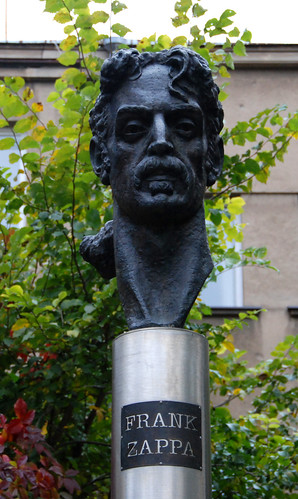
After my post yesterday, someone pointed out that in Vilnius, Lithuania they have a statue of Frank Zappa. No one knows why.
Actually, that isn't true. Some people know why, but it isn't a very good reason. The guy who made the bust is an old sculptor who worked in the Soviet era, so he did it in the style of his busts of Lenin etc. That is probably why he looks so sombre and powerful.
Today I will:
Yesterday I went to Homebase, bought a water pump for one of the monuments, hooked up the water pump to test it out, shot water all over the room and realised that the water pump is pretty powerful. I also designed a possible monument for when Cliff Richard dies (although, as Sarah pointed out to me, that may well never happen).
I also sat around a lot and got freaked out by what I was doing, which I feel is probably quite normal for this sort of thing. Although this is the first sustained (i.e. more than two or three day) residency I've done, so I don't know how I worked that out. But focusing on a single body of work, every day, all the time, is totally different to how I normally work. I usually have about five different projects on the go, along with making music, playing gigs and working at the gallery, so I don't have to get to the freak out stage - I can just flip between things and not got bored. This sustained pressure to keep the same lines of enquiry open, and yet still feel inventive and interested, is quite a tiring way to work. Tiring but worthwhile. I think.
Anyway, I was thinking about titles for the show as I'll have to write a press release to send out (the announcement of my residency is up here). The focus has shifted almost entirely to monuments now, so here are the choices. Perhaps someone else could pick on the basis of what sounds coolest?
- Possible Monuments
- Impossible Monuments
- Hypothetical Monuments
- Contiguous Monuments
- Infeasible Monuments and Hypothetical Objects
After my post yesterday, someone pointed out that in Vilnius, Lithuania they have a statue of Frank Zappa. No one knows why.
Actually, that isn't true. Some people know why, but it isn't a very good reason. The guy who made the bust is an old sculptor who worked in the Soviet era, so he did it in the style of his busts of Lenin etc. That is probably why he looks so sombre and powerful.
Today I will:
- Get loads of cardboard from the market
- Build my monument to the stolen Henry Moore statue
- Phone West Midlands Transport to see if I can rent a bus for a night
- Eat a sandwich
- Do the Guardian Crossword
I'm sat in the quiet room again, with a little bit of a headache and a dry mouth. A warm and small hangover muddles my head, which I think is good for art. I'm making things today, and you never want to over think whilst using paper mache.
Yesterday I designed ideas for public monuments: a few I'm building maquettes for, some that may well just stay in the design stages and one that might actually materialise on the day of the preview (28th May), if we are really lucky.
I won't go in to details until I have some pictures but there seems to be a theme of apology and failure, ideas that are definitely under-monumentalised. I like the idea of a temporary monument, or maybe a permanent but ephemeral monument, always on the move. Or a monument that destroys the value of the thing you are trying to celebrate.
There is a statue of Lord Horatio Nelson in the centre of Birmingham, surrounded by the redeveloped shopping area. This austere monument feels like an archaic way of celebrating in the midst of the glass fronted shops and the lattes and the Maclaren buggies. It is so singular and conservative compared to the dream of the high rise shopping centre - ultimate choice, ultimate freedom. Nelson and his bronze buddies are no longer the focal points of our towns and cities. There is no focal point, there is just flat, democratic choice: the equality of the high street.
I read the information board strapped to the railings surrounding Nelson. The statue was funded entirely through a public appeal to the working class of Birmingham; they were happy to give what they could to fund a statue to commemorate a brave hero of the seas. But what and who did Nelson really represent? Colonialism, imperialism and the privileged. Why were the working class appealed to? He was someone's hero, but how was he their hero?
When the credit crisis befell our great nation in 2008, we, as a society were berated for being tight arses. If we hadn't suddenly stopped spending, they said, then the crisis would never have happened. Of course, most people stopped spending because of the fear of defaulting on their loans, their credit cards and their mortgages, and the real problem, as we later learned, was not a failure of people to spend, but the willingness of the banks to lend, and the irresponsible and intensely selfish behaviour of people working in the financial industry.
This obsession with increasing speculative worth without increasing actual worth was a blind, abstracted way of making money, and it came from the obsession and reliance that government had/has on economic growth as proof of societal progress (and also, ironically, as the basis for expanding national debt).
The new and shiny town centres - not just Birmingham, but also Newcastle, Leeds, Manchester and Cardiff to name a few - were crucial to the government's idea of re-branding industrial cities as centres for consumption; monuments to capitalism. We were given a new town centre, a Starbucks (and a Caffe Nero, and a Costa), and cheap credit. But we had to pay for this style of regeneration. We had to spend our credit on supporting the businesses who filled our high streets, often corporations whose profits left the local area as soon as they entered the till.
And then, with the credit crunch and subsequent recession, we had to pay again for the obsession with growth, regeneration and speculation. We paid with sudden bankruptcy, house repossession and job losses. And soon we will pay with cuts in public spending and essential services.
We always pay for their monuments, but they don't always pay us back.
Yesterday I designed ideas for public monuments: a few I'm building maquettes for, some that may well just stay in the design stages and one that might actually materialise on the day of the preview (28th May), if we are really lucky.
I won't go in to details until I have some pictures but there seems to be a theme of apology and failure, ideas that are definitely under-monumentalised. I like the idea of a temporary monument, or maybe a permanent but ephemeral monument, always on the move. Or a monument that destroys the value of the thing you are trying to celebrate.
There is a statue of Lord Horatio Nelson in the centre of Birmingham, surrounded by the redeveloped shopping area. This austere monument feels like an archaic way of celebrating in the midst of the glass fronted shops and the lattes and the Maclaren buggies. It is so singular and conservative compared to the dream of the high rise shopping centre - ultimate choice, ultimate freedom. Nelson and his bronze buddies are no longer the focal points of our towns and cities. There is no focal point, there is just flat, democratic choice: the equality of the high street.
I read the information board strapped to the railings surrounding Nelson. The statue was funded entirely through a public appeal to the working class of Birmingham; they were happy to give what they could to fund a statue to commemorate a brave hero of the seas. But what and who did Nelson really represent? Colonialism, imperialism and the privileged. Why were the working class appealed to? He was someone's hero, but how was he their hero?
When the credit crisis befell our great nation in 2008, we, as a society were berated for being tight arses. If we hadn't suddenly stopped spending, they said, then the crisis would never have happened. Of course, most people stopped spending because of the fear of defaulting on their loans, their credit cards and their mortgages, and the real problem, as we later learned, was not a failure of people to spend, but the willingness of the banks to lend, and the irresponsible and intensely selfish behaviour of people working in the financial industry.
This obsession with increasing speculative worth without increasing actual worth was a blind, abstracted way of making money, and it came from the obsession and reliance that government had/has on economic growth as proof of societal progress (and also, ironically, as the basis for expanding national debt).
The new and shiny town centres - not just Birmingham, but also Newcastle, Leeds, Manchester and Cardiff to name a few - were crucial to the government's idea of re-branding industrial cities as centres for consumption; monuments to capitalism. We were given a new town centre, a Starbucks (and a Caffe Nero, and a Costa), and cheap credit. But we had to pay for this style of regeneration. We had to spend our credit on supporting the businesses who filled our high streets, often corporations whose profits left the local area as soon as they entered the till.
And then, with the credit crunch and subsequent recession, we had to pay again for the obsession with growth, regeneration and speculation. We paid with sudden bankruptcy, house repossession and job losses. And soon we will pay with cuts in public spending and essential services.
We always pay for their monuments, but they don't always pay us back.
I'm in a quiet room, on a make shift table upstairs in the studios. Today I'm going to do some serious drawing, maybe for the whole day. I haven't done that for years.
Yesterday: I wander the streets of Brum. It is sunny and warm and I wear my stupid sunglasses. They make me look like John Lennon or maybe just a dickhead. The first thing I do is visit Primark. I think about the ubiquity of brands as icons, as opposed to the physical specificity of monuments. Also I buy a towel. Joe Welden takes me to Eastside Projects, another space + studios round the corner from the Lombard Method, and he points out Grand Union, another space + studios. Around here there is also Ikon Eastside and Eastside Space (though I can't find Eastside Space on Google, so maybe I invented it...).
Later I give a little talk on my work. I talk about pissing, hypothetical objects, God machines, the stoned moment.
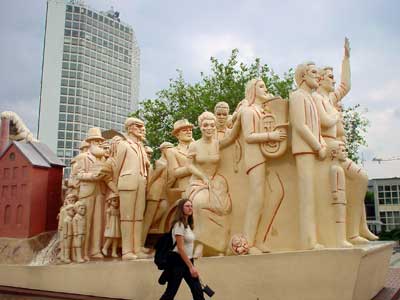
Tim Stock tells me about bad public sculpture in Birmingham and finds me this picture of a bad sculpture that was burned down.
Maybe I'll make a monument to the burning down of the monument.
In my talk I show this video to try and explain the heady brew of absurdity and empathy with which I want my work to be imbued.
Yesterday: I wander the streets of Brum. It is sunny and warm and I wear my stupid sunglasses. They make me look like John Lennon or maybe just a dickhead. The first thing I do is visit Primark. I think about the ubiquity of brands as icons, as opposed to the physical specificity of monuments. Also I buy a towel. Joe Welden takes me to Eastside Projects, another space + studios round the corner from the Lombard Method, and he points out Grand Union, another space + studios. Around here there is also Ikon Eastside and Eastside Space (though I can't find Eastside Space on Google, so maybe I invented it...).
Later I give a little talk on my work. I talk about pissing, hypothetical objects, God machines, the stoned moment.
Tim Stock tells me about bad public sculpture in Birmingham and finds me this picture of a bad sculpture that was burned down.
Maybe I'll make a monument to the burning down of the monument.
In my talk I show this video to try and explain the heady brew of absurdity and empathy with which I want my work to be imbued.
From tomorrow I'll be on a studio residency at The Lombard Method, an independently run studio and project space in Birmingham. I'll be making maquettes for public monuments, drawings of hypothetical objects and detritus sculptures for two whole weeks. The residency will culminate in a performance lecture about comprehensibility, the chauvinism of the human scale, and the possibilities of inter subjective production.
While I'm there I will try and blog once a day, to help me prepare for my talk and as a way of reflecting on the days activities. Here is a visual taster of some of the research I've been doing on the topic so far.
Seagulls shit on pregnant women. It's hormones, or pheromones, or the minute change in the timbre of their voices. If you have a pregnant woman in your car, the birds will shit on your car. Even if the pregnant woman has left the car, the birds will still shit on it. If they shit on the pregnant woman, and then the pregnant woman gets in the car, the birds will follow the car, shitting. The shits on the pregnant woman will be small (a smaller target is harder to hit i.e. requires more shots i.e. more shit overall, but also it is out of a sort of respect, though not respect as we could understand it, obviously), but the shits on the car will be huge (bigger target, less attempts required for a direct hit, celebratory exuberance of an easy shot). The shitting on the car and the pregnant woman is a show of sexual prowess. The birds are not attempting to mate with the pregnant woman. The birds understand that the pregnant woman is a pregnant human, but there is a sexual/mating element to the power displayed through the shitting. Needless to day, it is only the males who shit on pregnant woman/cars in which pregnant women are travelling/have travelled.
The shitting increases in incidence at around the start of May, and happens most around seaside towns. It happens in May simply because mating season is over and the birds have more time on their hands (wings? Claws?) and start to go out and look for pregnant women. Also, May is the earliest time that most people, including pregnant woman, will attempt a trip to the seaside. It happens most commonly at the seaside, not only because there are more seagulls near the sea and hence more birds to do the shitting, but also, and more importantly, because this shitting is a collective response, not only to the pregnant woman, but also to the other birds that are shitting on her. So, on recognising the presence of a pregnant woman in the vicinity, there is a small chance that a seagull will begin to follow her from above, and attempt a shit. However, if a seagull recognises that another seagull is following a pregnant woman from above, then the seagull will almost certainly join his fellow seagull, and begin to shit. The group's size increases exponentially and once the size of the group becomes large enough, the birds experience a certain sense of carnival fever; that wild abandon and loss of interest in everyday activities that comes with the excitement and frenzy of group celebration. The birds begin to split in to subsections, divided by imperceptible (to us) differences of body size, skull shape and beak colour that signal their relative position within seagull society. These sub-flocks will now actively seek out pregnant women, and cars that pregnant women are in, and cars that have at one point contained pregnant women, and they will shit on them. There is, needless to say, a masculine competitiveness that defines these shitting competitions, though there is no winner as such. A full day of seeking out pregnant women and cars that have come in to contact with pregnant women will make a seagull incredibly tired (the gulls will not eat during the shitting) and it may well not leave its nest for a day or two after the event. This period of recovery is dangerous for seagulls and some will die through exhaustion and starvation.
Seagulls are revolted and repelled by the smells and sounds produced by newborn human infants. There is no biological evidence that this has anything to do with their attraction to pregnant women, but common sense tells us that there must be a causal link.
The shitting increases in incidence at around the start of May, and happens most around seaside towns. It happens in May simply because mating season is over and the birds have more time on their hands (wings? Claws?) and start to go out and look for pregnant women. Also, May is the earliest time that most people, including pregnant woman, will attempt a trip to the seaside. It happens most commonly at the seaside, not only because there are more seagulls near the sea and hence more birds to do the shitting, but also, and more importantly, because this shitting is a collective response, not only to the pregnant woman, but also to the other birds that are shitting on her. So, on recognising the presence of a pregnant woman in the vicinity, there is a small chance that a seagull will begin to follow her from above, and attempt a shit. However, if a seagull recognises that another seagull is following a pregnant woman from above, then the seagull will almost certainly join his fellow seagull, and begin to shit. The group's size increases exponentially and once the size of the group becomes large enough, the birds experience a certain sense of carnival fever; that wild abandon and loss of interest in everyday activities that comes with the excitement and frenzy of group celebration. The birds begin to split in to subsections, divided by imperceptible (to us) differences of body size, skull shape and beak colour that signal their relative position within seagull society. These sub-flocks will now actively seek out pregnant women, and cars that pregnant women are in, and cars that have at one point contained pregnant women, and they will shit on them. There is, needless to say, a masculine competitiveness that defines these shitting competitions, though there is no winner as such. A full day of seeking out pregnant women and cars that have come in to contact with pregnant women will make a seagull incredibly tired (the gulls will not eat during the shitting) and it may well not leave its nest for a day or two after the event. This period of recovery is dangerous for seagulls and some will die through exhaustion and starvation.
Seagulls are revolted and repelled by the smells and sounds produced by newborn human infants. There is no biological evidence that this has anything to do with their attraction to pregnant women, but common sense tells us that there must be a causal link.